
The Pastoral Epistles group in the Evangelical Theological Society is accepting paper proposals for the meeting this Fall. We are continuing to examine ways in which a more vigorous, intentional engagement with the Pastorals can impact our understanding of Paul. Too often evangelicals explicitly or implicitly bracket off the Pastorals when doing Pauline theology whether in order to gain a hearing among those who dispute them or simply because we have grown accustomed to overlooking them. We have already seen a number of ways in which the absence of 1-2 Timothy and Titus impoverish our reading and have a sneaking suspicion there are yet more aspects and nuances to be explored. So, if you would be interested to pursue this topic, we would be glad to hear from you. Send questions or proposals to me at rayvanneste at gmail dot com.
Page 27 of 49
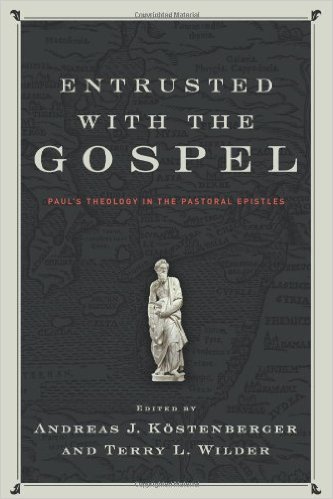 B&H Academic is offering a free copy of Entrusted with the Gospel: Paul’s Theology in the Pastoral Epistles (edited by Andreas Köstenberger and Terry Wilder) to anyone who signs up for the updates at their blog.
Essays include:
I. Howard Marshall on Recent Study in the Pastoral Epistles
Andreas Köstenberger on Hermeneutical and Exegetical Challenges
Terry L. Wilder on Authorship
F. Alan Tomlinson on Purpose/Stewardship
Greg Couser on Doctrine of God
Daniel L. Akin on Christology
Ray Van Neste on Cohesion and Structure of the PE
B. Paul Wolfe on Use of Scripture
Ben Merkle on Ecclesiology
George Wieland on Soteriology
Thor Madsen on Ethics
Chiao Ek Ho on Missiology
I was unable to attend SBL this year, but Chuck Bumgardner was kind enough to gather titles and abstracts for PE related papers at SBL from the helpful abstracts page on the SBL site.
Here is what was listed. It is encouraging to see this much work being done on these letters.
The Cretan Quote of Titus 1:12: Why Paul Appears to Be Such a Bigot
Program Unit: Disputed Paulines
Isaiah Luke Allen, Asbury Theological Seminary
Conventional readings of Titus 1:12-13 present real grammatical and contextual problems. Taken at face value, the apostle Paul addresses Titus and quotes Epimenides, a (5th-6th Century BCE) Cretan poet, in a descriptive and highly disfavorable moral assessment of the Cretans that Paul himself shares. This paper exposes some of the literary-contextual, grammatical, and semantic problems with this reading and suggests an interpretation that coheres with the NT portrayal of the canonical Paul and Titus, the grammar of the passage, and the context of the argument in the letter to Titus. Rather than being a bigot, Paul is exposing and attacking bigotry in the church.
Satan: The Author of False Teaching in the Pastoral Epistles
Program Unit: Disputed Paulines
Derek Brown, Lexham Press
The Pastoral Epistles reveal a number of intriguing developments within the Pauline tradition. One area which has not received sufficient attention is the references to the devil within Pastoral Epistles. Both 1 Timothy and 2 Timothy mention the malevolent figure— whether by the well known term satanas (1 Tim 1:20; 5:15), diabolos (1 Tim 3:6, 7; 2 Tim 2:26), or even ho antikeimai (“the opponent” or “the enemy,” 1 Tim 5:14; cf. 1 Clem. 51.1; Mart. Pol. 17.1)—but the collective importance of these references is rarely discussed in scholarly literature. The present paper will explore the nature of the allusions to Satan within the Pastorals by considering their function within their epistolary context, the theology of Satan which they imply, and their relationship to references to Satan in the other Pauline letters (both undisputed and disputed; see Brown, The God of this Age: Satan in the Churches and Letters of the Apostle Paul [Mohr Siebeck], forthcoming 2015). It will be argued that although the Pastoral Epistles sometimes reflect, or perhaps mimic, the earlier Pauline references to Satan (e.g., 1 Tim 1:20; cf. 1 Cor 5:5), the references to Satan in 1 Timothy and 2 Timothy aim to establish a direct connection between false teaching and Satan that is intended to warn and prevent the readers of the letters from subscribing to teaching that would separate them from the truth of the gospel and the community of faith.
Kinship and Leadership in 1 Timothy: A Study of Filial Framework and Model for Early Christian Communities in Asia Minor
Program Unit: Disputed Paulines
Daniel K. Darko, Gordon College
This paper examines kinship framework and language in the directives for leadership in early Christianity communities of Ephesus, aiming to curb the influence of false teachers and bolster mutual support in the membership. It investigates direct appeal to responsible household management, portraits of natural and fictive kinship, and group dynamics couched in filial parlance in the leadership correspondence (1 Timothy). The Greek text will be examined carefully against the background of Greco-Roman conventions on kinship and use of kinship lexemes in relation to leadership. The study of the household code alongside other references to kinship in the prism of Christian leadership will lead to new and perhaps alternate insights regarding how we read the institutional structure of the house churches, even the notion of monarchical leadership. The manner in which fictive and natural kinship are utilized will receive critical attention in the quest also to answer the question: Does fictive kinship override natural kinship or are there interface of the two to harness group identity and group dynamics?
“Apocalyptic Rhetoric” in the Pastoral Epistles
Program Unit: Disputed Paulines
Mark Harding, Australian College of Theology
The Apostle Paul is rightly termed an apocalypticist not only because his message originated in an apocalypse (Gal 1:12, 16), but also because he continued to receive visions and revelations. He imparted these to his hearers. The post-Pauline authors of Ephesians and Colossians mediate Paul’s apocalypticism chiefly through the discourse of “mystery.” Although it has been fashionable to downplay the apocalypticism of the Pastoral Epistles (PE), the letters do subscribe to this worldview. In the PE, Paul’s apocalypticism is encountered not only in their espousal of apocalyptic eschatology but also in their discourse of the finality of the mystery and revelation uniquely received and authoritatively mediated by the Apostle. This discourse—rooted as it is in revelation—is aptly termed “apocalyptic rhetoric.” This is a term that was first applied to the rhetoric of the New Testament Apocalypse by Adela Yarbro Collins and Barry Brummett in the early 1980s. The term can be applied to the rhetoric of the PE, although the PE (like the Pauline corpus as a whole) are letters and not apocalypses. In this discourse, the authority of the Apostle in the highly contested context of the PE is grounded in the epiphany of Christ and the moral and creedal implications that are in accord with that epiphany and to which his ministry, and the ministry of those he commissions, finally, infallibly and exclusively bears witness. The apostolic “deposit” vouchsafed to Paul and through him to his delegates and their successors is full, perfect and sufficient, such that teaching that is not in accord with it is a betrayal of the Pauline heritage. In this way, the PE are testimonies of the power of speech grounded in revelation and mediated by a writer who uniquely articulated the apostle’s authority.
The Rhetoric of PIETAS: First Timothy and the Negotiation of Roman Imperial Pietas
Program Unit: Disputed Paulines
Chris Hoklotubbe, Harvard University
This paper provides a postcolonial reading to 1 Timothy that attends to how the author negotiates the imperial situation in his appeal to piety (eusebeia) within the context of instructing the community to offer prayers on behalf of imperial authorities (1 Tim 2:1–2) and how women and widows ought to behave within the household of God (1 Tim 2:9–15). Scholars including Mary Rose D’Angelo and Angela Standhartinger convincingly argue that 1 Timothy’s instructions on prayer and admonitions for women to marry, bear children, and remain subordinate to their husbands accommodate to conservative social values promoted in imperial legislation and propaganda. However, scholars like Ben Witherington and Phillip Towner insist that these passages are not indicative of accommodation, but rather a missiological approach that Christianized secular virtues and even resisted imperial culture. I argue that a postcolonial optics is helpful for moving beyond a dichotomy of accommodation/resistance and allows us to better observe how both elements are present within the author’s negotiation of imperial social values and Christian doctrine within the scope of his construction of a hybrid Christian identity and piety. This paper will also succinctly contextualize 1 Timothy’s appeals to piety within the prevalence of rhetorical claims to piety (pietas/eusebeia) that occur in Roman poetry, monumental inscriptions, and coins in order to clarify the cultural significance of this virtue for how both elite Romans and provincial subjects, including the author of 1 Timothy, conceptualized imperial power and their relation to it. I argue that both claims to piety that pervaded the imperial propaganda of Trajan and Hadrian as evidenced in coins, reliefs, panegyrics, and building campaigns as well as elite Roman discourses that contrasted Roman pietas against foreign superstitio textualized the structures that comprised the imperial situation of 1 Timothy’s and illuminate its rhetoric of piety.
Timothy in Ephesus? First Timothy, the Acts of the Apostles, and the Acts of Timothy Reconsidered
Program Unit: Ancient Fiction and Early Christian and Jewish Narrative
Meira Z. Kensky, Coe College
This paper will analyze the way Timothy’s association with Ephesus is remembered and constructed in early Christian literature. While 1 Timothy imagines Timothy as an Ephesus-based administrator, and Eusebius tells us that the tradition holds Timothy as the first bishop of that city (Eus., Hist. Eccl. 3.4), other texts are ambiguous at best on this issue. The lack of a clear association between Timothy and Ephesus in the Acts of the Apostles is particularly striking. In addition to having ambiguous presence throughout Acts 19, Timothy is not located in Ephesus during the riot (19:23-41), and is also not named as present in the speech to the Ephesian elders in 20:17-38. Since many people think that Acts might have been written in Ephesus, Timothy’s absence during the Ephesian ministry is even more notable. Should we infer from Timothy’s absence that he was not really associated with Ephesus at all, and that this is a later invention by the author of 1 Timothy? The Acts of John, also set in Ephesus, is entirely silent not only on the presence of Timothy, but on the presence of any early Christian there before John, erasing the record of Pauline presence in the city. Ephesus is thus contested territory. And while the early tradition is ambiguous, the Acts of Timothy, a late addition to the corpus of Apocryphal Acts, details exactly how Paul ordained Timothy as Ephesus’ first bishop, and then narrates Timothy’s violent death during a pagan festival there. The text also talks about John’s activities in the city, and thus represents an attempt to harmonize early Christian traditions about this crucial center of early Christianity, who was working there at the same time, and what their relationship was to each other. Studying the way the Acts of Timothy paints its portrait of Timothy’s leadership and violent death in the city can shed light both on the memory of this crucial tradent as well as the memory of the city itself. What is gained in 1 Timothy by locating Timothy in Ephesus? And what is gained by having him die there in the Acts of Timothy?
Insisting on a Gospel of Resurrection in the Face of Suffering: An Initial Exploration of the Intersection of Religion and Politics in the Context in 2 Tim 2:8
Program Unit: Disputed Paulines
Edward Pillar, University of Wales, Trinity Saint David
The writer of 2Timothy is presented as imprisoned, chained like a criminal, and suffering ‘for the gospel.’ Thus the writer asserts that his crime is inextricably linked with his gospel, and it seems apparent that his suffering is not only considerable (2:9), but some have suggested that it may well be linked to the severe, brutal, and cruel persecutions recorded by Tacitus of the Neronian era. The writer appears to be seeking to encourage Timothy not to be afraid to commit more fully to the gospel and thus perhaps inevitably to enter into the prospect of suffering (1:8). The gospel, which has led to such vicious persecution and inhumane suffering, is precisely and succinctly articulated in 2:8, ‘Jesus Christ, raised from the dead, out of the seed of David.’ In this paper we will explore the political nature of the gospel that is not simply an intersection of politics and religion, but appears to create an inexorable conflict with imperial politics. We will consider the thesis that in this letter the context of severe persecution and suffering is crucial in this instance to understand how religion and politics intersect. Jesus, as the Christ, is thus God’s alternative emperor or king. ‘Jesus Christ’, uniquely ordered at this point in the letter, taken alongside ‘out of the seed of David’ suggests an ancient narrative as an alternative to the imperial story that perpetuated the tyranny of the emperor. Further, the insistence of an alternative gospel – itself a challenge to empire – in proclaiming the resurrection of Jesus following crucifixion at the hands of the Romans Empire is both a challenge to imperial assertions of supreme power but also subverts this power in the act of resurrection.
I have just realized that Tony Costa, in his book Worship and the Risen Jesus in the Pauline Letters (Peter Lang, 2013) incorporates the Pastorals in his analysis. He acknowledges the debate surrounding authorship, but announces at the outset that he will include all the letters attributed to Paul in his investigation. I have only been able to scan the book online, but it looks like the Pastorals show up fairly often.
I am encouraged to see this as we, in this space and in our ETS study group, are investigating how the typical neglect of the Pastorals impacts our view of Paul.
The Pastoral Epistles were given significant attention at this year’s Annual Meeting of the Evangelical Theological Society. First, we had an excellent session in the Pastoral Epistles Group.
Chuck Bumgardner began our session with a paper titled, “Kinship, Fictive Kinship, and the Letters to Timothy and Titus.” Bumgardner compared what these letters say about family relationships and relationships within the body of Christ (Bumgardner used the phrase “fictive kinship” because it is the standard phrase used to refer to social relationships which are seen or described as familial though there is no blood relation ). He argued that Paul’s use of such language in the PE is not incompatible with his use of it in his other letters, and it does not necessarily indicate that the church is moving from an egalitarian stage to a hierarchical one. His paper also provided an initial sounding of the intersection between Christian family and social family roles in the PE, suggesting that Paul navigates such intersections with a missionary concern for outsiders.
Dillon Thornton was snowed in and, therefore, unable to attend. However, he emailed me his paper, and I was able to read it. The paper,“’Saying What They Should Not Say’: Reassessing the Gravity of the Problem of the Younger Widows (1 Tim 5:9-16),” argued that the younger widows were aligned with the false teachers. Paul’s instruction left them three possibilities: 1) to remain with the false teachers and thus under judgment, 2) to marry unbelievers, thus parting ways with the false teachers (who forbid marriage), and still remaining under judgment, or 3) to remarry in the faith, thus parting ways with the false teachers and realigning with the Pauline church. This answers some of the knotty issues of this passage and gives more attention to many of the specifics than I have seen elsewhere.
Greg Couser’s paper, “The Church as Family: The Nature of the Household of God in 1 Timothy,” argued that the relationships within the church are not merely “fictive” but are in fact more real than blood relations, as Jesus himself said (Matt 12:46-49). Couser provided a robust argument that the ethics of 1 Timothy are not based in cultural accommodation but in the gospel itself. This is a crucial point for understanding the PE since their ethics are so often dismissed or overturned because they are seen as culturally bound.
Peter Walker closed the session with his paper, “1 Timothy & Titus Relocated: Reimagining the Connections.” Walker argued for placing the PE within the framework of the book of Acts. He has made this argument in print previously, but in this paper he discussed implications of this view including connections between these letters and 1-2 Corinthians and Romans. He also argued this would remove several common critiques of the PE. While, in the end, I was not convinced, Walker made many good challenging points which helped me think more clearly about the dating of the letters.
In addition to our session, several other papers related to the Pastorals were presented. Thanks to Chuck Bumgardner for gathering this list.
Bryan Blazosky (Central Baptist Theological Seminary) “Why 1 Timothy 1:8-11 Ought to be Used in Paul and the Law Studies”
Christopher R. Bruno (Cedarville University) “One God, One People, One Mediator: The Use of the One God Formula in the Disputed Pauline Epistles”
Jamin Hübner (John Witherspoon College) “The Evolution of Complementarian Exegesis” (This is equivalent to Jamin Hübner, “The Evolution of Complementarian Exegesis,” Priscilla Papers 29/1 (Winter 2015), 11-13.
Chris S. Stevens (McMaster Divinity College) “Titus in P32 and Sinaiticus: Textual Reliability and Scribal Design”
Gregory J. Stiekes (Southeastern Baptist Theological Seminary) “Paul’s Family of God: What Familial Language in the Pastorals Can and Cannot Tell Us about the Church”
Also, the book this panel discussed had a chapter on the PE:
Panel Discussion: Review of Margaret Y. MacDonald, The Power of Children: The Construction of Christian Families in the Greco-Roman World
Reviewers: Lynn Cohick (Wheaton College); E. Randolph Richards (Palm Beach Atlantic University); Karelynne Ayayo (Palm Beach Atlantic University); F. Alan Tomlinson (Midwestern Baptist Theological Seminary).
Response Margaret Y. MacDonald
[Originally posted at my personal site]
The recently published Fortress Commentary on the Bible: New Testament contains 22 pages of commentary, written by Deborah Krause, devoted to each of the Pastoral Epistles. With Fortress one expects a more critical direction from the commentary. The introduction to the whole volume makes this explicit with its endorsement of feminist, liberation and queer interpretation.
Krause begins with the assumption of non-Pauline authorship, and then most often explains why the exhortations found in these letters are not binding. She wrongly asserts that these are not proper letters but are simply vehicles for enforcing a certain church structure. These letters fit well within the models of letter writing in the first century (scholarship here has been clear). Furthermore, as the last several decades of scholarship has noted, these letters cannot be reduced to concerns about church structure.
After briefly laying out the perspective of non-Pauline authorship, Krause acknowledges, “it is important to remember that for the vast majority of the church’s history, 1 and 2 Timothy and Titus” were not seen as just one of various ways of appropriating the Pauline message. “Rather, the writings have been seen as authentic communication between Paul and his closest companions in ministry.” This is an important piece to remember, though it gives no pause to the author. She does acknowledge, though, that since the church has for so long believed these letters were actually from Paul, “these writings have been remarkably successful in achieving their original intent- to influence and direct the Pauline tradition as it has informed the life and ministry of the church” (590). Despite what we “know” now, Scripture has had its intended effect.
Of course, 1 Timothy 2 is of particular interest. While the prohibition on women teaching men “may sound antiquated, it is remarkable to see how broadly this text is cited as an authority in current manuals of church administration and polity” (595). What is remarkable to me is that one would think it remarkable for clear statements of Scripture (in keeping with the manner in which the Church has interpreted them through most of its history) to serve as authority in church polity. And, the apparent reason why this should amaze us is that this statement of Scripture sounds “antiquated.”
One might argue for a different interpretation of these letters in general and of 1 Timothy 2 in particular. But we ought not be surprised that Scripture serves as a norm for churches today no matter how “old” its teaching may sound. And we ought to be careful about so lightly and so completely disregarding the consistent witness of our forebears.
In the end, this commentary on the Pastorals seems to be concerned primarily with protecting readers from the actual message of these letters.
In the third volume of Craig Keener’s massive Acts commentary, he has a long excursus on the relationship between Acts and the Pastorals (pp. 3023-3026). Probably the most significant part of the excursus is the thorough chart listing the itineraries (people, places and events) of the Pastorals, Acts and the earlier Pauline letters side by side. This is very helpful. In the end, Keener is convinced of a second imprisonment for Paul which is described in 2 Timothy- the traditional explanation.
The draft of the program for the annual meeting of ETS has just been released. Here is the program for our Pastoral Epistles group. I hope a number of you will join us.
Wednesday 8:30 AM-11:40 AM
PASTORAL EPISTLES
Marriage & Family in the Pastorals
Hilton — 208
Moderator: Ray Van Neste (Union University)
8:30 AM—9:10 AM
Chuck Bumgardner (Southeastern Baptist Theological Seminary)
Kinship, Fictive Kinship, and the Letters to Timothy and Titus
9:20 AM—10:00 AM
Dillon Thornton (University of Otago)
“Saying What They Should Not Say”: Reassessing the Gravity of the Problem of the Younger
Widows (1 Tim 5:9-16)
10:10 AM—10:50 AM
Greg A. Couser (Cedarville University)
The Church as Family: The Nature of the Household of God in 1 Timothy
11:00 AM—11:40 AM
Peter Walker (Trinity School for Ministry)
1 Timothy & Titus Relocated: Reimagining the Connections
After teaching a semester-long Bible Institute class on the Pastorals (“congregational-level teaching plus homework,” he said), well-known systematic theologian, Fred Sanders, has posted a list of commentaries are resources which he found most useful. I almost always find it helpful and interesting to read about what others found useful, and this list does not disappoint. Sanders not only list the titles but explains what he found useful (or not useful) about each item. He also graciously put in a good word about this blog. I am glad he found it helpful.
The upcoming 2015 International Meeting of SBL lists three papers on the 1 Timothy. The first looks like the most interesting to me. It would be interesting to see how Graham’s work compares to that of Tim Swinson. Tamez’s title sounds like it may be drawn from her monograph which was not impressive. Thanks to Chuck Bumgardner for pointing out these titles and abstracts.
Graham, Brett M. “The Intertextuality of 1 Timothy: A Comparison of the Allusions to the Septuagint and the Jewish Pseudepigrapha in the Epistle.” Paper presented at the International Meeting of the SBL, Buenos Aires, 22 July 2015.
Abstract: The Pastoral Epistles extol the Holy Scriptures as being foundational for Christian living (2 Tim 3:15-16; cf. 1 Tim 4:13), but there is only one actual citation of these Scriptures (1 Tim 5:18) in all three of the letters. Even when the handful obvious quotations are considered, there is still not the level of engagement that might be expected from the writings described as ‘useful for every good work’ (2 Tim 3:16). Meanwhile, the quotation from Epimenides in Tit 1:12 suggests that the author of the Epistles may have also had a number of other sources to draw upon. This paper seeks to investigate the way that the first of the Pastoral Epistles, 1 Timothy, engages with external sources. Particular attention will be given to the influence of both the Septuagint and the Jewish (or O.T.) Pseudepigrapha, including a comparison of the manner and extent that these two sets of documents are referenced. In this process, a distinction will be drawn between simple idioms, influences and allusions. In simple idioms, the Epistle will share vocabulary or ideas with a possible source text but there will be no apparent reason, or benefit, of referring to that text. In contrast, the source text for an influence or allusion will provide an answer to unresolved problem in the Epistle. By applying such categories consistently throughout the whole of 1 Timothy, a clear picture of the importance of these extant documents will be evident.
Houwelingen, Rob van. “Meaning and Significance of the Instruction about Women in 1 Timothy 2:12-15.” Paper presented at the International Meeting of the SBL, Buenos Aires, 23 July 2015.
Abstract: “I do not permit a woman to teach or to assume authority over a man; she must be quiet”. Many Christians of the 21st century feel rather uncomfortable with the instruction about women from 1 Timothy 2. On the basis of his particular passage many church leadership positions have been reserved for men. But how should it be handled? First, I will make some remarks about the meaning of 1 Timothy 2. In regard to the vulnerable male/female relationship within the Christian congregation, the text refers back to the beginning of mankind: the creation, the fall and the redemption of the first human couple, Adam and Eve. The Genesis narrative tells a story of human weakness. In short: Eve was created after Adam; the woman let herself be fooled by Satan and therefore fell into transgression. She, however, would find salvation in her motherhood (1 Tim.2:15a should be translated: “she”, i.e. Eve). After that, I will discuss the significance of this passage for today. It is hermeneutically important to be aware of some key differences between our present context and that of the apostolic church. Let me mention only the central issue. The stipulation that women ought to be silent in the church is consistent with the accepted and prevailing social situation of those days. In our time, however, this command runs counter to the accepted social situation. We should consider that the instruction of 1 Timothy 2 aims to preserve the established order, both in the church and in society. Still, the overall message from 1 Timothy 2 seems to be that peaceful living is essential. Therefore, Christians are supposed to live a ‘normal’ life. Church leadership should empower them, without abusing authority and taking into account the male/female relationship.
Tamez, Elsa. “Struggles for Power in Early Christianity: The Case of 1 Timothy.” Paper presented at the International Meeting of the SBL, Buenos Aires, 21 July 2015. (no abstract)