Jonathan Rivett Robinson, “The Ephesian Artemis and 1 Timothy 2: Assessing the Connection.” Pages 101–22 in Early Christian Communities in the Urban Contexts of Asia Minor and the Greek East. Edited by Katie Marcar, James R. Harrison, and John M. G. Barclay. Ancient Judaism and Early Christianity 125. Leiden: Brill, 2026.
This Festschrift for Paul Trebilco gives a slate of articles with interesting-sounding titles, and Robinson’s caught my eye immediately. To my knowledge, Robinson hasn’t published on the Pastorals before, but the sort of critical inquiry he’s engaging in provokes helpful give-and-take. In his words:
In this essay I examine recent arguments regarding Artemis worship in Ephesus as an explanatory background to 1 Timothy 2:9–15. While these arguments have had limited impact on the scholarship, they have strong popular appeal and have been effectively disseminated to a general audience in print and online. These publications promote research which has not been subjected to critical review in the literature. This essay seeks to address that lacuna.
The interested reader will want to know which “recent arguments” are in view. Robinson engages two interlocutors:
Gary G. Hoag, Wealth in Ancient Ephesus and the First Letter to Timothy: Fresh Insights from Ephesiaca by Xenophon of Ephesus. Bulletin for Biblical Research Supplement Series 11. Winona Lake, IN: Eisenbrauns, 2015.
Note also Hoag, “Demystifying Gender Issues in 1 Timothy 2:9–15, with Help from Artemis.” Evangelical Review of Theology 44.3 (2020): 242–49.
Sandra L. Glahn, Nobody’s Mother: Artemis of the Ephesians in Antiquity and the New Testament. Downers Grove, IL: IVP Academic, 2023.
Note also Glahn, “The First-Century Ephesian Artemis: Ramifications of Her Identity.” Bibliotheca Sacra 172.688 (2015): 450‒69; “The Identity of Artemis in First-Century Ephesus.” Bibliotheca Sacra 172.688 (2015): 316‒34.
One sentence from the essay will give you a sense of where Robinson is going: “There is no distinctive feature in the text of 1 Timothy 2:9–15 that is illuminated or explained by reference to Artemis devotion, that is not more plausibly explained by other contextual factors” (115).
Robinson notes he was prompted to write the article by a review of Glahn’s book by Lyn Kidson, and he seems to subscribe to Kidson’s conclusions. I was able to read the entire essay on Google Books, though I can’t say you’ll be afforded the same opportunity.
Beers, Holly. “The ‘Teachings of Demons’ as ‘Magical’ Practices in 1 Timothy 4:1.” Journal of Biblical Literature 144.4 (2025): 763–81.
Abstract: “In this article, I make the case that the language of “teachings of demons” (διδασκαλίαις δαιμονίων) in 1 Tim 4:1 is a reference to the Watchers traditions of the Book of the Watchers (1 En. 1–36; cf. Gen 6:1–4). The Book of the Watchers and later texts portray the Watchers as not only mating with human women but also teaching magical heavenly secrets to humans. While the Watchers are called “demons” only once in the Book of the Watchers (19:1), the use of the language of “demon” to describe only divine or celestial beings who rebel against God’s purposes is common in Second Temple Jewish (and then Christian) circles. If at least part of the false teaching is magical, that accounts for several other aspects of 1 Timothy, including the use of περίεργος (“busybody,” “magician”) in 1 Tim 5:13 (cf. γόης, “sorcerer,” in 2 Tim 3:13); μυστήριον (“mystery”) in 1 Tim 3:9, 16; μῦθος (“myth”) in 1 Tim 1:4, 4:7 (cf. 2 Tim 4:4, Titus 1:14); and potentially the focus on problematic women (1 Tim 2:9–15, 4:7, 5:2–16; cf. 2 Tim 3:6) as well as the false teachers’ forbidding of marriage and foods (1 Tim 4:3).”
Hägerland, Tobias. “Teachings of Demons in Later Times (1 Tim 4.1–5).” New Testament Studies 71 (2025): 579–85.
Abstract: “In this short study, the syntactic structure of 1 Tim 4.1–3a is re-examined to address long-standing interpretative challenges regarding its apocalyptic warning against demonic teachings. A traditional reading of the passage, as reflected in many translations and commentaries, asserts that the opponents are accused of both forbidding marriage and mandating abstinence from certain foods. This interpretation often relies on invoking the phenomenon of zeugma to explain the syntax. However, this approach generates significant difficulties, particularly in reconciling the Greek text with the subsequent focus on dietary restrictions in 4.3b–5. The study proposes an alternative reading that resolves interpretative tensions, respects the text’s syntax and explains why the subsequent discussion does not address marriage prohibitions.”
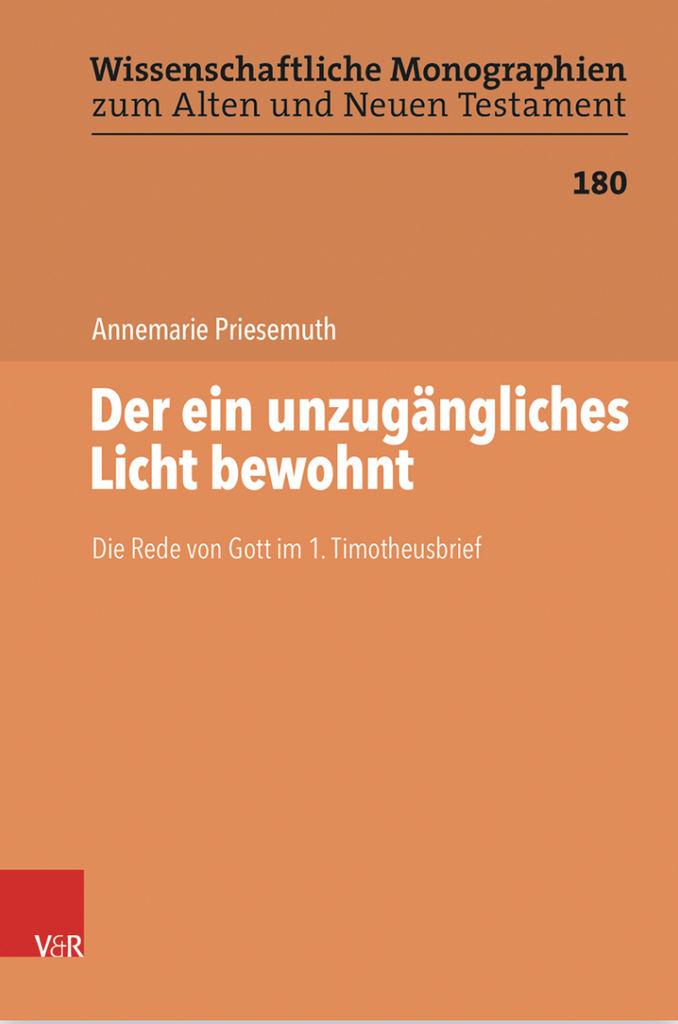
Priesemuth, Annemarie. Der ein unzugängliches Licht bewohnt: Die Rede von Gott im 1. Timotheusbrief. Wissenschaftliche Monographien zum Alten und Neuen Testament 180. Göttingen: Vandenhoeck & Ruprecht, 2025.
This recent monograph is the published version of Priesemuth’s Kiel University dissertation. The dissertation was completed under Christiane Zimmermann, who herself has written in the area Priesemuth addresses:
“Gott, unser Retter—Christus, unsere Hoffnung: Soteriologische Aspekte des 1. Timotheusbriefs.” Pages 405–426 in Sōtēria: Salvation in Early Christianity and Antiquity. Festschrift in Honour of Cilliers Breytenbach on the Occasion of his 65th Birthday. Edited by David S. du Toit, Christine Gerber, and Christiane Zimmermann. Leiden: Brill, 2019.
“Die negative Gottesbezeichnungen in 1 Tim 1,17 und 6,15f.: Eine sprachliche Grenzüberschreitung und ihre Folgen.” Pages 390‒408 in Kommunikation über Grenzen: Kongressband des XIII. Europäischen Kongresses für Theologie 21.‒25. September 2008 in Wien. Edited by Friedrich Schweitzer. Veröffentlichungen der Wissenschaftlichen Gesellschaft für Theologie 33. Gütersloh: Gütersloher, 2009.
Priesemuth discusses theology proper as presented in 1 Timothy: “how, where, and why 1 Timothy speaks of God” (15). On the Kiel University website, she offers this description:
“Die Betrachtung frühchristlicher Gottesbilder wurde in der neutestamentlichen Forschung lange Zeit vernachlässigt, insbesondere im Hinblick auf die nachpaulinischen Briefe. Die Dissertation versucht diese Lücke durch eine Untersuchung der Rede von Gott des 1. Timotheusbriefes ein Stück weit zu schließen. Eine detaillierte synchrone exegetische Analyse im Durchgang durch den Brief wird ergänzt durch motivgeschichtliche Untersuchungen, die die Motivgeschichte einzelner Aussagen über Gott berücksichtigen. Dabei zeigt sich, dass die Rede von Gott, die der Brief enthält, zentrale Funktionen für die Kommunikationsinteressen des Briefschreibers übernimmt und zugleich auf mögliche Adressat:innen des Briefes abgestimmt erscheint.”
“The study of early Christian conceptions of God has long been neglected in New Testament scholarship, particularly regarding the post-Pauline epistles. This dissertation seeks to help bridge that gap by examining how God is portrayed in the First Epistle to Timothy. A detailed synchronic exegetical analysis of the letter is complemented by studies tracing the history of specific motifs found in statements about God. The findings reveal that the letter’s depiction of God serves key functions in advancing the author’s communicative aims while simultaneously appearing tailored to the letter’s intended recipients.” (Google Translate)
Köstenberger notes in his five-page biblical-theological treatment of the topic that “theology proper has been a largely neglected theme in the literature on the LTT [Letters to Timothy and Titus]” (Commentary on 1–2 Timothy & Titus, BTCP, 414). Priesemuth’s work is not the first monograph-length study on theology proper in 1 Timothy, though it is, to my knowledge, the first published one. Roughly twenty years ago, this comparatively brief 171–page dissertation addressed the same topic:
Hetzler, Charles Oscar. “Our Savior and King: Theology Proper in 1 Timothy.” PhD diss., The Southern Baptist Theological Seminary, 2008.
Other focused work on the theology proper in the Pastorals can be found in these resources:
Bailey, M. L. “A Theology of Paul’s Pastoral Epistles.” Pages 333–67 in A Biblical Theology of the New Testament. Edited by Roy B. Zuck. Chicago: Moody, 1994. [see pp. 340–43]
Couser, Gregory A. “God and Christian Existence in the Pastoral Epistles: Toward Theological Method and Meaning.” Novum Testamentum 42.3 (2000): 262–83.
Fitzmyer, Joseph A. “The Savior God.” Pages 181–96 in The Forgotten God: Perspectives in Biblical Theology. Essays in Honor of Paul J. Achtemeier on the Occasion of His Seventy-fifth Birthday. Edited by A. Andrew Das and Frank J. Matera. Louisville: Westminster John Knox, 2002.
Marshall, Tim. “A Sovereign and Transcendent God: The Doxologies of 1 Timothy.” Semănătorul (The Sower): The Journal of Ministry and Biblical Research (Oradea, Romania) 1:2 (2018): 52–72. Repr., Eugene, OR: Wipf & Stock, 2018.
Spicq, Ceslas. Les épîtres pastorales. 2 vols.4th edition. Études bibliques 39. Paris: Gabalda, 1969. [see pp. 243–45]
Sumney, Jerry L. “‘God Our Savior’: The Fundamental Operational Theological Assertion of 1 Timothy.” Horizons in Biblical Theology 21.2 (1999): 105–23.
Sumney, Jerry L. “‘God Our Savior’: The Theology of 1 Timothy.” Lexington Theological Quarterly 33 (1998): 151–61.
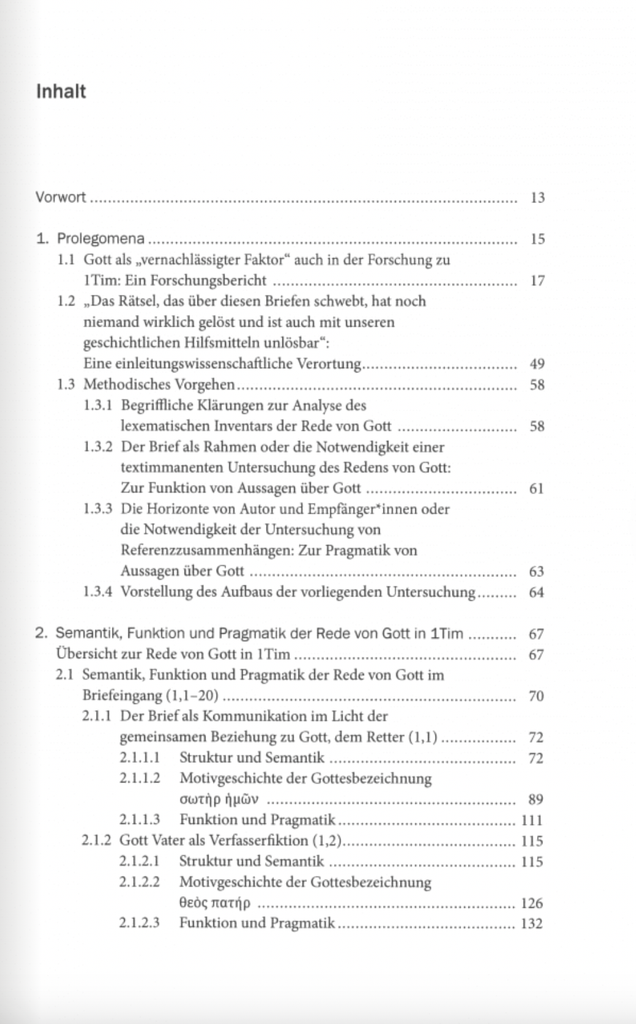
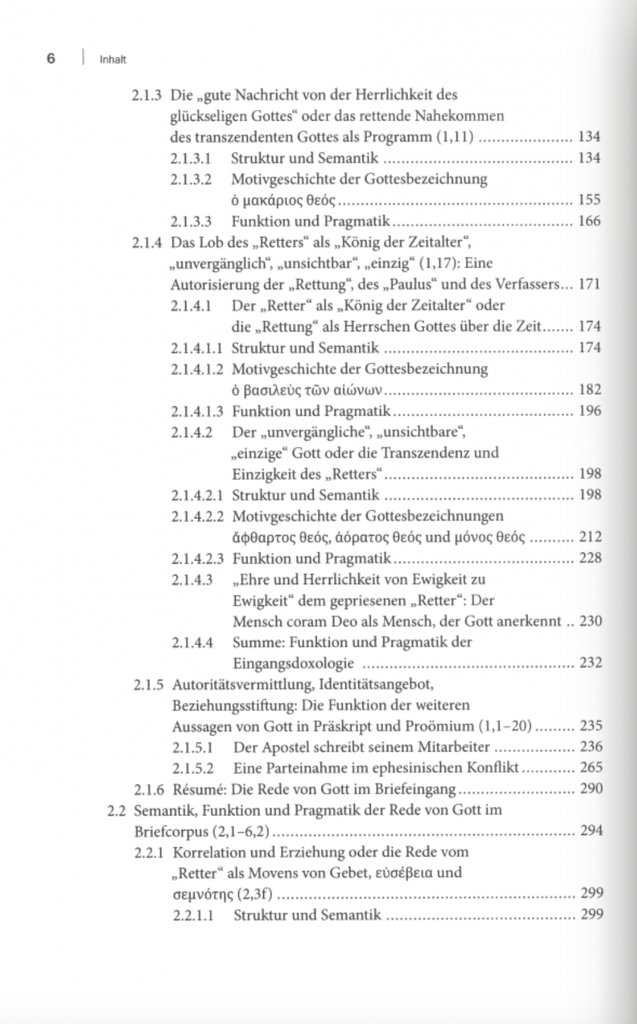
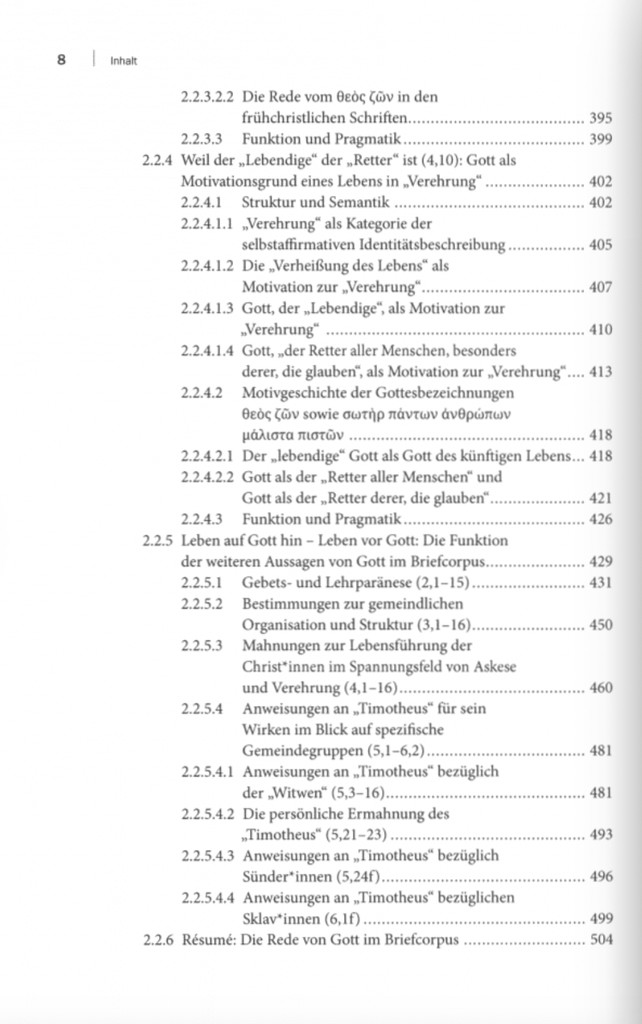
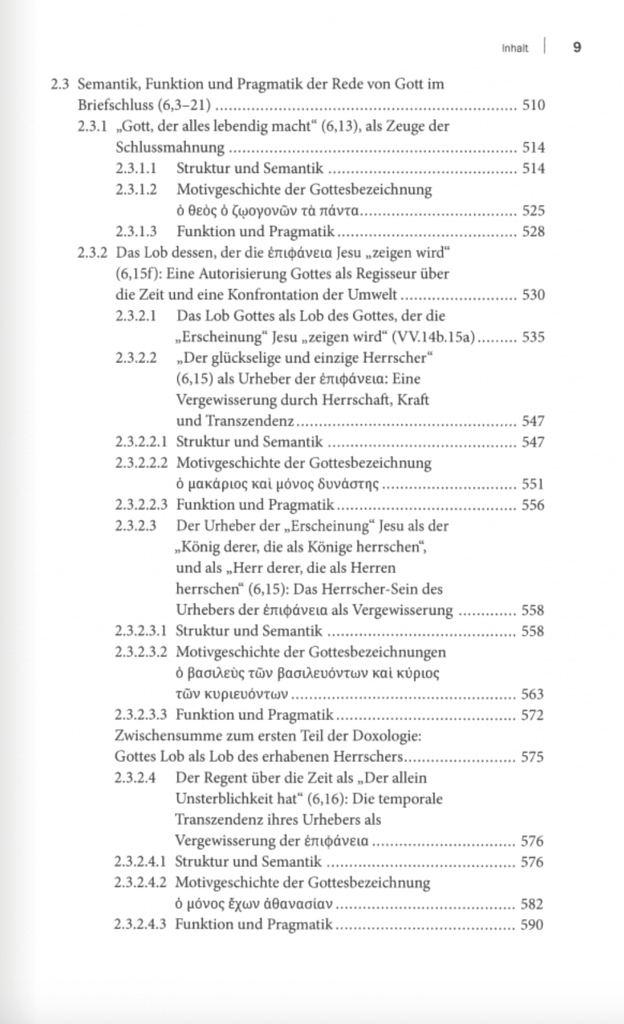
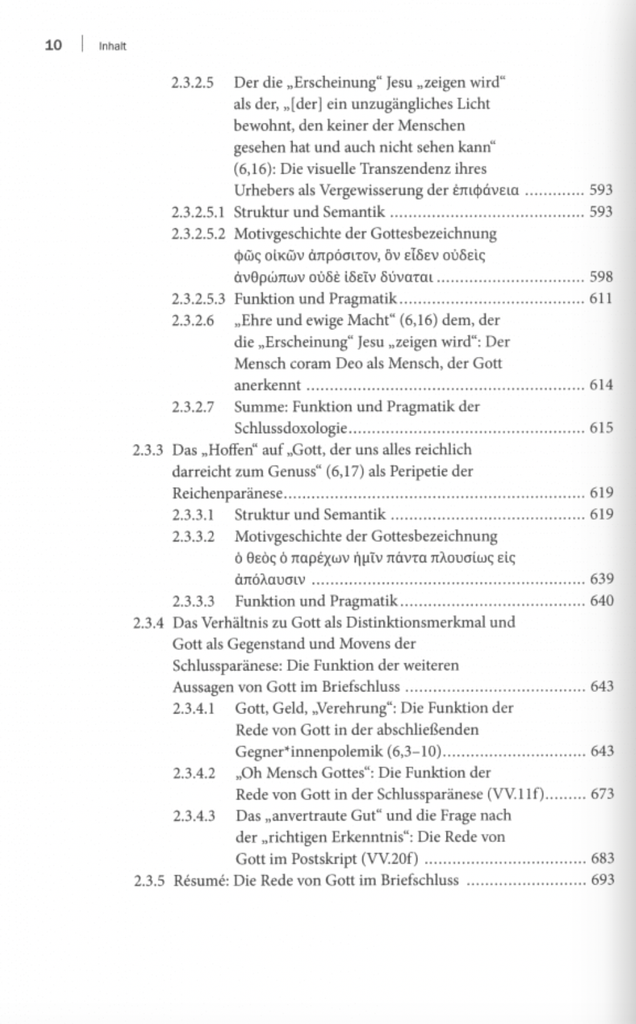
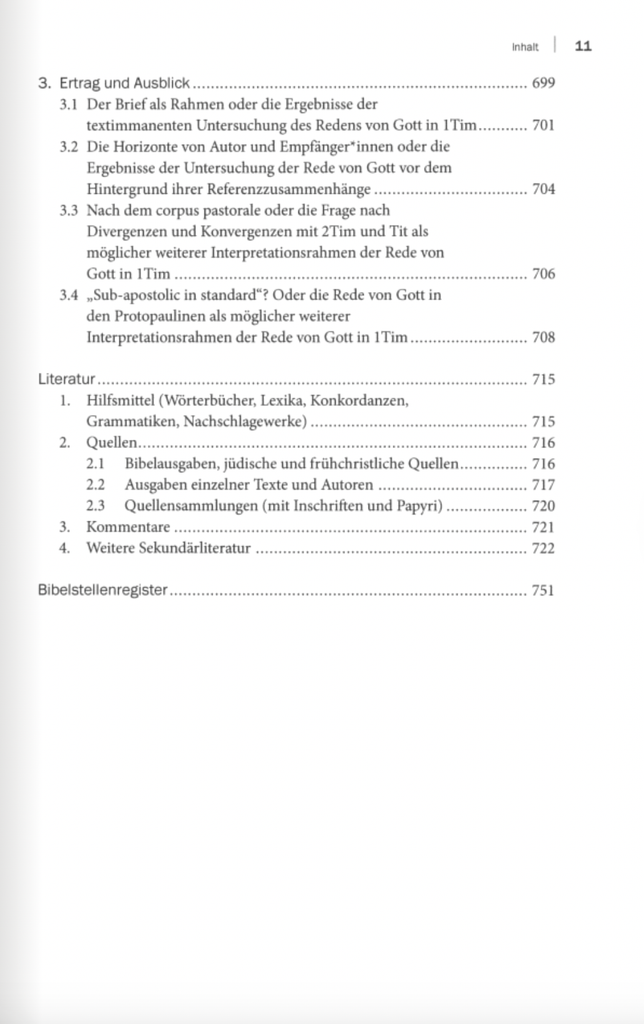
Below, the interested reader can find the contents of Priesemuth’s work, courtesy of the publisher.
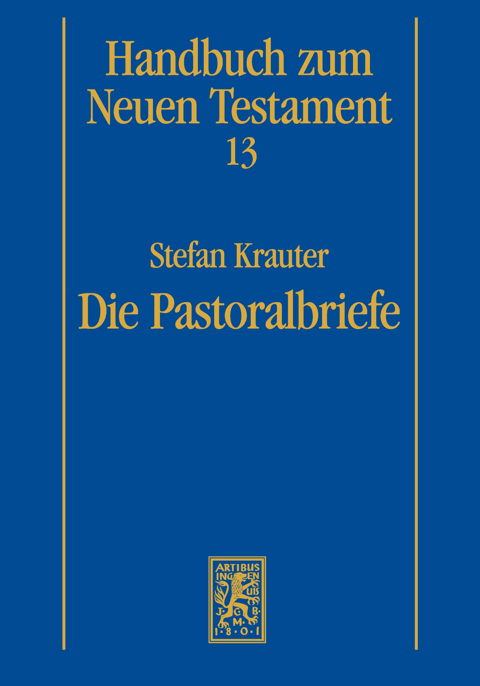
Stefan Krauter, Die Pastoralbriefe. Handbuch zum Neuen Testament 13. Tübingen: Mohr Siebeck, 2026.
Stefan Krauter (PhD, University of Tübingen) serves as a professor of New Testament at the Univerisity of Zurich. His faculty page indicates that in addition to a research focus on the Pauline corpus, he devotes attention to the examination of the New Testament writings in their relationships to the Greek and Latin literature of the early imperial period and the interpretation of the Pauline letters in the 16th century.
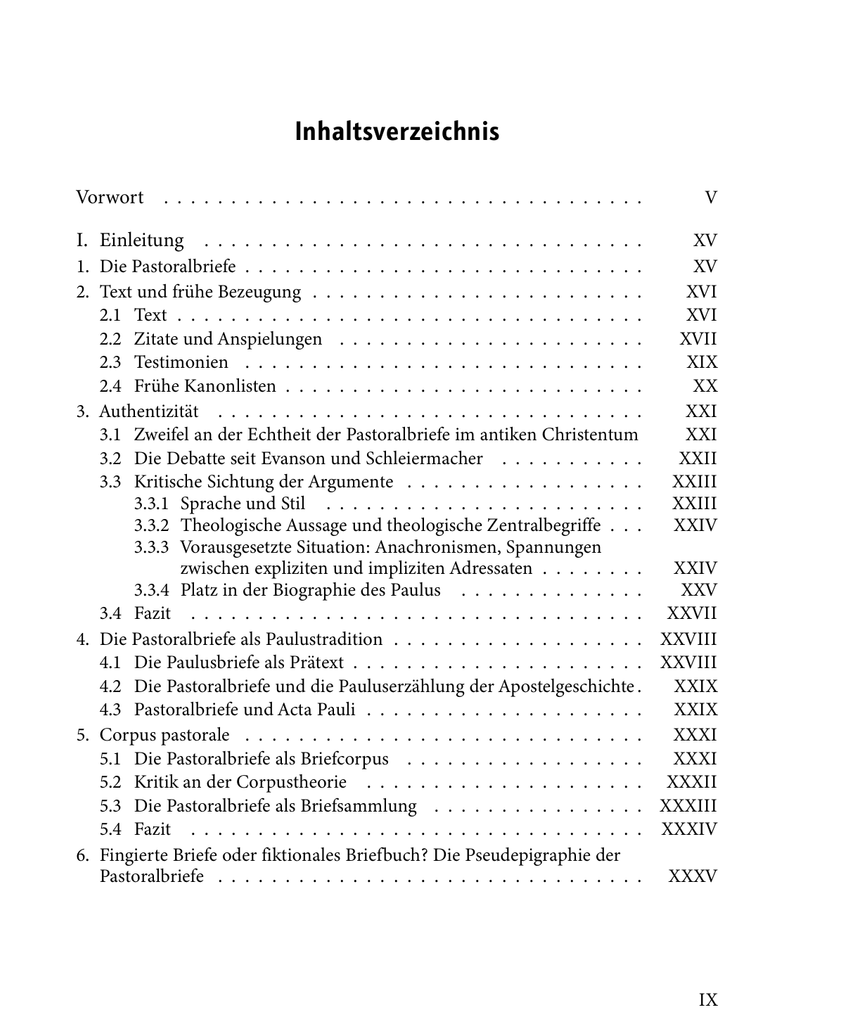
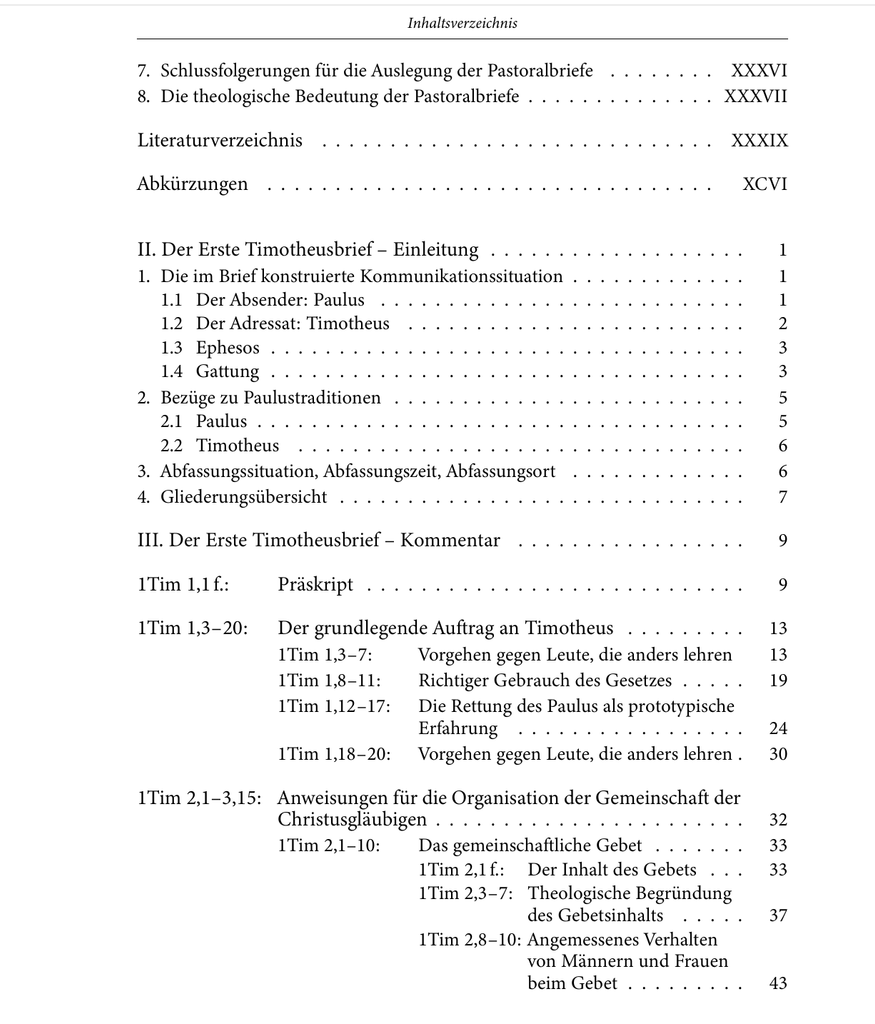
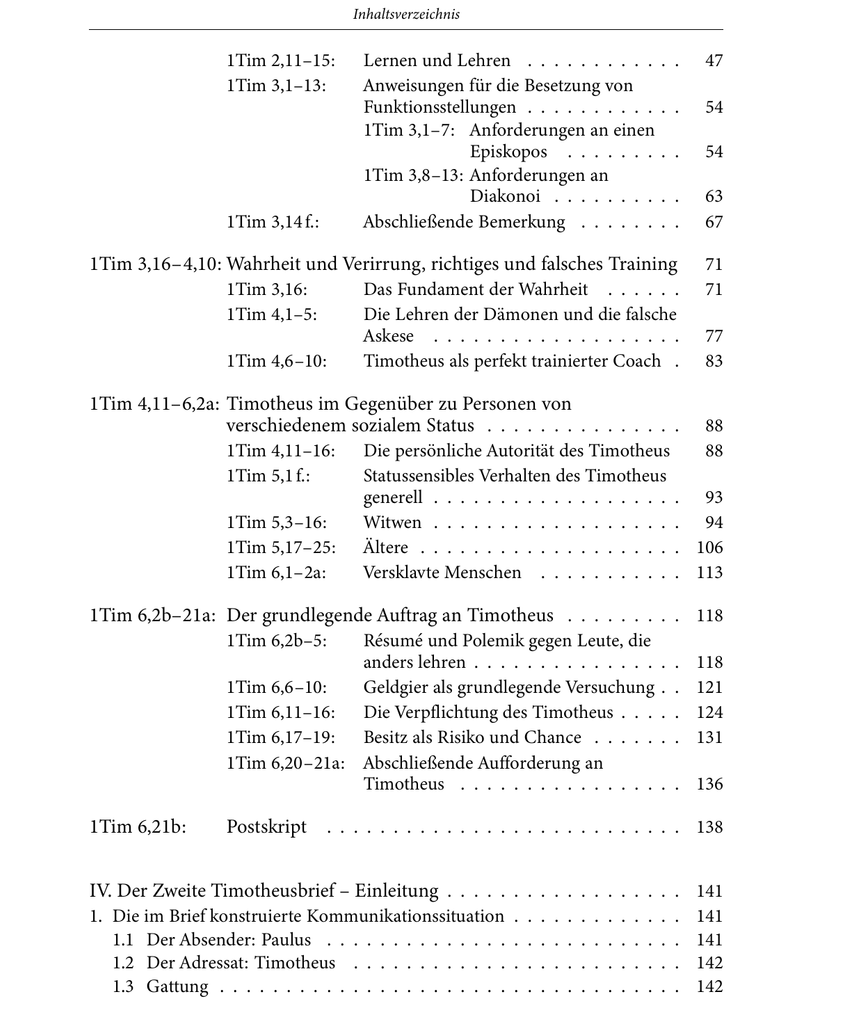
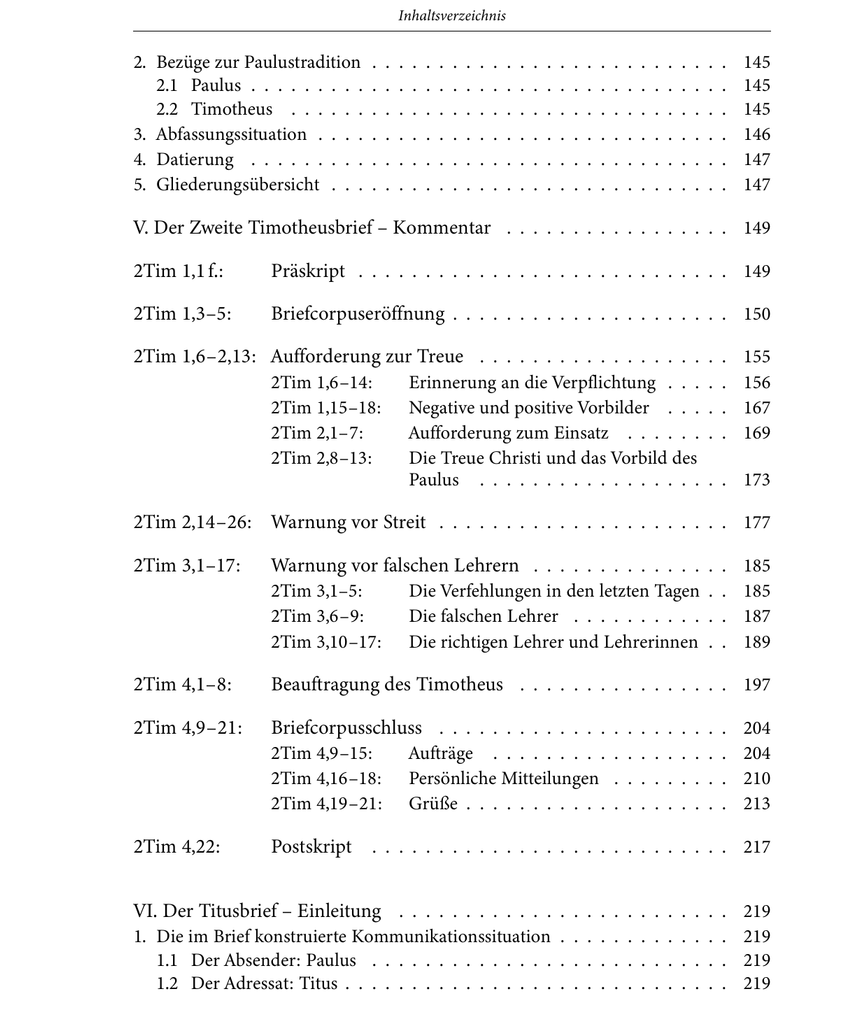
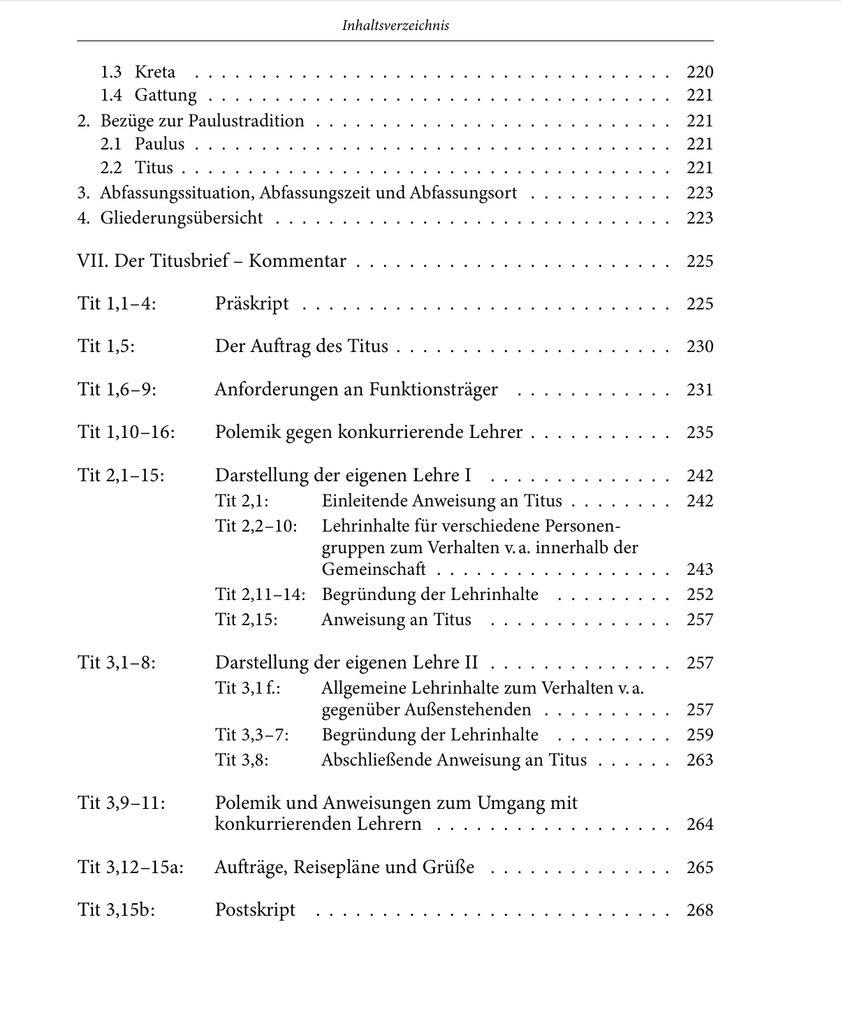
Krauter has now produced the commentary on the Pastoral Epistles in the Handbuch zum Neuen Testament to replace the hoary Die Pastoralbriefe of Martin Dibelius. Dibelius’s influential volume was originally published in 1913 as Die Briefe des Apostels Paulus. An Timotheus I, II an Titus, and saw its fourth edition in 1966, revised by Hans Conzelmann, then translated into English as The Pastoral Epistles in the Hermeneia series in 1972. Krauter’s replacement volume has now been published 120 years after Dibelius’s first edition, and 54 years after the Hermeneia volume. The table of contents and a sample of the work are available at Mohr Siebeck, and I have reproduced the TOC at the end of this post for convenience.
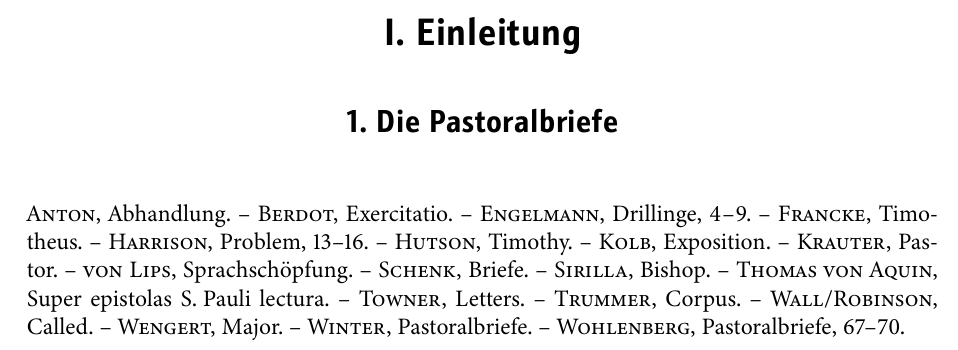
I’m pleased to note the presence of section bibliographies—that seems to be a growing trend, and I hope it continues. Note the wise employment of very abbreviated titles; that’s a good practice generally, and helps when trying to engage a great deal of scholarship in a relatively brief commentary.
And for a critical commentary, Krauter’s is “relatively brief,” due no doubt to HNT series constraints. Commentaries of 700-900 pages on the Pastorals are not uncommon these days (Mounce, 778; Pao: 831; Porter: 969; Tsuji, 759), and Krauter’s weighs in at 367 pages.
Though he favors the letters’ pseudonymity, Krauter is not of the mindset of much 20th-century scholarship that embraced that position as an accepted dogma. After a succinct multi-part summary of the status quaestionis, he concludes,
Die Sichtung der Argumente führt zu keinem klaren Bild, aber zu einer Tendenz: Es ist nicht sicher nachweisbar, dass alle drei Briefe oder einige von ihnen nicht von Paulus stammen. Es wird aber doch deutlich, dass die Annahme der Echtheit der Briefe große Probleme mit sich bringt. Sie macht unumgänglich, entweder Teile der Apg und andere Paulusbriefe für historisch falsch oder lückenhaft zu erklären oder mithilfe der Two imprisonments-Theorie eine Art Irgendwann für die Entstehung der Past zu schaffen. Dazu kommen die Spannungen in der vorausgesetzten Kommunikationssituation und die Hinweise auf eine frühe Zehnbriefesammlung ohne Past . . . . All dies lässt die Unechtheit der drei Briefe als plausiblere Annahme erscheinen, jedoch nicht als sicheres Wissen, auf das man allzu viele weitere Hypothesen bauen sollte. (xxvii)
An examination of the arguments yields no clear picture, yet it does reveal a trend: it cannot be conclusively proven that all three letters—or even some of them—did not originate with Paul. Nevertheless, it becomes evident that assuming the letters’ authenticity entails significant difficulties. Such an assumption necessitates either dismissing parts of Acts and other Pauline letters as historically inaccurate or incomplete, or invoking the “two imprisonments” theory to posit a vague timeframe for the composition of the Pastoral Epistles. Added to this are the tensions inherent in the implied communication context and the indications of an early ten-letter collection that excluded the Pastoral Epistles . . .. All these factors make the inauthenticity of the three letters appear the more plausible hypothesis—though not a certainty upon which too many further hypotheses should be built. (Google Translate)
When it comes to his own approach to the letters, he does take them as pseudonymous, though he observes the question of authenticity would not adjust his interpretation in most cases. He finds it more likely that the same author wrote all three letters.
In preparation for this volume, Krauter produced an impressive collection of research pieces which informed the production of the commentary proper:
“1 Tim 4:13: Public Lecture or Private Study?” Journal of the Bible and Its Reception 12.2 (2025): 215–30.
“1 Tim 5:19‒21: The Beginnings of Ecclesiastical Disciplinary Law?” Zeitschrift der Savigny-Stiftungfür Rechtsgeschichte: Romanistische Abteilung 112 (2026): 301–22.
“‘All Things Bright and Beautiful’: La théologie de la création dans 1 Timothée.” Revue de théologie et de philosophie 155 (2023).
“Auf den zweiten Blick: Eine Hinführung zu den Pastoralbriefen.” Bibel und Kirche 78.2 (2023).
“Cretan Memories: Crete in the Letter to Titus and the Acts of Titus.” Early Christianity 13 (2022): 455–67.
“Exilliteratur und die Gattung des Zweiten Timotheusbriefes.” Revue Biblique 129 (2022): 183–98.
“Ein Geist der Besonnenheit? Σωφρονισμός in 2Tim 1,7.” Zeitschrift für die neutestamentliche Wissenschaft 114.1 (2023): 123–36.
“Geistlose Briefe? Πνεῦμα in den Timotheusbriefen und im Titusbrief.” In Geist | Ruach | Pneuma | Spiritus. Exegetische, theologische, religionsgeschichtliche und phänomenologische Perspektiven. Edited by R. Feldmeier, J. Frey, and B. Schliesser. Wissenschaftliche Untersuchungen zum Neuen Testament. Tübingen: Mohr Siebeck, forthcoming.
“Genderrollen in den Pastoralbriefen: Ein Experiment mit verschiedenen Lesestrategien.” Theologische Literaturzeitung 146.5 (2021): 375–88.
“Ich weiß, wem ich mein Depositum anvertraut habe (2 Tim 1,12).” Biblische Zeitschrift 68 (2024).
“Die Kirche – Pfeiler und Fundament der Wahrheit? zur Übersetzung und Auslegung von I Tim 3,15f.” Theologische Zeitschrift 77.1 (2021): 45–59. [English abstract at close]
“The Lord be with your spirit (2 Tim 4:22a).” Revue Biblique 130 (2023).
“Ordination und Neues Testament.” Pages 11–28 in Ordination: Grundfragen und Impulse aus reformierter Perspektive. Edited by Stefan Krauter and Matthias D Wüthrich. Zürich: Theologischer Verlag, 2023.
“The Pastoral Epistles and the Jewish Paul.” Pages 139–156 in Reception of Paul during the First Two Centuries: Exploration of the Jewish Matrix of Early Christianity. Edited by František Ábel. Lanham, MD: Lexington Books/Fortress Academic, 2023.
“Die Pastoralbriefe im Dienst reformatorischer und antireformatorischer Polemik bei Caspar Cruciger dem Älteren und Ambrosius Catharinus.” Pages 247–68 in Reformatorische Paulusauslegungen. Edited by Stefan Krauter and Manuel Nägele. History of Biblical Exegesis 5. Tübingen: Mohr Siebeck, 2023.
“In Würde altern: Tit 2 und antike Vorstellungen vom Alter.” Theologische Zeitschrift 79.2 (2023): 146–65.
“Zwischen Oikos und Polis: Die Gemeinde und ihre Gemeindeversammlung in den Pastoralbriefen.” Pages 383–403 in Qahal und Ekklesia: Typen und Funktionen von Versammlungen im Alten und Neuen Testament und ihren Umwelten. Edited by Joachim J. Krauter, Stefan Krauter, and Wolfgang Oswald. Studies in Cultural Contexts of the Bible 19. Leiden: Brill, 2024.
Viljoen, François P. “Christ’s Immutability in 2 Timothy 2:11–13: A Threat, a Comfort, or an Encouragement?” Pages 78–93 in Biblical Theological Investigations into the Immutability of God in the New Testament. Edited by François P. Viljoen and Albert J. Coetsee. Eugene, OR: Wipf & Stock, 2026.
Abstract: “This paper explores the nature of Christ’s immutability in 2 Tim 2:11–13, with particular attention to the varied interpretations of the concluding clause, “he cannot deny himself.” The passage, structured around four conditional statements, highlights Christ’s steadfast character in contrast to human unreliability. The final clause presents interpretative challenges, with scholars offering divergent views: some regard it as a comforting affirmation of Christ’s unwavering faithfulness to the faithless, while others interpret it as a solemn warning, emphasizing his commitment to justly judge the unfaithful. This study engages these perspectives and argues for a more nuanced interpretation, grounded in the broader textual context of the clause. The central claim is that the passage should be read as a reaffirmation of the letter’s overarching exhortation, encouraging its addressee to persevere in his ministerial calling amid adversity.” (78)
From the foreward: “François Viljoen’s chapter examines Christ’s immutability in 2 Tim 2:11–13, focusing on the interpretive tensions surrounding the clause ‘he cannot deny himself.’ The passage, structured as a fourfold confessional statement, juxtaposes human unreliability with Christ’s steadfastness. While some scholars read the final clause as a comforting assurance of Christ’s faithfulness despite human lapses, others interpret it as a solemn warning of judgment upon denial. Viljoen argues for a nuanced synthesis: the statement functions not merely as threat or comfort but as exhortation, reinforcing the epistle’s overarching call to endurance in ministry. By situating the clause within the broader Pauline theology of divine faithfulness, the chapter demonstrates how Christ’s immutability rather serves as encouragement and assurance, anchoring perseverance in the unchanging reliability of the Lord.” (xviii–xix).
McQuaid, Joshua. “Nearness of God.” Journal of Theological Interpretation 19.1 (2025): 89–109.
Abstract: Among Scripture’s many descriptions of God, “living God” language is at once one of the most common and least examined. Interpretations of the relevant texts have largely ignored theological categories operative within the doctrine of God, leading to a haphazard understanding of how this scriptural theme might inform theological articulation. By investigating the living God language in Rom 14:11 and 1 Thess 1:9, this study specifically responds to earlier neglect of that language in the Pauline writings and seeks to demonstrate the value of its recovery for theological interpretation. It considers relevant background texts in Israel’s Scriptures and argues that Scripture’s living God language regularly signals God’s communicative nearness—that is, God’s nearness to see, to hear, and/or to speak—sounding a note of personal engagement that interpreters often neglect.
The title of this recent article may not catch the eye of students of the Pastorals. However, as a treatment of “living God” language in Paul, it will be of interest to those working in 1 Timothy 3:15 or 4:10.
In the first half of each year, we compile and post annual bibliographies for researchers in the Letters to Timothy and Titus. These lists of just-published and soon-to-be published studies aim to give some idea of research trends and to help researchers in the Pastorals maintain control of the secondary literature. Among other avenues of bibliographic discovery, we solicit the input of Pastorals scholars who have published previously on the letters. Our thanks to all who contributed!
Our annual bibliography of recent publications on the Letters to Timothy and Titus covers contributions from all of 2024 and early 2025. Over 180 items long and international in scope, the list contains monographs, journal articles, and commentaries, as well as lists of dissertations and conference presentations on the letters. It is available for viewing and downloading here.
Our annual bibliography of forthcoming academic publications on the Letters to Timothy and Titus is wide-ranging, containing over fifty forthcoming works, including essays, monographs, and commentaries. This bibliography is available for viewing and downloading here.
Around April of each year, we compile and post annual bibliographies for researchers in the Letters to Timothy and Titus. These lists of just-published and soon-to-be published studies aim to help researchers in the Pastorals maintain control of the secondary literature, and to give some idea of research trends. Among other avenues of bibliographic discovery, we solicit the input of Pastorals scholars who have published previously on the letters. Our thanks to all who contributed!
Our annual bibliography of recent publications on the Letters to Timothy and Titus covers contributions from all of 2023 and early 2024. Over 125 items long and international in scope, the list contains monographs, journal articles, and commentaries, as well as lists of dissertations and conference presentations on the letters. It is available for viewing and downloading here.
Our annual bibliography of forthcoming academic publications on the Letters to Timothy and Titus is wide-ranging, containing around 60 forthcoming works, including essays, monographs, and commentaries. This bibliography is available for viewing and downloading here.
I’ve made a first attempt at compiling a chronological list of relatively recent Pastorals scholarship. This first edition provides a year-by-year accounting of scholarly monographs and commentaries on the Pastorals from 1970 to the present (and future!), in any language. The table is available via the “Scholarship Timeline” tab at the top of the page. The full presentation is available here, and includes, in addition to the table, a full bibliography of all the works listed in the table.
I put together an early version of this table to help me to see what scholarship a given author had to draw upon at any given time in the last fifty years, and thought this sort of thing might be useful for others involved in Pastorals research.