Tag: 1 Timothy (Page 6 of 10)

The Pastorals in New Testament Abstracts 65.3

The following entries in New Testament Abstracts 65.3 may be of interest to researchers in the Pastorals.

1002. Philippe Van den Heede. “La participation à la mort du Christ par le baptême (Rm 6,3–11): Une conception pré-paulinienne (Rm 6,8; 2 Tm 2,11).” Revue Biblique 128.1 (2021): 99–115. (notice)

1035. Raymond F. Collins. “Paul in the Pastoral Epistles: A Life Well Lived.” The Bible Today 59.5 (2021): 308–15.

1036. Mary Ann Getty. “Elders and Widows.” The Bible Today 59.5 (2021): 301–7.

1037. Romeo Popa. “Ethic als Vermittlung zwischen Generationen in den Pastoralbriefen.” Sacra Scripta 18.1 (2020): 70–96.

1038. Mary Schieferstein. “Formation, Deception, and Childbearing: Reading 1 Timothy 2:13–3:1a in Light of Genesis 2–4.” Presbyterion 47.1 (2021): 112–20.

1039. Edward Mazich. “Lois and Eunice: Faith of Our Mothers.” The Bible Today 59.4 (2021): 242–48.

1040. T. Christopher Hoklotubbe. “Civilized Christ-Followers among Barbaric Cretans and Superstitious Judeans: Negotiating Ethnic Hierarchies in Titus 1:10–14.” Journal of Biblical Literature 140.2 (2021): 369–90. (notice)

1068. Michael Theobald. “Kirche im Neuen Testament.” Zeitschrift für Theologie und Kirche 117.4 (2020): 377–402. [note Pastorals on pp. 406–7]

(p. 437) Abraham M. Antony and Jose Varickasseril, eds. An Affable Pastor: A Commemorative Volume in Honour of Archbishop Dominic Jala SDB. Shillong, India: Vendrame Institute Publications, 2020. [note the article by Abraham M. Antony on the credentials of the episkopos in 1 Tim 3:1–7 in the context of the Pastoral Epistles]

(p. 438) Benjamin H. Dunning, ed. The Oxford Handbook of New Testament, Gender, and Sexuality. Oxford Handbooks. Oxford: Oxford University Press, 2019. [note Jorunn Økland, “Pauline Letters,” pp. 315–32, with the Pastorals discussed on pp. 325–26]

(p. 444) Robert W. Wall. Studies in Canonical Criticism: Reading the New Testament as Scripture. Library of New Testament Studies 615. London: T&T Clark, 2020. [note “Reading the Pauline Pastorals in Canonical Context,” pp. 93–126, which is excerpted from Wall and Steele, 1 and 2 Timothy and Titus]

(p. 454) Martin Wright. The Dividing Wall: Ephesians and the Integrity of the Corpus Paulinum. Library of New Testament Studies 646. London: T&T Clark, 2021.

(p. 455) Jaime Clark-Soles. Women in the Bible. Interpretation Resources for the Use of Scripture in the Church. Louisville: Westminster John Knox, 2020. [note chap. 10, “The Muting of Paul and His Female Coworkers: Women in the Deutero-Pauline Epistles,” pp. 281–306]

(p. 457) E. Elizabeth Johnson. Ecclesiology in the New Testament. Core Biblical Studies. Nashville: Abingdon, 2020.

(p. 457) Dorothy A. Lee. The Ministry of Women in the New Testament: Reclaiming the Biblical Vision. Grand Rapids: Baker Academic, 2021. [*Note the treatments of 1 Tim 2:11–15; 3:2–12 in chap. 6, “Paul’s Letters: Key Texts”]

(p. 458) William A. Simmons. The Holy Spirit in the New Testament: A Pentecostal Guide. Downers Grove, IL: IVP Academic, 2021. [note chap. 13: “The Holy Spirit in the Pastoral Epistles: The Spirit of Power, Love and Self-Control,” 161–72]

(p. 467) Karl-Heinrich Ostmeyer and Adrian Wypadlo, eds. Das Ziel vor Augen: Sport und Wittkampf im Neuen Testament und seiner Umwelt. Beiträge zur Wissenschaft vom Alten und Neuen Testament 226. Stuttgart: Kohlhammer, 2020. [note Thomas Söding, “Der Sport des Apostels: Die Dialektik von Kampf und Seig auf dem Weg von Phil 3 zu 2 Tim 4,” pp. 81–100]

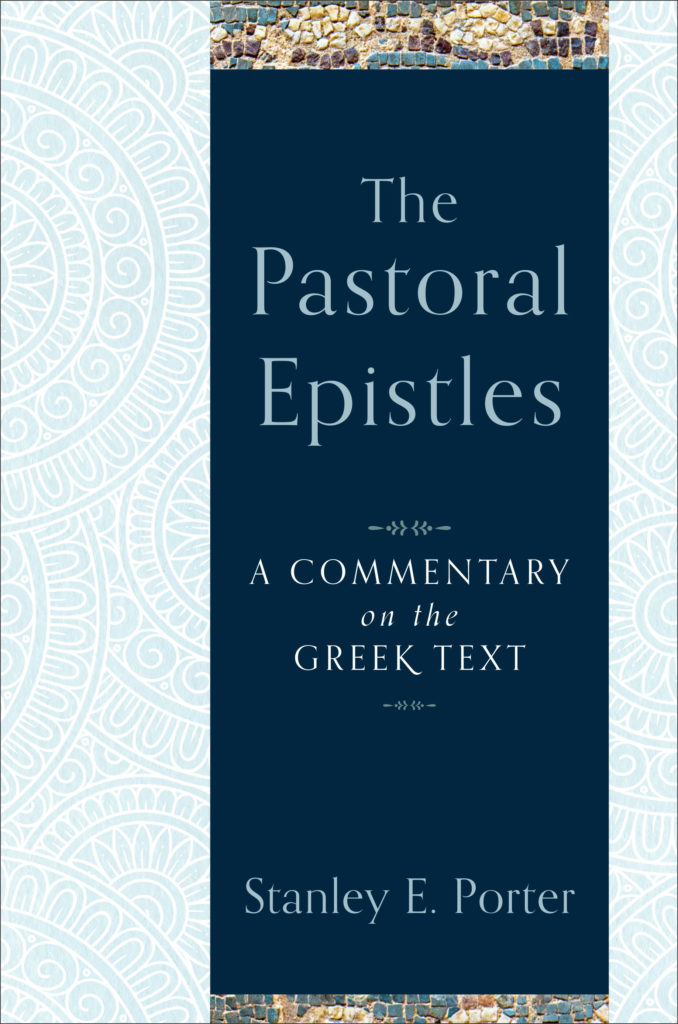
Porter, Pastoral Epistles, forthcoming 2022

I’ve known of Stan Porter’s forthcoming commentary on the Pastorals, but noticed it “officially” in Baker’s academic catalog today. Here’s the webpage. Per Baker, hardcover will be available in August 2022, e-book in November. Amazon, though, says Kindle version will be available 8/16/22 and hardcover 11/15/22.

Publisher’s blurb:

“New Testament scholar Stanley Porter offers a comprehensive commentary on the Pastoral Epistles that features rigorous biblical scholarship and emphasizes Greek language and linguistics.

“This book breaks new ground in its interpretation of the Pastoral Epistles by focusing on the Greek text and utilizing a linguistically informed exegetical method that draws on various elements in contemporary language study. Porter pays attention to the overall argument of each book while also delving into the semantics and lexicogrammar to tease out the textual meaning. Attentive to the history of scholarship on these three controversial works, the commentary addresses the major exegetical issues that arise in numerous highly disputed passages and offers innovative answers to traditional exegetical problems. Professors, students, and scholars of the New Testament will value this substantive work.”

Budiselić, “The Church as a Court: the Requirement for ‘Two or Three Witnesses’”

A new article by Ervin Budiselić does not focus heavily on the Pastorals, but I mention it here because of its obvious relevance for 1 Timothy 5:19, which is discussed on pp. 189–90. The article is available in its entirety at the address cited.

Budiselić, Ervin. “The Church as a Court: the Requirement for ‘Two or Three Witnesses.’” Kairos: Evangelical Journal of Theology 15.2 (2021): 179–94. https://doi.org/https://doi.org/10.32862/k.15.2.3

Abstract: “The Church in the New Testament is described with various images, and this article argues that one image that is implicitly present in the New Testament is the Church as a “court” or a “community of trial.” First, this can be argued because the God of the Bible – YHWH – is Creator, King, and Judge. That means that YHWH’s community is responsible, per YHWH’s revelation, to maintain the purity of its members in all aspects of life. Second, in the New Testament, we find examples where the Church functions as a court. However, the question is, does the biblical requirement for “two or three witnesses” also support the claim that the Church should function as a court? The purpose of this article is to identify places where the biblical command about “two or three witnesses appear,” to trace its development and to see what role and place it plays in the Church. By doing so, we would demonstrate that the presence of this stipulation in the New Testament is additional proof that we should sometimes view the Church as a “court.” The first part of the article explains that the context for the concept of witness is the Mosaic covenant and underlying assumption that governs the command about “two and three witnesses.” The second part analyzes the appearance of “two or three witnesses” in the Old Testament. In the third part, we will argue that the Church is truly a community of trial. We will so argue by observing selected examples from the New Testament where the Church functions as a court, and by tracking the development of the requirement about “two or three witnesses” in the New Testament. Based on this research, we will end by offering a reflection and a conclusion.”

I might mention that in addition to the literature cited in the article, one might add (though somewhat dated) an early monograph on the topic: H. van Vliet, No Single Testimony: A Study on the Adaptation of the Law of Deut. 19:15 Par. into the New Testament, Studia Theologica Rheno-Traiectina 4 (Utrecht: Kreminck en Zoon, 1958).

The Pastorals in Interpretation 75.4

Every so often, a scholarly journal will devote an entire issue to the Pastorals. The current issue of Interpretation does so (TOC), and contains the following articles:

MacDonald, Margaret Y. “Education and the Household in the Pastoral Epistles.” Interpretation 75.4 (2021): 283–93. (https://doi.org/10.1177/00209643211027768) Abstract: “The article examines the convergence of studies on the Pastoral Epistles, with greater attention to the theme of education as a key to the purpose of the documents. The close association between the household and education is considered in an effort to shed light on the presentations of Timothy and Titus, emerging leadership roles, intergenerational instruction, and constructions of gender.”

Huizenga, Annette. “Idealized Motherhood: Examples of the Gendered Worldview of the Pastoral Letters.” Interpretation 75.4 (2021): 294–304. (https://doi.org/10.1177%2F00209643211027765) Abstract: “In the Pastoral Letters, the roles and practices of mothering in a domestic household serve as benchmarks for the general instructions on how ‘one ought to behave in the household of God’ (1 Tim 3:15). This article examines several passages in 1–2 Timothy and Titus in which the author employs an idealized and stereotypical view of motherhood in order to persuade female believers to fulfill this socially-appropriate condition and to restrict them from leadership positions in the community.”

Kartzow, Marianne Bjelland. “The ‘Believing Woman’ and Her ekklēsia: Rethinking Intersectional Households and Manuscript Variations in the Widows’ Tale (1 Tim 5:3–16).” Interpretation 75.4 (2021): 305–16. (https://doi.org/10.1177/00209643211027767) Abstract: “The widows of the Pastoral Epistles (1 Tim 5:3–16) have been a puzzle for interpreters for generations. In the ‘Widows’ Tale’ different categories of women are given a whole set of instructions, including how they shall be organized and with whom to live. In this article, I will highlight the interpretative potential of the very last verse of the paragraph, where ‘a believing woman who has widows’ is mentioned. In some important manuscripts, scribes have added ‘believing man’ in v. 16, while others have left out the woman altogether. What can these disagreements and changes tell? I will argue that not enough scholarly attention has been directed to this verse. There is huge potential for a new understanding of the whole paragraph hidden here. Attention to alternative housing arrangements and manuscript variations will be employed as interpretative tools. I will use the disagreement among scribes to rethink variety and difference, and to reimagine ekklēsia within intersectional early Christian households.”

Fortune, Marie M. “Is Nothing Sacred? I Timothy and Clergy Sexual Abuse.” Interpretation 75.4 (2021): 317–27. (https://doi.org/10.1177/00209643211027764) Abstract: “1 Timothy and the Pastoral Letters appear to be efforts to codify structure and roles in the early church. These efforts largely reflected the patriarchal social structures of the time and as such are not relevant to the twenty-first-century church. But some of the concerns identified herein, for example expectations of church leaders, are useful for a current discussion. What is missing is any acknowledgement of the potential for identified church leaders to take advantage of vulnerable congregants, particularly women and children. How might the writer of 1 Timothy have addressed this serious problem in the churches?”

Merkle, “The Authority of Deacons in Pauline Churches”

Benjamin L. Merkle has made another contribution to the literature on the Pastorals:

Merkle, Benjamin L. “The Authority of Deacons in Pauline Churches.” Journal of the Evangelical Theological Society 64.2 (2021): 309–25.

Abstract: The New Testament office of deacon is disputed primarily because of the paucity of information. Consequently, many look to the following in order to determine the role of deacons in the church: (1) the lexical meaning of διάκονος and its cognates (διακονέω and διακονία); (2) the function of the Seven in Acts 6:1–6; and (3) the qualifications for deacons in 1 Timothy 3:8–13. Additionally, one’s view of the role of women in ministry can influence how one perceives the function and authority of deacons. This essay argues that deacons held an official and authoritative, yet nonessential and subordinate, position in the Pauline churches. I support this thesis by considering: (1) the official title of deacons; (2) the official function of deacons; (3) the official qualifications of deacons; and (4) the official period of testing and honorable standing of deacons.

I took a class on the Greek text of the Pastorals with Dr. Merkle and benefitted greatly from it. I’m thankful for his commitment to thinking through issues in these letters and publishing the results for the benefit of both church and academy, as well as his work behind the scenes in the ETS Pastorals study group. Other publications of his on the Pastorals include:

“Are the Qualifications for Elders or Overseers Negotiable?” Bibliotheca Sacra 171.682 (2014): 172–88.

“Ecclesiology in the Pastoral Epistles.” Pages 173–98 in Entrusted with the Gospel: Paul’s Theology in the Pastoral Epistles. Edited by Andreas J. Köstenberger and Terry L. Wilder. Nashville: B&H Academic, 2010.

The Elder and Overseer: One Office in the Early Church. Studies in Biblical Literature 57. New York: Lang, 2003.

“Hierarchy in the Church? Instruction from the Pastoral Epistles regarding Elders and Overseers.” The Southern Baptist Journal of Theology 7 (2003): 32–43. Reprinted as “Hierarchy in the Church? Instruction from the Pastoral Epistles concerning Elders and Overseers.” Journal for Baptist Theology and Ministry 2.1 (2004): 45–62.

“Paul’s Arguments from Creation in 1 Corinthians 11:8–9 and 1 Timothy 2:13–14: An Apparent Inconsistency Answered.” Journal of the Evangelical Theological Society 49 (2006): 527–48.

White, “Establishing Traditions: Discipline and Expulsion in the Pastoral Epistles”

In a new monograph on Paul and what is often referred to as church discipline, Adam White includes a chapter on the Pastorals:

Adam G. White. Paul, Community, and Discipline: Establishing Boundaries and Dealing with the Disorderly. Paul in Critical Context. Minneapolis: Lexington/Fortress Academic, 2021. [note the chapter “Establishing Traditions: Discipline and Expulsion in the Pastoral Epistles,” pp. 217–32]

The volume introduction notes that “the PE reveals something of a later formalisation of the practices revealed in the undisputed letters.” White reads the Pastorals as pseudonymous, approaching them as three letters by a single author. Naturally, given the topic, he focuses on 1 Timothy and Titus. Section headings include “Dealing with Unruly Widows,” “Dealing with Unruly Elders,” and “Dealing with False Teachers in Crete.”

Archer, “Was the Spirit Poured out on Women to Remain Silent in the Church? Reading 1 Corinthians 14.34–35 and 1 Timothy 2.11–15 in the Light of Pentecost”

The voluminous literature addressing 1 Timothy 2:11-15 has been supplemented by a new essay:

Archer, Melissa. “Was the Spirit Poured out on Women to Remain Silent in the Church? Reading 1 Corinthians 14.34–35 and 1 Timothy 2.11–15 in the Light of Pentecost.” Pages 123–34 in Grieving, Brooding, and Transforming: The Spirit, The Bible, and Gender. Journal of Pentecostal Theology Supplement Series 46. Edited by Cheryl Bridges Johns and Lisa P. Stephenson. Leiden: Brill, 2021.

Moo on the Pastorals in A Theology of Paul and His Letters

Doug Moo has now published his important volume on Pauline theology in the Biblical Theology of the New Testament series:

Douglas J. Moo. A Theology of Paul and His Letters: The Gift of the New Realm in Christ. Biblical Theology of the New Testament. Grand Rapids: Zondervan, 2021.

After two introductory chapters, Moo examines the theology of Paul’s letters one by one before addressing Paul’s theology from a biblical theological standpoint. Each of the Pastorals receives its own individual treatment (1 Timothy, 316–34; Titus, 335–39; 2 Timothy, 340–44). As well, since Moo accepts the Pastorals as authentically Pauline, he incorporates them into his larger Pauline theology.

Reinhardt, “‘God, Who Giveth Us Richly’: Wealth, Authorship, and Audience in 1 Timothy 6”

A recent article engages the topic of wealth in the context of the Pastorals, a topic which happens to be pertinent to the upcoming presentations in the ETS Pastorals study group.

Jackson Reinhardt. “‘God, Who Giveth Us Richly’: Wealth, Authorship, and Audience in 1 Timothy 6.” Journal of the Oxford Graduate Theological Society 2.1 (2021): 101–14.

Abstract: “While prior biblical scholarship has firmly rejected the Pauline authorship of the Pastoral Epistles (1–2 Timothy and Titus), rarely has analysis focused on socio-economic context. I argue that examining the economic conditions and theology of 1 Timothy provides additional reasons to rejects the letter’s authenticity. While Paul’s audience was primarily impoverished urbanites, the author of 1 Timothy (i.e., the Pastor) was writing to a prosperous congregation who needed instruction on the proper handling of their wealth. Paul’s theology of wealth, in turn, reflects the context of his audience: he supported inter-ecclesial programs of mutual interdependence and a rejection of the prevailing modes of economic exploitation that existed in first-century Palestine. The Pastor does not promote any similar alternative economy among believers. He contends that wealthy believers should be charitable so as to build up a heavenly treasure and secure posthumous favor.”

A PDF of the article is freely available here.

Towner, “Resonance, Dissonance, Resistance and 1 Timothy 2.8–15”

Phil Towner has added an essay to the voluminous literature on 1 Tim 2:8–15:

Philip H. Towner. “Resonance, Dissonance, Resistance and 1 Timothy 2.8–15: The Eschatological Obsolescence and ‘Rewriting’ of a Proscriptive Text.” Między Oryginałem a Przekładem 53.3 (2021): 67–84.

A PDF of the article (which is in English) may be obtained at https://journals.akademicka.pl/moap/article/view/3861 .

The article is a reworked version of Towner’s 2010 ETS presentation of nearly the same title. According to the introductory article in the journal, the essay was presented “in the Workshop on Contemporary Theory and Practice of Bible Translation, an interconfessional seminar which takes place at the Pontifical Urbaniana University at the beginning of every academic year.

Abstract: “This study asks whether translation might be a valid mode of (literary)
criticism. It approaches a hortatory biblical text (1 Timothy 2.8-14 [3.1a]),
somewhat notoriously and rigidly applied in some quarters of the church
as containing timeless ethical instruction concerning women in the church,
from the standpoint of its intertextual network, listening for resonance and
dissonance as the relevant intertexts and precursor texts are explored. It
is ultimately diagnosed as a text that is eschatologically obsolescent, and
translated/rewritten, on the basis of its intertextual composition, to reflect
the openness inscribed by the authorial Other.

« Older posts Newer posts »

© 2026 Pastoral Epistles

Theme by Anders NorenUp ↑