Tag: Letters to Timothy and Titus (Page 5 of 11)

Padilla, The Pastoral Epistles (TNTC)

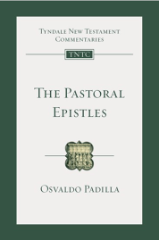
The well-known TNTC series — Tyndale New Testament Commentaries — is releasing a new commentary on the Pastoral Epistles by Osvaldo Padilla.

The new volume replaces a former treatment of the letters by Donald Guthrie (1916–1992), who mounted a robust defense of Pauline authorship in his 1957 TNTC volume (2nd ed., 1990), one of the first in the series. Guthrie was not a prolific author of Pastorals literature, but well-known for what he did write in that vein. Pertinent works included The Pastorals and the Mind of Paul (London: Tyndale, 1955); “The Development of the Idea of Canonical Pseudepigrapha in New Testament Criticism,” Vox Evangelica 1 (1962): 43–59; and his treatment of the letters in his well-known New Testament Introduction, published and revised in various editions from the 1960s to the final 4th edition in 1990. He also contributed articles on the Pastorals to the New Bible Dictionary. His New Testament Theology thoroughly incorporates the Pastorals as Pauline, but is structured such that there is little in the way of distinct treatment of the letters.

I will formally review Padilla’s volume in the future, but will simply note here its release. Osvaldo Padilla is professor of divinity at Beeson Divinity School. The Pastoral Epistles is “the first time I have written in the ‘genre’ of the commentary” (ix), although he has published The Acts of the Apostles: Interpretation, History and Theology (Downers Grove, IL: IVP Academic, 2016). From my initial glance through the volume, he writes as a defender of the letters’ authenticity, as would be expected in the TNTC series (1–16), and as an egalitarian (cf. 97–98). Highlighting these points is not meant to minimize other aspects of the volume, simply to to note two areas that are often of significant interest in a Pastorals commentary. I am grateful to IVP for providing a review copy.

The Pastorals at SBL 2022

The 2022 SBL/AAR Annual Meeting program lists the following sessions which may be of interest to Pastorals researchers:

Margaret MacDonald, “Flexible Arrangements: Uncovering the Relationship between Space and Education in the Pastoral Epistles”

Victoria Perez Rivera, “Scripturalizing the Pastorals: Exegesis and Power”

Marion Ann Taylor, “Should Women Speak/Preach? Marie Dentière, Calvin, and Farel”

Anna C. Miller and Katherine A. Shaner, “Ensouled Tools and Social Death: Resisting Re-inscription of Aristotelian Natural Slavery in 1 Timothy”

Oluwarotimi Paul Adebayo, “A Socio-rhetorical Understanding of θεόπνευστος in 2 Timothy 3:16–17 in Its Contribution to Scripture Authority”

Judy Kim, “Who is the “Heretic” (Αἱρετικός) to be Shunned?: Origen’s Understanding of the Apostolic Injunction in Titus 3:10–11”

The Pastorals at ETS 2022

In the ETS Annual Meeting program, the Pastoral Epistles study group is absent for the first time in 11 years. However, several sessions at the annual meeting engage the Pastorals:

Courtney Veasey, “The Function of Καταστολή in 1 Tim 2:9 in the Identification of the Church as a Holy Community.”

David H. Warren, “Negation and Ellipsis in the Pastorals”

Hershel Wayne House, “Why Did Paul Forbid Women to Teach Men in the Church? (1 Timothy 2:11–15)”

Goswell, “The Bookends of the Pauline Corpus”

A new article of interest for Pastorals researchers:

Gregory Goswell, “The Bookends of the Pauline Corpus.” Journal of the Evangelical Theological Society 65.1 (2022): 111–26.

Abstract: Romans at the head of the Pauline corpus and the Pastoral Epistles at or near the end act as bookends and provide a missional frame around the epistolary collection. Though the order of the letters appears to be due to the mechanical principle of decreasing length (Romans is the longest letter) and the (somewhat) arbitrary division made between letters to churches and to individuals, the position of Romans and the Pastoral Epistles at either end of the collection of Paul’s letters makes sense, given the general and comprehensive character of Romans and the probable setting of the Pastoral Epistles late in Paul’s missionary career as he contemplates his removal from the scene. Influenced by Romans, the reader of the letters that follow is alerted to when and how Paul sets his doctrinal and ethical instructions in a missional frame. Similarly, the Pastoral Epistles suggest a missional reading of the earlier letters. The letter to the Philippians is used as a test case for the influence that Romans and the Pastorals bring to bear on the reading of the intervening letters.

Edwards, “‘Taken Up in Glory’”

Another article engaging 1 Timothy 3:16 is now available:

David R. Edwards, “‘Taken Up in Glory’: Early Christian Traditions of the Ascension in Light of 1 Timothy 3:16.” Journal of Early Christian History 12.2 (2022). https://doi.org/10.1080/2222582X.2022.2109052

This article is the publication of an earlier conference presentation: “‘Taken Up in Glory’: Early Christian Traditions of the Ascension of Jesus in Light of 1 Tim. 3:16.” Presentation at the Annual Meeting of the SBL, San Antonio, 21 November 2021.

Abstract: I revive a chronological approach to the hymn in 1 Timothy 3:16, a reading which has frequently been dismissed on the basis of the alleged misplacement of the ascension after the Gentile missionary movement. Behind the rejection of a chronological reading has been the normativity of the narrative of Luke- Acts—or at least a conventional reading of it. This study argues that the peculiar chronology of the hymn arose from attempts to harmonise the multiple ascension reports in Luke 24 and Acts 1 along with the tradition reported by Paul in 1 Corinthians 15. Lying behind the hymn is an interpretation of Luke- Acts as implying multiple and ongoing post-resurrection appearances and ascensions which culminate in a final ascension after the appearance to Paul, which occurs in the narrative of Luke-Acts just after the Christian proclamation expands to Gentiles through the baptism of the Ethiopian eunuch.

See this previous post for earlier bibliography on 1 Timothy 3:16.

Beale, “The Background to ‘Fight the Good Fight’ in 1 Timothy 1:18, 6:12, and 2 Timothy 4:7”

G. K. Beale is hard at work on his forthcoming Pastorals commentary in the ZECNT series, co-authored with Christopher Beetham. In the meantime, he has published a new article on the Pastorals, grounded in an SBL presentation he gave in 2021:

G. K. Beale, “The Background to ‘Fight the Good Fight’ in 1 Timothy 1:18, 6:12, and 2 Timothy 4:7.” Zeitschrift für die neutestamentliche Wissenschaft 113.2 (2022): 202–30. https://doi.org/10.1515/znw-2022-0011

Abstract:

The combined wording in 1 Tim 1:18 of στρατεύω + στρατεία can be rendered in English “fight the fight,” “battle the battle,” or more generally “perform military service” or “serve in a military campaign.” The combination surprisingly occurs often throughout Greco-Roman literature to express a patriotic warfare idiom for good character revealed by persevering through warfare or military campaigns. This idiom is applied to Timothy to demonstrate his good Christian character and reputation over against the false teachers’ bad character. The idiom also occurs often in a legal context to affirm a person’s character and good reputation, which qualifies a person to be an officer of the court or endorses a person’s character before the court in a legal dispute, showing him to be worthy of an innocent verdict. In 1 Timothy this idiom is used in a legal context (accompanied repeatedly by the μάρτυς word group, as in the Hellenistic occurrences of the idiom) that demonstrates and acquits Timothy’s character and reputation before the false teachers. The redundant word combination of ἀγωνίζομαι + ἀγών (“struggle the struggle”) in 1 Tim 6:12 and 2 Tim 4:7 is recognized by commentators as a development of the phrase in 1 Tim 1:18. In the Greek world, this also is a well-worn idiom used in the same way as the στρατεύω + στρατεία expression, most likely highlighting the difficulty of the fight. This is why the expression ἀγωνίζομαι + ἀγών is synonymous with the expression in 1 Tim 1:18, even with the added adjective “good.” This is also why some English translations even translate the redundant expressions in 1 Tim 1:18, 1 Tim 6:12, and 2 Tim 4:7 as “fight the good fight,” clearly seeing στρατεύω + στρατεία and ἀγωνίζομαι + ἀγών as synonymous. This lexical study of Greco-Roman backgrounds endorses the conclusion that the two expressions are idioms and are synonymous.

The Pastorals in New Testament Abstracts 66.1

The following items listed in New Testament Abstracts 66.1 (2022) may be of interest to Pastorals scholars.

218. Annette Huizenga, “Idealized Motherhood: Examples of the Gendered Worldview of the Pastoral Letters.” Interpretation 75.4 (2021): 294–304. https://doi.org/10.1177/00209643211027765

219. Margaret Y. MacDonald, “Education and the Household in the Pastoral Epistles.” Interpretation 75.4 (2021): 283–93. https://doi.org/10.1177/00209643211027768

220. Jermo Van Nes, “Second-Century Vocabulary in the Pastoral Epistles? A Reassessment.” Filología Neotestamentaria 34 (2021): 41–67.

221. Marie M. Fortune, “Is Nothing Sacred? I Timothy and Clergy Sexual Abuse.” Interpretation 75.4 (2021): 317–27. https://doi.org/10.1177/00209643211027764.

222. Marianne B. Kartzow, “The ‘Believing Woman’ and Her ekklēsia: Rethinking Intersectional Households and Manuscript Variations in the Widows’ Tale (1 Tim 5:3–16).” Interpretation 75.4 (2021): 305–16. https://doi.org/10.1177/00209643211027767

(p. 146) Andreas J. Köstenberger, 1–2 Timothy and Titus. Evangelical Biblical Theology Commentary. Bellingham, WA: Lexham, 2021.

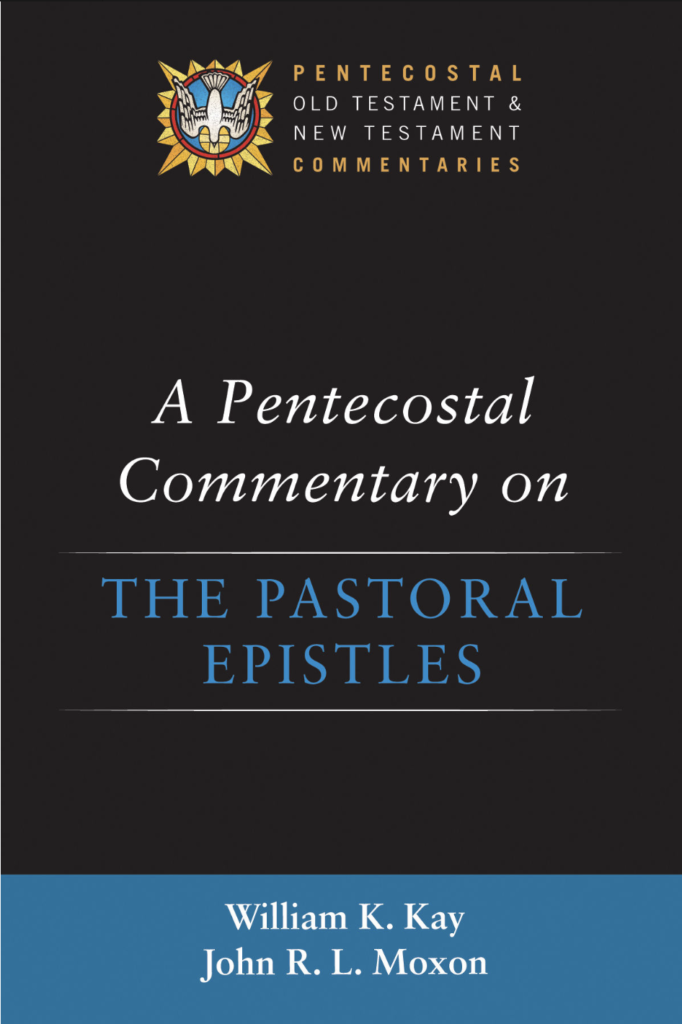
Kay and Moxon, A Pentecostal Commentary on the Pastoral Epistles

The second volume in a new commentary series, Pentecostal New Testament Commentaries, is out, and it addresses the Pastorals:

William K. Kay and John R. L. Moxon. A Pentecostal Commentary on the Pastoral Epistles. Pentecostal New Testament Commentaries. Eugene, OR: Wipf & Stock, 2022.

As one might expect, the commentary gives “special attention to the typical interests and questions of Pentecostal and charismatic readers” (introduction). The Pastorals are accepted as authentically Pauline. “The view taken by this commentary is that the special character and concerns of these texts are already present in some measure for other NT writers and that they can be explained by (a) a clear second-generation, future-facing orientation, (b) one or more amanuenses or assistants, and (c) a decision to use new, more specifically Hellenistic religious language” (introduction).

The introduction notes that “in terms of the great questions facing us today about church planting, mission, leadership and ‘next generation’ church, these epistles could count as amongst the most significant and exciting of the New Testament.”

The authors specify several reasons to attend to the Pastorals, especially for those in the volume’s target audience:
(1) “The epistles tell us about some of the important ‘second phase’ activities that were needed in early mission work.”
(2) “The epistles help us to realize how the early church organized its ministry in practical terms.”
(3) “Third … is the issue of how one even enters a ministry. If 1 Corinthians were our sole guide, we might imagine this happened by a self-evident spiritual gift or anointing. It perhaps comes as a surprise therefore when in the PE, Paul speaks of ‘aspiring’ to a ministry role (1 Tim 3:1), of the ‘testing’ of candidates (1 Tim 3:10), and a fact often missed, that ministry always occurred in teams (cf. 1 Tim 4:14). The PE certainly know about gifts, prophecy, and discerning spirits (1 Tim 4:1, 14), yet procedures and structures clearly appear alongside them. Equally disarming, of course, is the idea of a disciplinary process (run by the congregation?) that could, we assume, lead to the removal of an elder (1 Tim 5:19), contrary to the oft-cited Ps 105:15.”
(4) “Another eye-catching emphasis in the PE is the theme of holiness…. Whilst imagined in some Pentecostal contexts to be the more or less inevitable consequence of receiving the Spirit, the emphasis in the PE lies on training, formation, safeguarding and accountability.”

The Pastorals in WUNT

Recently, the Pastorals seem to be having an outsized presence in Mohr Siebeck’s Wissenschaftliche Untersuchungen zum Neuen Testament series. The following are recently published and forthcoming volumes in WUNT 1 and and WUNT 2 which each focus solely on one or more of the Pastorals. Authorship/editorship is widespread: Australia (Kidson), Germany (Herzer, Zimmermann), Nigeria (Manomi), Switzerland (Bulundwe), USA (Langford).

Lyn Kidson, Persuading Shipwrecked Men: Rhetorical Strategies in 1 Timothy (WUNT 2/526; 2020) (RBL review) (JETS) (ABR) (JSNT)
Dogara Ishaya Manomi, Virtue Ethics in the Letter to Titus: An Interdisciplinary Study (WUNT 2/560; 2021)
Jens Herzer, Die Pastoralbriefe und das Vermächtnis des Paulus: Studien zu den Briefen an Timotheus und Titus (WUNT 476; 2022)
Ruben Zimmermann and Dogara Ishaya Manomi, eds. “Ready for Every Good Work” (Titus 3:1): Implicit Ethics in the Letter to Titus (WUNT 484; 2022)
Andrew M. Langford, Diagnosing Deviance: Pathology and Polemic in the Pastoral Epistles (WUNT 2/ ; 2022 est.)
Kampotela Luc Bulundwe, 2 Timothée dans le corpus paulinien. Analyse mémorielle (WUNT 2/ ; 2022 or 2023)

To be sure, plenty of single essays on one or more of the Pastorals have appeared in edited WUNT collections. However, before the recent spate of volumes just noted, only the following WUNT volumes (to my knowledge) focused solely on one or more of the Pastorals (or, for Trebilco and Smith, were monographs with a very significant Pastorals component):

Ulrike Wagener, Die Ordnung des “Hauses Gottes.” Der Ort von Frauen in der Ekklesiologie und Ethik des Pastoralbriefe (WUNT 2/65; 1994)
Andrew Y. Lau, Manifest in Flesh: The Epiphany Christology of the Pastoral Epistles (WUNT 2/86; 1996)
Hanna Stettler, Die Christologie der Pastoralbriefe (WUNT 2/105; 1998)
Paul R. Trebilco, The Early Christians in Ephesus from Paul to Ignatius (WUNT 166; 2004)
Bernhard Mutschler, Glaube in den Pastoralbriefen: Pistis als Mitte christlicher Existenz (WUNT 256; 2010)
Claire Smith, Pauline Communities as “Scholastic Communities”: A Study of the Vocabulary of “Teaching” in 1 Corinthians, 1 and 2 Timothy and Titus (WUNT 2/335; 2012)

The first batch of volumes above has six WUNT volumes on the Pastorals being published in around four years (2020–2023). The earlier batch of volumes, another half-dozen, spans nearly two decades (1994–2012).

Zimmermann and Manomi, eds., “Ready for Every Good Work” (Titus 3:1)

Mohr Siebeck has now listed as forthcoming the volume containing the proceedings of the 2019 “Ethics in Titus” conference held in Mainz:

Ruben Zimmermann and Dogara Ishaya Manomi, eds. “Ready for Every Good Work” (Titus 3:1): Implicit Ethics in the Letter to Titus. Wissenschaftliche Untersuchungen zum Neuen Testament 484. Kontexte und Normen neutestamentlicher Ethik / Contexts and Norms of New Testament Ethics 13. Tübingen: Mohr Siebeck, 2022.

My email to Mohr Siebeck confirmed that the volume is scheduled for formal release on 30 September 2022. The contributors to the volume are a veritable “who’s who” in Pastorals scholarship:

Introduction
Ruben Zimmermann/Dogara Ishaya Manomi: The »Implicit Ethics« in Titus. Introductory Remarks and Summary of the Contributions

I. Linguistic and Rhetorical Aspects of the Implicit Ethics: A Text-immanent Approach
Luke Timothy Johnson: The Pedagogy of Grace. The Experiential Basis of Morality in Titus
Annette Bourland Huizenga: Moral Education in Titus. Antitheses for Ethical Living
Dogara Ishaya Manomi: The Language of Virtue. Discovering Implicit Virtue-Ethical Linguistic Elements in Titus
Rick Brannan: The Language of Ethical Instruction in the Letter to Titus. A View Informed by Discourse Grammar and Speech Act Theory
Jermo van Nes: Moral Language and Ethical Argument in Titus. A Reassessment of the Pseudonymity Hypothesis
Philip H. Towner: The Ethical Agenda of Titus. The Time and Space of Ethics

II. Historical and Contextual Dimensions of the Implicit Ethics: A Socio-historial Approach
Jens Herzer: Ethics, Ethos, and Truth. Reassessing the Question of the Individuality of the Pastoral Epistles
Michael Theobald: Internal Ethos or Ethos before the Public Forum? Titus and His Construct of the Opponents
Ray Van Neste: »Our People«. Ethics and the Identity of the People of God in the Letter to Titus
Harry O. Maier: Ethics and Empire in Titus. Texts, Co-texts, and Contexts

III. The Relevance of the Implicit Ethics: A Hermeneutical Approach
Korinna Zamfir: Women’s Vocation and Ministry according to Titus. Ethical Issues and Their Contemporary Relevance
Claire S. Smith: Ethics of Teaching and Learning in Christianity Today. Insights from the Book of Titus
Hans-Ulrich Weidemann: Written to Be with Paul. Reading Galatians with Titus
Marianne Bjelland Kartzow: »Speak evil of no one!« (Titus 3:2).

« Older posts Newer posts »

© 2026 Pastoral Epistles

Theme by Anders NorenUp ↑