Tag: Letters to Timothy and Titus (Page 8 of 11)

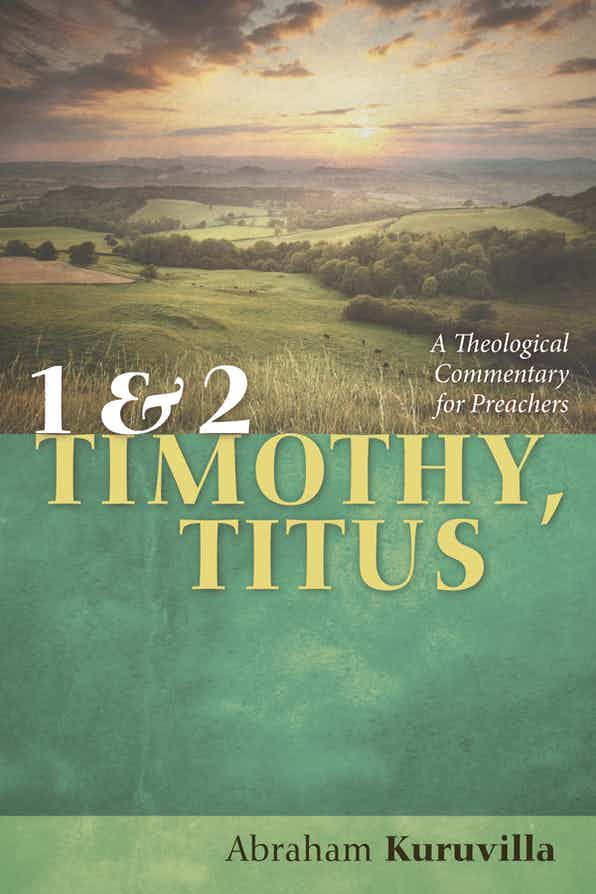
Review: Kuruvilla, 1 & 2 Timothy, Titus: A Theological Commentary for Preachers

Abraham Kuruvilla, who taught homiletics at Dallas Theological Seminary for some years and has recently taken a position as Professor of Christian Preaching at the Southern Baptist Theological Seminary, has added to his burgeoning collection of “theological commentaries for preachers” with a volume on the Pastorals.

Paul S. Jeon, Lecturer in NT at Reformed Theological Seminary and senior pastor at NewCity Church in Vienna, VA, has provided a review, which is exclusive to this blog and may be accessed here.

Torbus, “Oral Teachings of Old Women in 1 Timothy 4:7”

Sławomir Torbus is “a graduate of the Institute of Classical Philology and Ancient Culture at the University of Wroclaw.… He received his doctorate from the University of Wroclaw in 2004. He is currently an assistant professor in the Department of Hellenic Studies Institute of Classical Studies, Mediterranean and Oriental at the University of Wroclaw. He is a specialist in the history and theory of rhetoric and especially the analysis of the rhetoric of the New Testament.” (source)

He has a previous article on 1 Tim 4:7 in Polish (with an English-language abstract): “‘Baśnie starych kobiet’ w 1 Tm 4,7: Wokół interpretacji przymiotnika γραώδης [“‘Old Women’s Fables’ in 1 Tim. 4,7: Interpretations of the Adjective γραώδης”],” Theologica Wratislaviensia 10 (2015): 139–49. He has just published a second article (in English) which builds upon the first one:

Torbus, Sławomir. “Oral Teachings of Old Women in 1 Timothy 4:7.” Quaestiones Oralitatis 5 (2020): 133–43.

Abstract: “The paper attempts to consider the possibility that the expression γραώδεις μῦθοι used in 1 Timothy 4:7 might refer to oral teachings conveyed by older women in Ephesus. It can be observed that in the Pastoral Epistles, the word μῦθοι denotes false teachings which stand in sharp contrast with the truth contained in the written Scriptures. The context of 1 Timothy may suggest the possibility that older women could convey such oral teachings in the space of the οἶκος, which was a natural ecclesiastical environment of the earliest Christian church.”

Both articles are available at Academia.

Krauter, “Genderrollen in den Pastoralbriefen: ein Experiment mit verschiedenen Lesestrategien”

A recent article approaches the question of gender roles in the Pastorals by circumventing the corpus approach to reading the letters:

Krauter, Stefan. “Genderrollen in den Pastoralbriefen: ein Experiment mit verschiedenen Lesestrategien.” Theologische Literaturzeitung 146.5 (2021): 375–88.

Abstract: Most recent studies on gender in the Pastoral Epistles assume that all three letters were written by the same author and are forgeries. This leads to the fact that the statements of 1 Timothy about women dominate the interpretation. The article shows that the Pastoral Epistles can also be examined for gender issues using other models about their origin, namely as letters by different authors and as parts of a fictional collection of letters. Then the different profile of the statements of the three letters about women and men becomes clearer.

Towner, “2 Tim 1,7, Cowardice, and the Specter of Betrayal: The Intersection of Intertextuality and Paronomasia”

Philip Towner has published an article of interest to Pastorals researchers:

Philip H. Towner, “2 Tim 1,7, Cowardice, and the Specter of Betrayal: The Intersection of Intertextuality and Paronomasia.” Biblica 101.4 (2020): 577–601.

Abstract: This article explores the opening exhortation to Timothy in 2 Timothy 1, with a particular focus on 1,7 as an admonition whose gravity has been missed. Close examination of 2 Tim 1,7 reveals it to be an intertextual rewriting of Rom 8,15 intentionally complicated by an instance of wordplay (paronomasia). The subtle wordplay produces a second stage of intertextuality that leads to the tradition of Joshua’s succession of Moses (Deuteronomy 31) and the formulaic language of commissioning. But the resonance reaches beyond this tradition to another web of texts that, especially when translated into Greek (LXX), form a dark topos taken up with the relation between cowardice and unbelief (the cowardice topos). Once the intertextual ground has been covered and the cowardice topos observed, the admonitory nature of 2 Tim 1,7 can be seen: the intertextual remembrance, which of course includes the heroic figure of Joshua and his faithfulness, nonetheless issues a dire warning, calling to mind the consequences of unbelief and cowardice as it raises the specter of betrayal.

To my knowledge, this is the Towner’s first publication on the Pastorals since the release of his 2006 NICNT commentary, and his 2007 treatment of the use of the OT in the Pastorals in Carson and Beale, Commentary on the New Testament Use of the Old Testament.

Tomczyk, “Wealth as Generosity in Giving: Linguistic and Theological Study of 1Tim 6:17–19”

I gratefully acknowledge the help of Dominik Tomczyk for his assistance in all things Pastorals-related in the Polish language (and there are many!). He has recently published an article on 1 Timothy 6:17–19 (which happens to connect topically with this year’s ETS theme):

Tomczyk, Dominik. “Bogactwo jako hojność dawania. Analiza lingwistyczno-teologiczna 1Tm 6,17–19 / Wealth as Generosity in Giving: Linguistic and Theological Study of 1Tm 6:17–19.” Wrocławski Przegląd Teologiczny [Wrocław Theological Review] 29.1 (2021): 71–93.

The article is in Polish, but has an English-language abstract (reproduced below), and I found that the pdf translated reasonably well using Google Translate — enough to get the gist of the article. Note also that in the first footnote there is a good bibliography of earlier treatments of the article’s passage of interest. The article is available at Academia.

Abstract: The author of the article provides a linguistic and theological study of
the text from 1Tm 6:17-19, which is a sort of “instruction” offered by the author of the Letter on the Christian attitude towards wealth. Each one of these three verses is analysed separately. The paper draws the reader’s attention to the fact that the material riches owned by a man is a gift from God and brings with itself a threefold accountability: to man, to society and to God. The text under study underlines two main components of wealth which are captured by the adjectives εὐμετάδοτος (generosity beyond measure) and κοινωνικός (the social dimension of wealth). God’s intention for providing men with tangible assets (wealth) is, primarily, doing good to others, also by generous sharing of their possessions. We should perceive wealth from the eschatological point of view which ought to influence the present attitude of wealthy people. A rich man should put his trust not in ephemeral and temporary things but in God who is everlasting and eternal. He is the source of all abundance and wealth. Rich Christians should imitate God in His universal attitude of sharing with everybody.

Cousland, “‘What the Thunder Said’: A Note on Charlotte Brontë’s Shirley and I Timothy 2.11–14”

An article for those interested in the reception history of the Pastorals, and of 1 Tim 2:8–15 in particular:

J. R. C. Cousland, “‘What the Thunder Said’: A Note on Charlotte Brontë’s Shirley and I Timothy 2.11–14.” Brontë Studies (2021). (doi) [the individual article appears to be available online without having been formally incorporated into a journal issue yet]

Abstract: Charlotte Brontë’s Shirley (1849) offers a revealing example of how she herself might interpret Scripture when she has her heroine Caroline Helstone offer an alternative reading of I Timothy 2. 11–14. Her reading is prescient in recognising the hermeneutical problems posed by the passage, but also reveals a deep-rooted dissatisfaction with the social structures that prohibit women from gaining the theological education afforded to men. Brontë’s innate conviction that women are also made in the imago dei is the propelling force in her willingness to question patriarchal narratives of Scripture.

If the title of the article intrigues you (as it did me!), you can find Brontë’s Shirley online here, and the pertinent section appears to be on pp. 270–72.

The Pastorals at the 2021 Tyndale Fellowship Conference

The 2021 Tyndale Fellowship Conference included two presentations on the Pastorals:

Jermo van Nes, “The Letters to Timothy and Titus: Second-Century Writings?”
Abstract: Many contemporary New Testament scholars consider 1-2 Timothy and Titus, collectively known as the Pastoral Epistles (PE), to be pseudonymous writings. Some of them do so on the basis of the PE’s comparatively large number of hapaxes, which they believe is closer to the writings of the Apostolic Fathers and early Apologists dating from the second century AD. The aim of this presentation is to reconsider this influential thesis as once advocated by P.N. Harrison (1921). It will be argued that the (statistical) evidence presented by Harrison is flawed as he gives no proper definition of hapaxes and early Apologists, unevenly compares the PE collectively to individual writings, and does not use any criteria to show how his results are statistically significant. By way of alternative, this presentation will (1) provide a proper definition of hapaxes, (2) count how many of these hapaxes recur in all Greek religious second-century writings listed as such in the Thesaurus Linguae Graecae database, and (3) by means of (simple) linear regression analysis determine whether or not 1 Timothy, 2 Timothy, and/or Titus in comparison to each of the other Pauline letters share significantly more hapaxes with these second-century writings. 

John Percival, “Rhetorical and Theological Strategy in the Narrative Substructure of 2 Timothy”
Abstract: This paper demonstrates that an examination of the narrative substructure of 2 Timothy sheds light on its rhetorical and theological strategy. Narrative approaches to Pauline literature and theology have borne much fruit over the last 35 years, but the letters to Timothy and Titus have, as is often the case, been largely overlooked. Rather than looking at the Pastoral Epistles as a homogenous corpus, in this paper we will consider the distinctive contribution of 2 Timothy. Focus falls on four areas: God’s pre-temporal action, the time of “the Scriptures,” the first appearing of Christ, and the second, eschatological appearing of Christ. By analysing the way these areas are presented, and how they fit together into a coherent, salvation-historical whole, we illuminate the rhetorical and theological strategy employed in 2 Timothy. Addressed to a church leader dealing with false teaching and opposition, the narrative of God’s plan of salvation offers unique resources affirming God’s eternal commitment to his people, culminating in them sharing Christ’s eschatological reign. Problems occur when narrative elements become dislocated, for example, by claiming the resurrection has already occurred. 

McKnight, “From Timely Exegesis to Contemporary Ecclesiology”

I list here an article which falls under the category of “hidden contributions to Pastorals scholarship”:

Scot McKnight, “From Timely Exegesis to Contemporary Ecclesiology: Relevant Hermeneutics and Provocative Embodiment of Faith in a Corona-Defined World – Generosity During a Pandemic.” HTS Teologiese Studies/Theological Studies 77.4 (2021): a6426. https://doi.org/10.4102/hts.v77i4.6426

The article engages the Pastorals in a discussion of generosity and humanitarian concern for the poor (pp. 2-3). McKnight is slated to produce a commentary on the Pastorals in the New Cambridge Bible Commentary.

Forthcoming Publications on the Pastorals (as of April 2021)

We have produced our annual list of forthcoming publications on the Letters to Timothy and Titus. This bibliography is wide-ranging and academically oriented, containing 50 forthcoming works on the Pastoral Epistles including essays, monographs, and commentaries. We compile this list each year by contacting academic publishers and Pastorals scholars who have published previously on the letters, with the aim of helping researchers in the Pastorals to see current trends. In some cases, authors provided a brief synopsis of their work specifically for this project. Our thanks to all who contributed!

The list is available here.

« Older posts Newer posts »

© 2026 Pastoral Epistles

Theme by Anders NorenUp ↑