
Category: Pastoral Epistles|1 Timothy (Page 6 of 10)

Merkle, “The Authority of Deacons in Pauline Churches”

Benjamin L. Merkle has made another contribution to the literature on the Pastorals:

Merkle, Benjamin L. “The Authority of Deacons in Pauline Churches.” Journal of the Evangelical Theological Society 64.2 (2021): 309–25.

Abstract: The New Testament office of deacon is disputed primarily because of the paucity of information. Consequently, many look to the following in order to determine the role of deacons in the church: (1) the lexical meaning of διάκονος and its cognates (διακονέω and διακονία); (2) the function of the Seven in Acts 6:1–6; and (3) the qualifications for deacons in 1 Timothy 3:8–13. Additionally, one’s view of the role of women in ministry can influence how one perceives the function and authority of deacons. This essay argues that deacons held an official and authoritative, yet nonessential and subordinate, position in the Pauline churches. I support this thesis by considering: (1) the official title of deacons; (2) the official function of deacons; (3) the official qualifications of deacons; and (4) the official period of testing and honorable standing of deacons.

I took a class on the Greek text of the Pastorals with Dr. Merkle and benefitted greatly from it. I’m thankful for his commitment to thinking through issues in these letters and publishing the results for the benefit of both church and academy, as well as his work behind the scenes in the ETS Pastorals study group. Other publications of his on the Pastorals include:

“Are the Qualifications for Elders or Overseers Negotiable?” Bibliotheca Sacra 171.682 (2014): 172–88.

“Ecclesiology in the Pastoral Epistles.” Pages 173–98 in Entrusted with the Gospel: Paul’s Theology in the Pastoral Epistles. Edited by Andreas J. Köstenberger and Terry L. Wilder. Nashville: B&H Academic, 2010.

The Elder and Overseer: One Office in the Early Church. Studies in Biblical Literature 57. New York: Lang, 2003.

“Hierarchy in the Church? Instruction from the Pastoral Epistles regarding Elders and Overseers.” The Southern Baptist Journal of Theology 7 (2003): 32–43. Reprinted as “Hierarchy in the Church? Instruction from the Pastoral Epistles concerning Elders and Overseers.” Journal for Baptist Theology and Ministry 2.1 (2004): 45–62.

“Paul’s Arguments from Creation in 1 Corinthians 11:8–9 and 1 Timothy 2:13–14: An Apparent Inconsistency Answered.” Journal of the Evangelical Theological Society 49 (2006): 527–48.
White, “Establishing Traditions: Discipline and Expulsion in the Pastoral Epistles”

In a new monograph on Paul and what is often referred to as church discipline, Adam White includes a chapter on the Pastorals:

Adam G. White. Paul, Community, and Discipline: Establishing Boundaries and Dealing with the Disorderly. Paul in Critical Context. Minneapolis: Lexington/Fortress Academic, 2021. [note the chapter “Establishing Traditions: Discipline and Expulsion in the Pastoral Epistles,” pp. 217–32]

The volume introduction notes that “the PE reveals something of a later formalisation of the practices revealed in the undisputed letters.” White reads the Pastorals as pseudonymous, approaching them as three letters by a single author. Naturally, given the topic, he focuses on 1 Timothy and Titus. Section headings include “Dealing with Unruly Widows,” “Dealing with Unruly Elders,” and “Dealing with False Teachers in Crete.”

Archer, “Was the Spirit Poured out on Women to Remain Silent in the Church? Reading 1 Corinthians 14.34–35 and 1 Timothy 2.11–15 in the Light of Pentecost”

The voluminous literature addressing 1 Timothy 2:11-15 has been supplemented by a new essay:

Archer, Melissa. “Was the Spirit Poured out on Women to Remain Silent in the Church? Reading 1 Corinthians 14.34–35 and 1 Timothy 2.11–15 in the Light of Pentecost.” Pages 123–34 in Grieving, Brooding, and Transforming: The Spirit, The Bible, and Gender. Journal of Pentecostal Theology Supplement Series 46. Edited by Cheryl Bridges Johns and Lisa P. Stephenson. Leiden: Brill, 2021.

Moo on the Pastorals in A Theology of Paul and His Letters

Doug Moo has now published his important volume on Pauline theology in the Biblical Theology of the New Testament series:

Douglas J. Moo. A Theology of Paul and His Letters: The Gift of the New Realm in Christ. Biblical Theology of the New Testament. Grand Rapids: Zondervan, 2021.

After two introductory chapters, Moo examines the theology of Paul’s letters one by one before addressing Paul’s theology from a biblical theological standpoint. Each of the Pastorals receives its own individual treatment (1 Timothy, 316–34; Titus, 335–39; 2 Timothy, 340–44). As well, since Moo accepts the Pastorals as authentically Pauline, he incorporates them into his larger Pauline theology.

Reinhardt, “‘God, Who Giveth Us Richly’: Wealth, Authorship, and Audience in 1 Timothy 6”

A recent article engages the topic of wealth in the context of the Pastorals, a topic which happens to be pertinent to the upcoming presentations in the ETS Pastorals study group.

Jackson Reinhardt. “‘God, Who Giveth Us Richly’: Wealth, Authorship, and Audience in 1 Timothy 6.” Journal of the Oxford Graduate Theological Society 2.1 (2021): 101–14.

Abstract: “While prior biblical scholarship has firmly rejected the Pauline authorship of the Pastoral Epistles (1–2 Timothy and Titus), rarely has analysis focused on socio-economic context. I argue that examining the economic conditions and theology of 1 Timothy provides additional reasons to rejects the letter’s authenticity. While Paul’s audience was primarily impoverished urbanites, the author of 1 Timothy (i.e., the Pastor) was writing to a prosperous congregation who needed instruction on the proper handling of their wealth. Paul’s theology of wealth, in turn, reflects the context of his audience: he supported inter-ecclesial programs of mutual interdependence and a rejection of the prevailing modes of economic exploitation that existed in first-century Palestine. The Pastor does not promote any similar alternative economy among believers. He contends that wealthy believers should be charitable so as to build up a heavenly treasure and secure posthumous favor.”

A PDF of the article is freely available here.

Towner, “Resonance, Dissonance, Resistance and 1 Timothy 2.8–15”

Phil Towner has added an essay to the voluminous literature on 1 Tim 2:8–15:

Philip H. Towner. “Resonance, Dissonance, Resistance and 1 Timothy 2.8–15: The Eschatological Obsolescence and ‘Rewriting’ of a Proscriptive Text.” Między Oryginałem a Przekładem 53.3 (2021): 67–84.

A PDF of the article (which is in English) may be obtained at https://journals.akademicka.pl/moap/article/view/3861 .

The article is a reworked version of Towner’s 2010 ETS presentation of nearly the same title. According to the introductory article in the journal, the essay was presented “in the Workshop on Contemporary Theory and Practice of Bible Translation, an interconfessional seminar which takes place at the Pontifical Urbaniana University at the beginning of every academic year.

Abstract: “This study asks whether translation might be a valid mode of (literary)
criticism. It approaches a hortatory biblical text (1 Timothy 2.8-14 [3.1a]),
somewhat notoriously and rigidly applied in some quarters of the church
as containing timeless ethical instruction concerning women in the church,
from the standpoint of its intertextual network, listening for resonance and
dissonance as the relevant intertexts and precursor texts are explored. It
is ultimately diagnosed as a text that is eschatologically obsolescent, and
translated/rewritten, on the basis of its intertextual composition, to reflect
the openness inscribed by the authorial Other.

Machado, “‘Manifestado na carne’ (1Tm 3,16)”

Sidney Machado, of the Faculdades Claretianas in Brazil, and visiting professor at the Pontifical Ateneo Santo Anselmo in Rome, has added to the extensive literature on 1 Timothy 3:16 with a recent article in Revista Pistis Praxis.

Sidney Damasio Machado. “‘Manifestado na carne’ (1Tm 3,16): Considerações sobre a transmissão damensagem cristã na Igreja primitive // ‘Manifested in the flesh’ (1Tm 3,16): Considerations on the Transmission of the Christian Message in the Early Church.” Revista Pistis Praxis 13.2 (2021): 758–85. (full-text article available at https://doi.org/10.7213/2175-1838.13.02.DS05)

The article is in Portuguese, but the abstract in English will provide guidance:

Abstract: The theme of epiphany/vision unifies most religious and philosophical expressions in the early Greco-Roman world. The use of the expression “manifested in the flesh” (“ἐφανερωθη ἐν σαρκί” (1Tm 3,16)) in the Pastoral Letters [is indicative] of the efforts of early Christianity to dialogue with the culture and inculturate the content of the Christian faith in the Hellenistic environment. Seeing the commitment to inculturated evangelization in the early Church constitutes an incentive and a provocation in view of an inculturated evangelization.

Heringer, “Beginning with the End: 1 Timothy 1:3–6 and Formative Theological Education”

Researchers in the Pastorals may be interested in a new article on moral formation as an integral part of Christian higher education. This is, to my knowledge, the first article in the five-year-old Journal of Theological Interpretation specifically focusing on a passage from the Pastorals:

Seth Heringer. “Beginning with the End: 1 Timothy 1:3–6 and Formative Theological Education.” Journal of Theological Interpretation 15.2 (2021): 365–80. https://doi.org/10.5325/jtheointe.15.2.0365

Abstract: Institutions of Christian higher education are currently facing numerous and substantial challenges pressuring them to direct resources into training students in professional skills and away from religious and moral formation. Contrary to this prevailing movement, Joel Green has emphasized that Christian education should be orientated toward the church with the goal of forming students to love God with their whole being. This article will argue that Green’s position is rooted in 1 Tim 1:3–6, where Paul juxtaposes heterodox and orthodox instruction. Heterodox instruction seeks “myths” and “genealogies,” leading to worthless arguments and the destruction of relationships. Orthodox instruction teaches about God’s ordering of the world according to his plan as revealed in the gospel. The telos of orthodox instruction is love brought about by three penultimate ends: “a pure heart, a good conscience, and a sincere faith.” If these ends are to be sought by Christian institutions, then formative instruction is a biblically mandated, essential aim that must be sought through institution-wide efforts and measured like other educational outcomes.

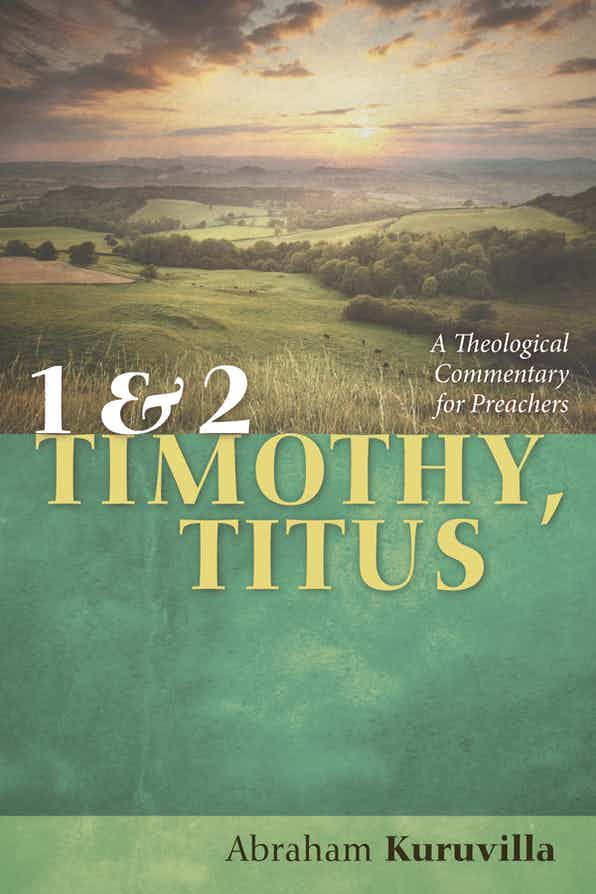
Review: Kuruvilla, 1 & 2 Timothy, Titus: A Theological Commentary for Preachers

Abraham Kuruvilla, who taught homiletics at Dallas Theological Seminary for some years and has recently taken a position as Professor of Christian Preaching at the Southern Baptist Theological Seminary, has added to his burgeoning collection of “theological commentaries for preachers” with a volume on the Pastorals.

Paul S. Jeon, Lecturer in NT at Reformed Theological Seminary and senior pastor at NewCity Church in Vienna, VA, has provided a review, which is exclusive to this blog and may be accessed here.

The Pastorals in NTA 65.1

The current issue of New Testament Abstracts lists the following entries which substantively engage the Letters to Timothy and Titus:

226. Hoag, Gary G. “Demystifying Gender Issues in 1 Timothy 2:9–15, with Help from Artemis.” Evangelical Review of Theology 44.3 (2020): 242–49.

227. Kidson, Lyn. “Fasting, Bodily Care, and the Widows of 1 Timothy 5:3–15.” Early Christianity 11.2 (2020): 191–205.

(p. 120) Theobald, Michael. “Von ‘Menchlichen Satzungen’ (Jes 29,13) Befreit: Eine nachpaulinische Tradition (Kol 2,20–23; Tit 1,14f) im Licht von Jesus-Worden (Mk 7).” Pages 95–120 in Bestimmte Freiheit: Festschrift für Christof Landmesser zum 60. Geburtstag. Edited by Martin Bauspieß, Johannes U. Beck, and Friederike Portenhauser. Arbeiten zur Bibel und ihrer Geschichte. Leipzig: Evangelische Verlagsanstalt, 2020.

(pp. 120–21) Wall, Robert W., and W. D. Shiell. Introduction and commentary for 1-2 Timothy in Baylor Annotated Study Bible: New Revised Standard Version. Edited by W. H. Bellinger and T. D. Still. Waco, TX: Baylor University Press, 2019.

(pp. 120-21) Wall, Robert W., and D. Brooks. Introduction and commentary for Titus in Baylor Annotated Study Bible: New Revised Standard Version. Edited by W. H. Bellinger and T. D. Still. Waco, TX: Baylor University Press, 2019.

(p. 132) Dettwiler, Andreas. “Pastoral Epistles.” Pages 19–26 in The Reception of Jesus in the First Three Centuries, vol. 2: From Thomas to Tatian: Christian Literary Receptions of Jesus in the Second and Third Centuries CE. Edited by Jens Schröter and Christine Jacobi. New York: Bloomsbury T&T Clark, 2020.

(pp. 141–42) Kidson, Lyn M. Persuading Shipwrecked Men: Rhetorical Strategies in 1 Timothy. Wissenschaftliche Untersuchungen zum Neuen Testament 2/526. Tübingen: Mohr Siebeck, 2020.

« Older posts Newer posts »

© 2026 Pastoral Epistles

Theme by Anders NorenUp ↑