Page 6 of 49

Percival, “The Plan of Salvation in the Letters to Timothy and Titus”

John Percival has finished up his Cambridge PhD thesis on the Pastorals, and researchers in the Pastorals will want to engage his work in their own where they can. Because of the nature of the project, it will be germane to other research done throughout all three letters. This is true not only for the thesis’s main area of investigation, the plan of salvation, but also in the way it examines distinctions among the three letters.

Here’s the abstract:

“The New Testament letters to Timothy and Titus (LTT) are often lumped together as ‘The Pastoral Epistles.’ While there are understandable reasons for this approach, it has meant that the distinctive contribution of each of the three letters has not been sufficiently considered. Furthermore, narrative approaches to the Pauline letters have led to fruitful explorations of their theology, especially from a salvation-historical perspective, but these approaches have not been applied to the LTT, at least in part due to their marginal status in the conversation. Taken together, this has impoverished our understanding of the theology and purpose of the LTT.
“Therefore, this thesis employs a narrative approach to examine the salvation-historical outlook of each of the LTT. This is accomplished by adopting minimal assumptions about authorship and reviewing each letter in turn, describing the components of a narrative ‘plan of salvation.’ The relationship between the elements of the plan is examined so as to shed light on the narrative world, theology and, especially, the rhetorical purpose of the letter. For such short letters, there is a wealth of data and clear differences between the three. Thus we are able to identify areas where the letters have been misrepresented or misunderstood in scholarly literature, offering a fresh and creative contribution to scholarship on the LTT. The outcome is a clearer understanding of the distinctive contribution of each letter, particularly in terms of the plan of salvation as conceived from a narrative perspective.”

For more information, see this Cambridge repository page.
Aich, “Allusive Echoes Between Jeremiah 36 LXX and 1 Timothy 2:1–2”

Benjamin Aich has produced an article which will be of interest to researchers in 1 Timothy, especially those who are interested in the use of the OT in the Pastorals.

Benjamin Aich. “Allusive Echoes Between Jeremiah 36 LXX and 1 Timothy 2:1–2: An Inner-Biblical Study.” Restoration Quarterly 65.1 (2023): 1–15.

“Since Thomas Aquinas, many commentators on the Pastoral Epistles have noted some sort of echo or allusion to Jer 29:7 (36:7 LXX) in the paraenesis of 1 Tim 2:1–2 . But before Aquinas, Augustine brought the literary, theological, and exilic context of Jer 36 LXX to bear on his discussion of 1 Tim 2:1–2 (Catech. 21.37; cf. Faust. 12.36). Exploring such features, as Augustine did, is only the natural result of noting a reference or an allusion to one verse in a specific context. However, Augustine’s example of broad engagement has been severely neglected. Combating this trend, I investigate the allusion to Jer 36:7 LXX in 1 Tim 2:1–2 in order to understand the broader interplay between the texts, so that students, scholars, and clergy would grasp how Jer 36 LXX might serve and illumine 1 Timothy’s discourse.”

Aich has made his article available at his Academia page.

Kidson, “Naming 1 Timothy 3.16b”

Lyn Kidson has added to the considerable amount of secondary literature on 1 Timothy 3:16:

Lyn Kidson, “Naming 1 Timothy 3:16b: A ‘Hymn’ by Another Name?” New Testament Studies 69.1 (2023): 46–56. https://doi.org/10.1017/S002868852200025X

Abstract: Most scholars assume that 1 Timothy 3.16b is a hymn, or a fragment of a hymn, belonging to another context. However, Furley (1995) points out that even the ancients had difficulty categorising their poetic materials. 1 Timothy 3.16b has no metre and neither praises God nor asks him for benefits, which are the usual indicators of a hymn. This article argues that 1 Timothy 3.16b was written by the writer for insertion into the letter, and it was intended to be used in his congregation as a bulwark (1 Tim 3.15) against his opponents. 1 Timothy 3.16b more closely resembles an epigram, normally written to accompany an epiphany of a god.

For earlier literature on 1 Timothy 3:16, see this earlier post.

The Pastorals in New Testament Abstracts 66.2

The following items listed in New Testament Abstracts 66.2 (2022) may be of interest to Pastorals scholars.

615. L’ubomir Majtán, “Motívy obriezky Timoteja v Sk 16,1–5: Historický, etnický, a náboženský aspekt obriezky Timoteja v Skutkoch apoštolov a teologická interpretácia z pohl’adu spoločenstva prvotnej Cirkvi (Motives of Circumcision of Timothy in Acts 16:1–5: Historical, Ethnical and Religious Aspects of the Circumcision of Timothy in the Acts of the Apostles and the Theological Interpretation from the Perspective of the Early Church Community).” Studia Biblica Slovaca (Bratislava) 13.1 (2021): 74–94.

673. Michel Gourgues, “‘…Lui qui veut que tous soient sauvés et arrivent à la connaissance de la vérité’ (1 Tm 2,4). Quelle vérité?” Science et Esprit 73.1­–2 (2021): 65–77.

674. Adam Booth, “Paul among the Physicians: 1 Tim 2:15 and Salvation in a Context of Contested Health Claims.” Revue Biblique 128.4 (2021): 593–608.

675. Christian Schramm, “Der ‘Mantel des Paulus’ (2 Tim 4,13): vergessen, zurückgelassen, deponiert? Eine Notiz mit Autorisierungspotenzial.” Biblische Zeitschrift 65.1 (2021): 86–110.

676. John G. Cook. “Titus 1,12: Epimenides, Ancient Christian Scholars, Zeus’s Death, and the Cretan Paradox.” Zeitschrift für Antikes Christentum / Journal of Ancient Christianity 25.3 (2021): 367–94. https://doi.org/10.1515/zac-2021-0032

712. Ricardo Sanjurjo Otero, “El origen del término πρεσβύτερος, entre Pablo y la tercera generación Cristiana.” Estudios Biblicos 79.3 (2021): 469–95.

791. Perkins, Larry J., and Spencer Elliott. “The Use of οἰκία/οἶκος in Greek Exodus: An Attempt to Understand Principles of Lexical Variation in Greek Exodus.” Journal of Septuagint and Cognate Studies 54 (2021): 111–27. [Perkins wrote the BHGNT volume on the Pastorals, and the variation of οἰκία/οἶκος is relevant to the Pastorals]

(p. 284) Peter Wick and Daniel Klinkmann, Bibelkunde des Neuen Testaments. 2nd ed. Stuttgart: Kohlhammer, 2020. [note the treatments of the Pastorals, pp. 73–79, as well as the “Exkurs zu Timotheus und Titus,” pp. 79–81, on the identity of Timothy and Titus]

(p. 302) Mark J. Keown, Discovering the New Testament: An Introduction to Its Background, Theology, and Themes, vol. 2: The Pauline Letters. Bellingham, WA: Lexham, 2021. [treatment of the Pastorals as a group, pp. 331–51]

(p. 303) Kathy Ehrensperger, “Διδάσκαλος ἐθνῶν—Pauline Trajectories According to 1 Timothy.”  Pages 88–104 in The Early Reception of Paul the Second Temple Jew: Text, Narrative and Reception History. Edited by Isaac W. Oliver and Gabriele Boccaccini with Joshua Scott. Library of Second Temple Studies 92. London: Bloomsbury T&T Clark, 2020.

(p. 307) Andrea Taschl-Erber, “Gottesbilder in den Deuteropaulinen: Metaphernrezeption im Kontext von Bildfeldtraditionen.” Pages 187–216 in Gottes-Bilder: Zur Metaphorik biblischer Gottesrede. Beiträge zur Wissenschaft vom Alten und Neuen Testament 232. Stuttgart: Kohlhammer, 2022.

(p. 308) Seth M. Ehorn, “Exodus in the Disputed Pauline Letters.” In Exodus in the New Testament. Edited by Seth M. Ehorn. Library of New Testament Studies. London: Bloomsbury T&T Clark, 2022.

(p. 309) Siker, Jeffrey, Sin in the New Testament. Essentials of Biblical Studies. Oxford: Oxford University Press, 2019. [pp. 137–38 on the Pastorals.]

(p. 316) Allan T. Georgia, Gaming Greekness: Cultural Agonism among Christians and Jews in the Roman Empire. Gorgias Studies in Early Christianity and Patristics 76. Piscataway, NJ: Gorgias, 2020. [note section 2 in chap. 3, “The Evolution of ἀγῶνες in the Pauline Tradition,” esp. “Venues of Competition in the Pastoral Epistles,” pp. 121–29; and section 3 in chap. 3, “Paul and the Critique of Magic and Popular Cult Practices in the Acts of the Apostles and the Pastoral Epistles,” esp. “Characterizing Paul’s Adversaries in the Pastoral Epistles,” pp. 143–149]

Καλός/καλῶς in the Pastorals

“Good is a major theme in the PE.” (Mounce, Pastoral Epistles, 33.)

Without considering ἀγαθός for the moment, note that καλός/καλῶς are found in 1 Tim 16x/4x; 2 Tim 3x/0x; Titus 4x/0x (note also καλοδιδάσκαλος, Titus 2:3).

See focused discussion of καλός and/or καλῶς in the Pastorals in Roberto Amici, “Principi e norme di non estraneità al mondo nelle lettere a Timoteo e a Tito,” EstBib 67.3 (2009): 447–56; Rüdiger Fuchs, “Bisher unbeachtet—zum unterschiedlichen Gebrauch von ἀγαθός, καλός, und καλῶς in den Schreiben an Timotheus und Titus,” EuroJTh 15 (2006): 15–33; W. Grundmann, “καλός,” TDNT 3:549–50; Lock, Pastoral Epistles, 22–23; Marcheselli-Casale, Le Lettere Pastorali, 393–95; Marshall, Pastoral Epistles, 227–29; Jerome D. Quinn, The Letter to Titus, AB 35 (New York: Doubleday, 1990), 175–76; Pietro Rossano, “L’ideale del bello (Καλός) nell’etica di S. Paolo,” in Studiorum Paulinorum Congressus internationalis catholicus 1961, AnBib 18 (Rome: Pontificio Istituto Biblico, 1963), esp. 377–81; M. Silva, “καλός, κτλ.,” NIDNTTE 2:610; Spicq, Les épîtres pastorales, 676–84; J. Wanke, “καλός,” EDNT 2:245.

Padilla, The Pastoral Epistles (TNTC)

The well-known TNTC series — Tyndale New Testament Commentaries — is releasing a new commentary on the Pastoral Epistles by Osvaldo Padilla.

The new volume replaces a former treatment of the letters by Donald Guthrie (1916–1992), who mounted a robust defense of Pauline authorship in his 1957 TNTC volume (2nd ed., 1990), one of the first in the series. Guthrie was not a prolific author of Pastorals literature, but well-known for what he did write in that vein. Pertinent works included The Pastorals and the Mind of Paul (London: Tyndale, 1955); “The Development of the Idea of Canonical Pseudepigrapha in New Testament Criticism,” Vox Evangelica 1 (1962): 43–59; and his treatment of the letters in his well-known New Testament Introduction, published and revised in various editions from the 1960s to the final 4th edition in 1990. He also contributed articles on the Pastorals to the New Bible Dictionary. His New Testament Theology thoroughly incorporates the Pastorals as Pauline, but is structured such that there is little in the way of distinct treatment of the letters.

I will formally review Padilla’s volume in the future, but will simply note here its release. Osvaldo Padilla is professor of divinity at Beeson Divinity School. The Pastoral Epistles is “the first time I have written in the ‘genre’ of the commentary” (ix), although he has published The Acts of the Apostles: Interpretation, History and Theology (Downers Grove, IL: IVP Academic, 2016). From my initial glance through the volume, he writes as a defender of the letters’ authenticity, as would be expected in the TNTC series (1–16), and as an egalitarian (cf. 97–98). Highlighting these points is not meant to minimize other aspects of the volume, simply to to note two areas that are often of significant interest in a Pastorals commentary. I am grateful to IVP for providing a review copy.

The Pastorals at SBL 2022

The 2022 SBL/AAR Annual Meeting program lists the following sessions which may be of interest to Pastorals researchers:

Margaret MacDonald, “Flexible Arrangements: Uncovering the Relationship between Space and Education in the Pastoral Epistles”

Victoria Perez Rivera, “Scripturalizing the Pastorals: Exegesis and Power”

Marion Ann Taylor, “Should Women Speak/Preach? Marie Dentière, Calvin, and Farel”

Anna C. Miller and Katherine A. Shaner, “Ensouled Tools and Social Death: Resisting Re-inscription of Aristotelian Natural Slavery in 1 Timothy”

Oluwarotimi Paul Adebayo, “A Socio-rhetorical Understanding of θεόπνευστος in 2 Timothy 3:16–17 in Its Contribution to Scripture Authority”

Judy Kim, “Who is the “Heretic” (Αἱρετικός) to be Shunned?: Origen’s Understanding of the Apostolic Injunction in Titus 3:10–11”

The Pastorals at ETS 2022

In the ETS Annual Meeting program, the Pastoral Epistles study group is absent for the first time in 11 years. However, several sessions at the annual meeting engage the Pastorals:

Courtney Veasey, “The Function of Καταστολή in 1 Tim 2:9 in the Identification of the Church as a Holy Community.”

David H. Warren, “Negation and Ellipsis in the Pastorals”

Hershel Wayne House, “Why Did Paul Forbid Women to Teach Men in the Church? (1 Timothy 2:11–15)”

Kidson, “Real Widows, Young Widows, and the Limits of Benefaction in 1 Timothy 5:3–16”

Lyn Kidson has produced another contribution to the discussion of widows in 1 Timothy 5. (See also her “Fasting, Bodily Care, and the Widows of 1 Timothy 5:3–15,” Early Christianity 11.2 (2020): 191–205 [DOI: 10.1628/ec-2020-0016])

Lyn Kidson, “Real Widows, Young Widows, and the Limits of Benefaction in 1 Timothy 5:3–16.” Australian Biblical Review 70 (2022): 83–100.

Abstract: John Barclay, in his 2020 article, “Household Networks and Early Christian Economics,” outlines the puzzles that “abound” in 1 Timothy 5:3–16. Among his list of puzzles, he asks, “Is it inconsistent to say that a χήρα can be registered only if she has brought up children (5.10), but to deny her support in 5:4–8 if she has children to look after? Who are the younger χῆραι that the Pastor is evidently so anxious about (5:11–15) …?” Barclay’s article has gone a long way to resolving these puzzles. The “younger χῆραι” he identifies as “virgins.” This was an anomaly in the social world of the early Christians, which forced them to adapt terms for the woman beyond puberty but was without a man. This was a χήρα. While in agreement with Barclay, this article probes a little more deeply into the problem of the younger χήρα and her dowry. It makes the proposal that if the younger χήρα is a virgin, then the issue in 1 Timothy 5 is not her ongoing support, which seems manageable for the “real widow,” but the support for the virgin who wishes to marry after she has been assigned as a qualifying χήρα.

Baum, “Saving Wealthy Ephesian Women from a Self-Centered Way of Life (1 Tim 2:15)”

A essay on the crux of 1 Tim 2:15 in a festschrift honoring Rob van Houwelingen on the occasion of his retirement:

Armin Baum, “Saving Wealthy Ephesian Women from a Self-Centered Way of Life (1 Tim 2:15): Salvation by Childbearing in the Context of Ancient Arguments against Sexual Intercourse, Pregnancy, and Child-rearing,” in Troubling Texts in the New Testament: Essays in Honour of Rob van Houwelingen, Contributions to Exegesis and Theology (Leuven: Peeters, 2022), 257–83.

Abstract: “Many Bible readers regard the statement in 1 Timothy 2: 15 (“She will be saved through childbearing … “) as very unfair. Why did Paul (or one of his disciples) lose sight of gender equality? And is this passage not irreconcilable with passages such as Galatians 3:28, where Paul advocated the soteriological equality of the sexes, and with 1 Corinthians 7:8, where Paul encouraged unmarried women and widows to remain single? 1 Timothy 2: 15 confronts us with two exegetical challenges. First, its telegraphic style was probably quite comprehensible for Paul’s protege Timothy; but for us who are much less familiar with Paul’s thoughts, it.is much more difficult to decipher. Secondly, while for Paul, Timothy and the women concerned the concrete situation in the church of Ephesus was crystal clear, for us who are not involved and look at it from a distance of 2000 years it is anything but easy to figure out what exactly Paul was talking about. But read against its literary and historical context, l Timothy 2:15 is not a misogynistic text but rather a statement against luxury-oriented selfishness which is in conflict with the law of love.”

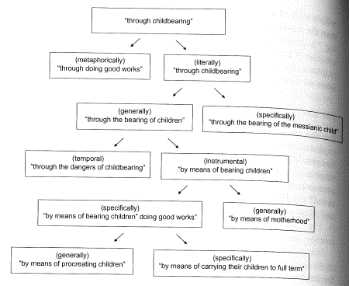
Helpful in this essay is a taxonomy of views regarding τεκνογονία in 2:15 (p. 260):

Baum’s final interpretive translation reveals his take on the passage: “(The luxury-minded) women (in the church of Ephesus) will be saved (from their spiritually dangerous self-centered lifestyle) by bearing children (and thereby accepting the maternal role) and by holding fast to (the basic Christian virtues of) faith, love, holiness and (particularly) chastity” (p. 280).

« Older posts Newer posts »

© 2026 Pastoral Epistles

Theme by Anders Noren — Up ↑