
Page 11 of 49

Merkle, “The Authority of Deacons in Pauline Churches”

Benjamin L. Merkle has made another contribution to the literature on the Pastorals:

Merkle, Benjamin L. “The Authority of Deacons in Pauline Churches.” Journal of the Evangelical Theological Society 64.2 (2021): 309–25.

Abstract: The New Testament office of deacon is disputed primarily because of the paucity of information. Consequently, many look to the following in order to determine the role of deacons in the church: (1) the lexical meaning of διάκονος and its cognates (διακονέω and διακονία); (2) the function of the Seven in Acts 6:1–6; and (3) the qualifications for deacons in 1 Timothy 3:8–13. Additionally, one’s view of the role of women in ministry can influence how one perceives the function and authority of deacons. This essay argues that deacons held an official and authoritative, yet nonessential and subordinate, position in the Pauline churches. I support this thesis by considering: (1) the official title of deacons; (2) the official function of deacons; (3) the official qualifications of deacons; and (4) the official period of testing and honorable standing of deacons.

I took a class on the Greek text of the Pastorals with Dr. Merkle and benefitted greatly from it. I’m thankful for his commitment to thinking through issues in these letters and publishing the results for the benefit of both church and academy, as well as his work behind the scenes in the ETS Pastorals study group. Other publications of his on the Pastorals include:

“Are the Qualifications for Elders or Overseers Negotiable?” Bibliotheca Sacra 171.682 (2014): 172–88.

“Ecclesiology in the Pastoral Epistles.” Pages 173–98 in Entrusted with the Gospel: Paul’s Theology in the Pastoral Epistles. Edited by Andreas J. Köstenberger and Terry L. Wilder. Nashville: B&H Academic, 2010.

The Elder and Overseer: One Office in the Early Church. Studies in Biblical Literature 57. New York: Lang, 2003.

“Hierarchy in the Church? Instruction from the Pastoral Epistles regarding Elders and Overseers.” The Southern Baptist Journal of Theology 7 (2003): 32–43. Reprinted as “Hierarchy in the Church? Instruction from the Pastoral Epistles concerning Elders and Overseers.” Journal for Baptist Theology and Ministry 2.1 (2004): 45–62.

“Paul’s Arguments from Creation in 1 Corinthians 11:8–9 and 1 Timothy 2:13–14: An Apparent Inconsistency Answered.” Journal of the Evangelical Theological Society 49 (2006): 527–48.
Zamfir, “‘Beware of Him, for He Strongly Opposed Our Message’: Antagonisms and Identity Construction in 2 Timothy”

As part of an edited Brill volume, Korinna Zamfir has produced an essay on the opponents in 2 Timothy:

Korinna Zamfir. “‘Beware of Him, for He Strongly Opposed Our Message’: Antagonisms and Identity Construction in 2 Timothy.” Pages 162–73 in Antagonismen in neutestamentlichen Schriften Studien zur Neuformulierung der ‘Gegnerfrage’ jenseits des Historismus.” Edited by Stefan Alkier. Beyond Historicism – New Testament Studies Today 1. Leiden: Brill, 2021.

White, “Establishing Traditions: Discipline and Expulsion in the Pastoral Epistles”

In a new monograph on Paul and what is often referred to as church discipline, Adam White includes a chapter on the Pastorals:

Adam G. White. Paul, Community, and Discipline: Establishing Boundaries and Dealing with the Disorderly. Paul in Critical Context. Minneapolis: Lexington/Fortress Academic, 2021. [note the chapter “Establishing Traditions: Discipline and Expulsion in the Pastoral Epistles,” pp. 217–32]

The volume introduction notes that “the PE reveals something of a later formalisation of the practices revealed in the undisputed letters.” White reads the Pastorals as pseudonymous, approaching them as three letters by a single author. Naturally, given the topic, he focuses on 1 Timothy and Titus. Section headings include “Dealing with Unruly Widows,” “Dealing with Unruly Elders,” and “Dealing with False Teachers in Crete.”

Final Session of ETS Study Group

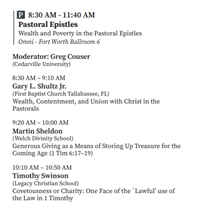
This week we will hold the final meeting of our Pastoral Epistles Study Group at ETS. We have not sought renewal for the group, but may look to restart the group in a couple of years. We have had a profitable decade of studying these important letters together.

If you are coming to ETS, join us for our session on Wednesday at 8:30. The only change to our published schedule is that Greg Couser will not be able to attend, so we have had to cancel his paper and I will moderate the session. We hope to see you in Fort Worth.

Image

Simmons, “The Holy Spirit in the Pastorals”

Those interested in pneumatology in the Pastorals will be interested in a chapter in a recent volume:

Simmons, William A. The Holy Spirit in the New Testament: A Pentecostal Guide. Downers Grove, IL: IVP Academic, 2021. [note chap. 13: “The Holy Spirit in the Pastoral Epistles: The Spirit of Power, Love and Self-Control,” pp. 161–72]

Zamfir and Theobald: Two Essays on Dating the Pastorals

A just-published WUNT volume contains two essays on dating the Pastoral Epistles:

Korinna Zamfir, “Something Old, Something New, Something Borrowed: Dating the Pastoral Epistles.” Pages 313–54 in Die Datierung neutestamentlicher Pseudepigraphen: Herausforderungen und neuere Lösungsansätze. Edited by Wolfgang Grünstäudl and Karl Matthias Schmidt. Wissenschaftliche Untersuchungen zum Neuen Testament 470. Tübingen: Mohr Siebeck, 2021.

Michael Theobald, “Zur Datierung der Pastoralbriefe: Parameter zur Ausmessung ihres Entstehungskorridors.” Pages 355–84 in Die Datierung neutestamentlicher Pseudepigraphen: Herausforderungen und neuere Lösungsansätze. Edited by Wolfgang Grünstäudl and Karl Matthias Schmidt. Wissenschaftliche Untersuchungen zum Neuen Testament 470. Tübingen: Mohr Siebeck, 2021.

Archer, “Was the Spirit Poured out on Women to Remain Silent in the Church? Reading 1 Corinthians 14.34–35 and 1 Timothy 2.11–15 in the Light of Pentecost”

The voluminous literature addressing 1 Timothy 2:11-15 has been supplemented by a new essay:

Archer, Melissa. “Was the Spirit Poured out on Women to Remain Silent in the Church? Reading 1 Corinthians 14.34–35 and 1 Timothy 2.11–15 in the Light of Pentecost.” Pages 123–34 in Grieving, Brooding, and Transforming: The Spirit, The Bible, and Gender. Journal of Pentecostal Theology Supplement Series 46. Edited by Cheryl Bridges Johns and Lisa P. Stephenson. Leiden: Brill, 2021.

Moo on the Pastorals in A Theology of Paul and His Letters

Doug Moo has now published his important volume on Pauline theology in the Biblical Theology of the New Testament series:

Douglas J. Moo. A Theology of Paul and His Letters: The Gift of the New Realm in Christ. Biblical Theology of the New Testament. Grand Rapids: Zondervan, 2021.

After two introductory chapters, Moo examines the theology of Paul’s letters one by one before addressing Paul’s theology from a biblical theological standpoint. Each of the Pastorals receives its own individual treatment (1 Timothy, 316–34; Titus, 335–39; 2 Timothy, 340–44). As well, since Moo accepts the Pastorals as authentically Pauline, he incorporates them into his larger Pauline theology.

Manomi, Virtue Ethics in Titus

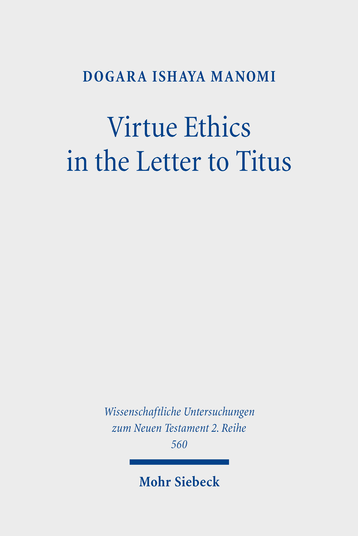
The first of two WUNT volumes on ethics in Titus expected this year and next is now available. Both are part of WUNT’s Context and Norms of New Testament Ethics series. The volume of the proceedings of the 2019 “Ethics in Titus” conference held at Johannes Gutenberg University in Mainz, Germany, is still forthcoming. Just published, however, is a recent dissertation by Dogara Manomi. The two volumes are not formally related — they are not a two-part publication — but Manomi is integrally involved in both.

Dogara Ishaya Manomi. Virtue Ethics in the Letter to Titus: An Interdisciplinary Study. Kontexte und Normen neutestamentlicher Ethik / Contexts and Norms of New Testament Ethics 12. Wissenschaftliche Untersuchungen zum Neuen Testament 2/560. Tübingen: Mohr Siebeck, 2021. [Mohr Siebeck’s German title is more descriptive: Tugendethik im Brief an Titus: Eine interdisziplinäre Interaktion von biblischer Ethik und Tugendethik mit hermeneutischen Reflexionen aus der Perspektive der afrikanischen Ethik]

Manomi is currently a full-time lecturer at the Theological College of Northern Nigeria located in Jos, Plateau state, Nigeria, an Affliated Researcher of the Evangelische Theologische Faculteit, Leuven, Belgium, and a Research Associate of the University of Pretoria, South Africa.

I had not known much about virtue ethics before I read Manomi’s monograph, but his helpful survey of the topic (before bringing it to bear upon the Epistle to Titus) brought me up to speed. I provide here the publisher summary of the volume and major headings:

“Dogara Ishaya Manomi analyzes and identifes the characteristics of (neo-)Aristotelian virtue ethics that are implicitly and explicitly embedded in the linguistic elements, theological motifs, and ethical norms in the letter to Titus. He argues that (neo-)Aristotelian virtue ethics and the ethical perspectives of Titus share the following features: a sense of a moral telos that leads to human flourishing; emphasis on character, habits, and inner dispositions; focus on the morality of persons more than the morality of actions; commitment to moral perfectionism; particularity of moral agents; the concept of moral exemplar; a concern for character development through training or moral education; and a consideration of the moral significance of community. The author concludes, therefore, that there is a significant correlation between (neo-)Aristotelian
virtues ethics and the ethical perspectives of the letter to Titus, to the extent that the letter to Titus can be described as a virtue-ethical text. Moreover, his research concludes that the virtue-ethical perspectives of Titus, in comparison with African
ethics, have foundational and narrative differences, yet they share some important similarities. However, through progressive hermeneutical negotiations, concessions, appropriations, and application between the two virtue-ethical perspectives, there emerges a new virtue-ethical horizon described as ‘African Biblical Virtue Ethics,’ which is, as accountable as possible, faithful to the virtue-ethical perspectives of Titus and ‘at home’ to African Christian ethics.
This study was awarded the prestigious Johannes Gutenberg Dissertation Prize.”

I. Description of Contents and Methodology
II. History of Interpretation of the Selected Virtues in Titus
III. A Virtue-Ethical Reading of the Letter to Titus
IV. Appropriating the Virtue-Ethical Perspective of Titus
into African Ethics: Hermeneutical, Contextual, and Ethnological
Reflections
V. Summary and Conclusion

Reinhardt, “‘God, Who Giveth Us Richly’: Wealth, Authorship, and Audience in 1 Timothy 6”

A recent article engages the topic of wealth in the context of the Pastorals, a topic which happens to be pertinent to the upcoming presentations in the ETS Pastorals study group.

Jackson Reinhardt. “‘God, Who Giveth Us Richly’: Wealth, Authorship, and Audience in 1 Timothy 6.” Journal of the Oxford Graduate Theological Society 2.1 (2021): 101–14.

Abstract: “While prior biblical scholarship has firmly rejected the Pauline authorship of the Pastoral Epistles (1–2 Timothy and Titus), rarely has analysis focused on socio-economic context. I argue that examining the economic conditions and theology of 1 Timothy provides additional reasons to rejects the letter’s authenticity. While Paul’s audience was primarily impoverished urbanites, the author of 1 Timothy (i.e., the Pastor) was writing to a prosperous congregation who needed instruction on the proper handling of their wealth. Paul’s theology of wealth, in turn, reflects the context of his audience: he supported inter-ecclesial programs of mutual interdependence and a rejection of the prevailing modes of economic exploitation that existed in first-century Palestine. The Pastor does not promote any similar alternative economy among believers. He contends that wealthy believers should be charitable so as to build up a heavenly treasure and secure posthumous favor.”

A PDF of the article is freely available here.

« Older posts Newer posts »

© 2026 Pastoral Epistles

Theme by Anders Noren — Up ↑