
Page 12 of 49

Towner, “Resonance, Dissonance, Resistance and 1 Timothy 2.8–15”

Phil Towner has added an essay to the voluminous literature on 1 Tim 2:8–15:

Philip H. Towner. “Resonance, Dissonance, Resistance and 1 Timothy 2.8–15: The Eschatological Obsolescence and ‘Rewriting’ of a Proscriptive Text.” Między Oryginałem a Przekładem 53.3 (2021): 67–84.

A PDF of the article (which is in English) may be obtained at https://journals.akademicka.pl/moap/article/view/3861 .

The article is a reworked version of Towner’s 2010 ETS presentation of nearly the same title. According to the introductory article in the journal, the essay was presented “in the Workshop on Contemporary Theory and Practice of Bible Translation, an interconfessional seminar which takes place at the Pontifical Urbaniana University at the beginning of every academic year.”

Abstract: “This study asks whether translation might be a valid mode of (literary)
criticism. It approaches a hortatory biblical text (1 Timothy 2.8-14 [3.1a]),
somewhat notoriously and rigidly applied in some quarters of the church
as containing timeless ethical instruction concerning women in the church,
from the standpoint of its intertextual network, listening for resonance and
dissonance as the relevant intertexts and precursor texts are explored. It
is ultimately diagnosed as a text that is eschatologically obsolescent, and
translated/rewritten, on the basis of its intertextual composition, to reflect
the openness inscribed by the authorial Other.”
Machado, “‘Manifestado na carne’ (1Tm 3,16)”

Sidney Machado, of the Faculdades Claretianas in Brazil, and visiting professor at the Pontifical Ateneo Santo Anselmo in Rome, has added to the extensive literature on 1 Timothy 3:16 with a recent article in Revista Pistis Praxis.

Sidney Damasio Machado. “‘Manifestado na carne’ (1Tm 3,16): Considerações sobre a transmissão damensagem cristã na Igreja primitive // ‘Manifested in the flesh’ (1Tm 3,16): Considerations on the Transmission of the Christian Message in the Early Church.” Revista Pistis Praxis 13.2 (2021): 758–85. (full-text article available at https://doi.org/10.7213/2175-1838.13.02.DS05)

The article is in Portuguese, but the abstract in English will provide guidance:

Abstract: The theme of epiphany/vision unifies most religious and philosophical expressions in the early Greco-Roman world. The use of the expression “manifested in the flesh” (“ἐφανερωθη ἐν σαρκί” (1Tm 3,16)) in the Pastoral Letters [is indicative] of the efforts of early Christianity to dialogue with the culture and inculturate the content of the Christian faith in the Hellenistic environment. Seeing the commitment to inculturated evangelization in the early Church constitutes an incentive and a provocation in view of an inculturated evangelization.

Heringer, “Beginning with the End: 1 Timothy 1:3–6 and Formative Theological Education”

Researchers in the Pastorals may be interested in a new article on moral formation as an integral part of Christian higher education. This is, to my knowledge, the first article in the five-year-old Journal of Theological Interpretation specifically focusing on a passage from the Pastorals:

Seth Heringer. “Beginning with the End: 1 Timothy 1:3–6 and Formative Theological Education.” Journal of Theological Interpretation 15.2 (2021): 365–80. https://doi.org/10.5325/jtheointe.15.2.0365

Abstract: Institutions of Christian higher education are currently facing numerous and substantial challenges pressuring them to direct resources into training students in professional skills and away from religious and moral formation. Contrary to this prevailing movement, Joel Green has emphasized that Christian education should be orientated toward the church with the goal of forming students to love God with their whole being. This article will argue that Green’s position is rooted in 1 Tim 1:3–6, where Paul juxtaposes heterodox and orthodox instruction. Heterodox instruction seeks “myths” and “genealogies,” leading to worthless arguments and the destruction of relationships. Orthodox instruction teaches about God’s ordering of the world according to his plan as revealed in the gospel. The telos of orthodox instruction is love brought about by three penultimate ends: “a pure heart, a good conscience, and a sincere faith.” If these ends are to be sought by Christian institutions, then formative instruction is a biblically mandated, essential aim that must be sought through institution-wide efforts and measured like other educational outcomes.

Roberts, The Pastoral Epistles and the New Perspective on Paul

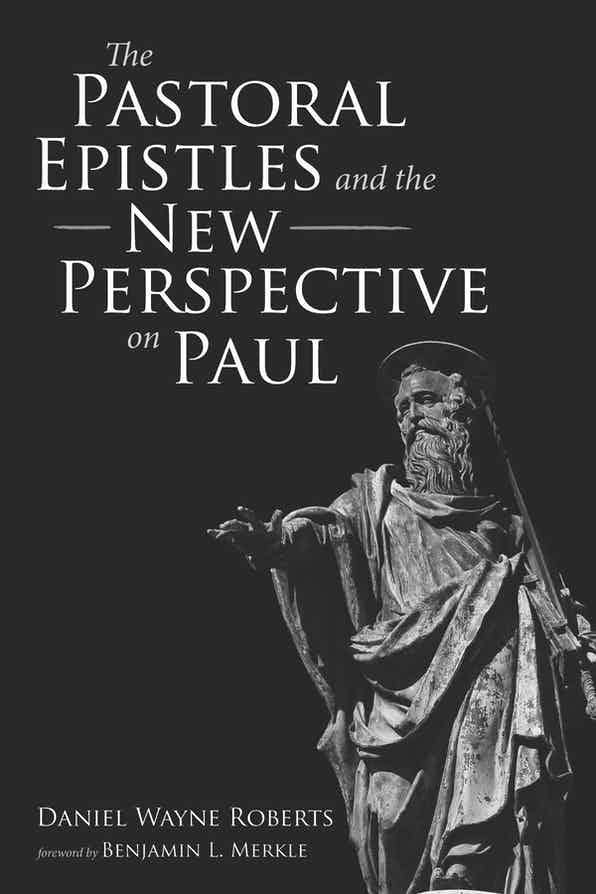
I’m very pleased to note a new publication on the Pastorals:

Daniel Wayne Roberts. The Pastoral Epistles and the New Perspective on Paul. Eugene, OR: Wipf & Stock, 2021.

This is a published version of Roberts’ dissertation completed at Southeastern Baptist Theological Seminary under the direction of Benjamin L. Merkle. I provide here the publisher summary and the major headings of the work:

The so-called “New Perspective on Paul” has become a provocative way of understanding Judaism as a pattern of religion characterized by “covenantal nomism,” which stands in contrast to the traditional, Lutheran position that argues that the Judaism against which Paul responded was “legalistic.” This “new perspective” of first-century Judaism has remarkably changed the landscape of Pauline studies, but it has done so in relative isolation from the Pastoral Epistles, which are considered by most critical scholarship to be pseudonymous. Because of this lack of interaction with the Pastoral Epistles this study seeks to test the hermeneutic of the New Perspective on Paul from a canonical perspective. This study is not a polemic against the New Perspective on Paul, but an attempt to test its hermeneutic within the Pastoral Epistles. Four basic tenets of the New Perspective on Paul, taken from the writings of E. P. Sanders, N. T. Wright, and James D. G. Dunn, are identified and utilized to choose the passages in the Pastoral Epistles to be studied to test the New Perspective’s hermeneutic outside “undisputed” Paul. The four tenets are as follows: Justification/Salvation, Law and Works, Paul’s View of Judaism, and the Opponents. Based on these tenets, the passages considered are 1 Tim 1:6-16; 2:3-7; 2 Tim 1:3, 8-12; and Titus 3:3-7.

1. The New Perspective on Paul and the Pastoral Epistles: Problem, Thesis, and Method
2. History of Research: The New Perspective on Paul and the Pastoral Epistles
3. Paul, the Law, and the “Chief of Sinners”: 1 Timothy 1:6–16; 2:3–7
4. “Not According to Works”: 2 Timothy 1:3, 8–12
5. Justified by Grace: Titus 3:3–7
6. Some Conclusions Regarding the New Perspective on Paul and the Pastoral Epistles

The Pastorals at SBL 2021

The schedule for the SBL 2021 Annual Meeting in San Antonio is now available. The following sessions should be of interest to specialists in the Pastorals. Click here to read abstracts of these presentations.

Carson Bay, University of Bern
“To Instruct, to Rebuke, to Correct”: 2 Timothy 3:16, Josephus Against Apion 1.3, and Hellenistic Apologetic between Christian Epistolography and Jewish Historiography

Greg Beale, Reformed Theological Seminary
“Fight the Good Fight” in 1 Tim. 1:18

Brad Bitner, Westminster Seminary California
1 Timothy and the Confession Inscriptions of Asia Minor

David R. Edwards, Florida State University
“Taken Up in Glory”: Early Christian Traditions of the Ascension of Jesus in Light of 1 Tim. 3:16

Paul Robertson, University of New Hampshire
Cluster Mapping Paul’s Letters: Grouping and Identifying the Location of Stylistic Similarities

Jonathan Sanchez, University of Notre Dame
Making an Example: The Rhetorical Usefulness of Timothy in 1 Timothy

W. Andrew Smith, Shepherds Theological Seminary
Progress towards the ECM of the Pastoral Epistles

Angela Standhartinger, University of Marburg, Germany
Duties of Age: Old Women in the Pastoral Epistles in Context

Adam White, Alphacrucis College
Setting the Boundaries: Reading 1 Timothy and Titus as Community Charters

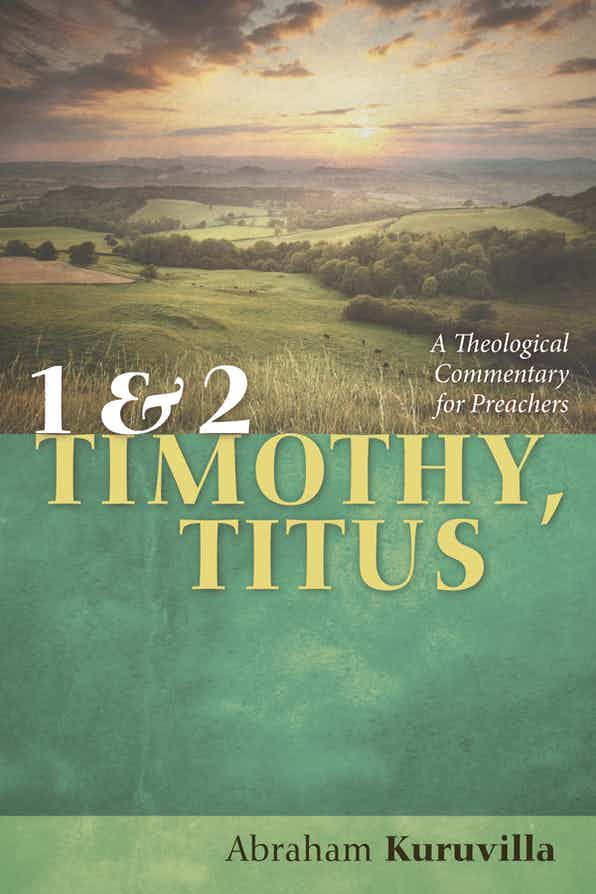
Review: Kuruvilla, 1 & 2 Timothy, Titus: A Theological Commentary for Preachers

Abraham Kuruvilla, who taught homiletics at Dallas Theological Seminary for some years and has recently taken a position as Professor of Christian Preaching at the Southern Baptist Theological Seminary, has added to his burgeoning collection of “theological commentaries for preachers” with a volume on the Pastorals.

Paul S. Jeon, Lecturer in NT at Reformed Theological Seminary and senior pastor at NewCity Church in Vienna, VA, has provided a review, which is exclusive to this blog and may be accessed here.

Torbus, “Oral Teachings of Old Women in 1 Timothy 4:7”

Sławomir Torbus is “a graduate of the Institute of Classical Philology and Ancient Culture at the University of Wroclaw.… He received his doctorate from the University of Wroclaw in 2004. He is currently an assistant professor in the Department of Hellenic Studies Institute of Classical Studies, Mediterranean and Oriental at the University of Wroclaw. He is a specialist in the history and theory of rhetoric and especially the analysis of the rhetoric of the New Testament.” (source)

He has a previous article on 1 Tim 4:7 in Polish (with an English-language abstract): “‘Baśnie starych kobiet’ w 1 Tm 4,7: Wokół interpretacji przymiotnika γραώδης [“‘Old Women’s Fables’ in 1 Tim. 4,7: Interpretations of the Adjective γραώδης”],” Theologica Wratislaviensia 10 (2015): 139–49. He has just published a second article (in English) which builds upon the first one:

Torbus, Sławomir. “Oral Teachings of Old Women in 1 Timothy 4:7.” Quaestiones Oralitatis 5 (2020): 133–43.

Abstract: “The paper attempts to consider the possibility that the expression γραώδεις μῦθοι used in 1 Timothy 4:7 might refer to oral teachings conveyed by older women in Ephesus. It can be observed that in the Pastoral Epistles, the word μῦθοι denotes false teachings which stand in sharp contrast with the truth contained in the written Scriptures. The context of 1 Timothy may suggest the possibility that older women could convey such oral teachings in the space of the οἶκος, which was a natural ecclesiastical environment of the earliest Christian church.”

Both articles are available at Academia.

Burnet, “Petit fait vrai et construction du personnage: Réflexions sur 2Tm 4,13”

We have not yet provided notice of a recent addition to the literature by Regis Burnet. The article engages the conversation on pseudepigrapha, focusing on the example of personalia in 2 Tim 4:13 and commenting on the prominent attention given to the φαιλόνης when the fathers discuss the passage.

Burnet, Régis. “Petit fait vrai et construction du personnage: Réflexions sur 2Tm 4,13.” Pages 331–42 in La contribution du discours a la caracterisation des personnages bibliques: Neuvieme colloque international due RRENAB, Louvain-la-Neuve, 31 mai – 2 juin 2018. Edited by André Wénin. Bibliotheca Ephemeridum Theologicarum Lovaniensium 311. Leuven: Peeters, 2020.

The essay is available on Academia.

The Pastorals in NTA 65.1

The current issue of New Testament Abstracts lists the following entries which substantively engage the Letters to Timothy and Titus:

226. Hoag, Gary G. “Demystifying Gender Issues in 1 Timothy 2:9–15, with Help from Artemis.” Evangelical Review of Theology 44.3 (2020): 242–49.

227. Kidson, Lyn. “Fasting, Bodily Care, and the Widows of 1 Timothy 5:3–15.” Early Christianity 11.2 (2020): 191–205.

(p. 120) Theobald, Michael. “Von ‘Menchlichen Satzungen’ (Jes 29,13) Befreit: Eine nachpaulinische Tradition (Kol 2,20–23; Tit 1,14f) im Licht von Jesus-Worden (Mk 7).” Pages 95–120 in Bestimmte Freiheit: Festschrift für Christof Landmesser zum 60. Geburtstag. Edited by Martin Bauspieß, Johannes U. Beck, and Friederike Portenhauser. Arbeiten zur Bibel und ihrer Geschichte. Leipzig: Evangelische Verlagsanstalt, 2020.

(pp. 120–21) Wall, Robert W., and W. D. Shiell. Introduction and commentary for 1-2 Timothy in Baylor Annotated Study Bible: New Revised Standard Version. Edited by W. H. Bellinger and T. D. Still. Waco, TX: Baylor University Press, 2019.

(pp. 120-21) Wall, Robert W., and D. Brooks. Introduction and commentary for Titus in Baylor Annotated Study Bible: New Revised Standard Version. Edited by W. H. Bellinger and T. D. Still. Waco, TX: Baylor University Press, 2019.

(p. 132) Dettwiler, Andreas. “Pastoral Epistles.” Pages 19–26 in The Reception of Jesus in the First Three Centuries, vol. 2: From Thomas to Tatian: Christian Literary Receptions of Jesus in the Second and Third Centuries CE. Edited by Jens Schröter and Christine Jacobi. New York: Bloomsbury T&T Clark, 2020.

(pp. 141–42) Kidson, Lyn M. Persuading Shipwrecked Men: Rhetorical Strategies in 1 Timothy. Wissenschaftliche Untersuchungen zum Neuen Testament 2/526. Tübingen: Mohr Siebeck, 2020.

Krauter, “Genderrollen in den Pastoralbriefen: ein Experiment mit verschiedenen Lesestrategien”

A recent article approaches the question of gender roles in the Pastorals by circumventing the corpus approach to reading the letters:

Krauter, Stefan. “Genderrollen in den Pastoralbriefen: ein Experiment mit verschiedenen Lesestrategien.” Theologische Literaturzeitung 146.5 (2021): 375–88.

Abstract: Most recent studies on gender in the Pastoral Epistles assume that all three letters were written by the same author and are forgeries. This leads to the fact that the statements of 1 Timothy about women dominate the interpretation. The article shows that the Pastoral Epistles can also be examined for gender issues using other models about their origin, namely as letters by different authors and as parts of a fictional collection of letters. Then the different profile of the statements of the three letters about women and men becomes clearer.

« Older posts Newer posts »

© 2026 Pastoral Epistles

Theme by Anders Noren — Up ↑