Tag: bibliography (Page 1 of 3)

Krauter, Die Pastoralbriefe

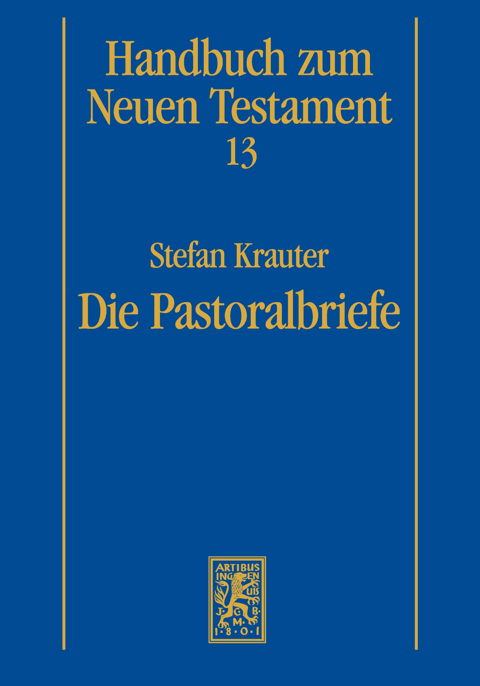
Stefan Krauter, Die Pastoralbriefe. Handbuch zum Neuen Testament 13. Tübingen: Mohr Siebeck, 2026. 

Stefan Krauter (PhD, University of Tübingen) serves as a professor of New Testament at the Univerisity of Zurich. His faculty page indicates that in addition to a research focus on the Pauline corpus, he devotes attention to the examination of the New Testament writings in their relationships to the Greek and Latin literature of the early imperial period and the interpretation of the Pauline letters in the 16th century.

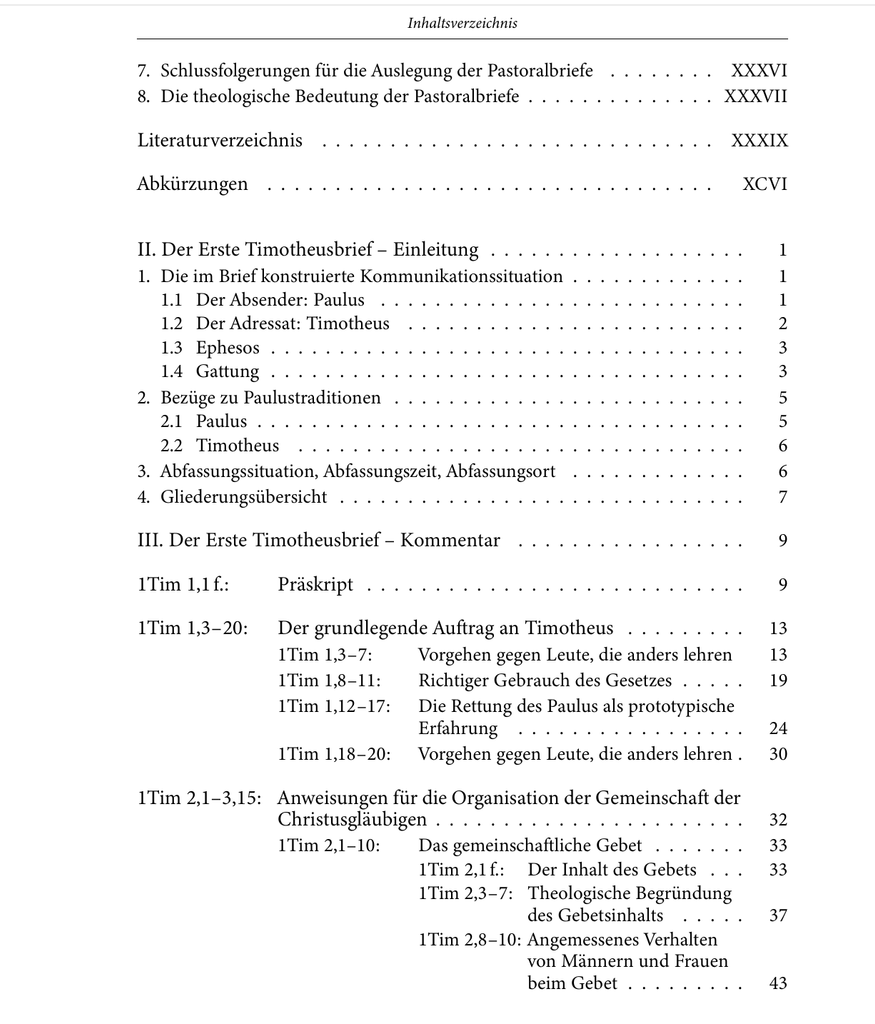
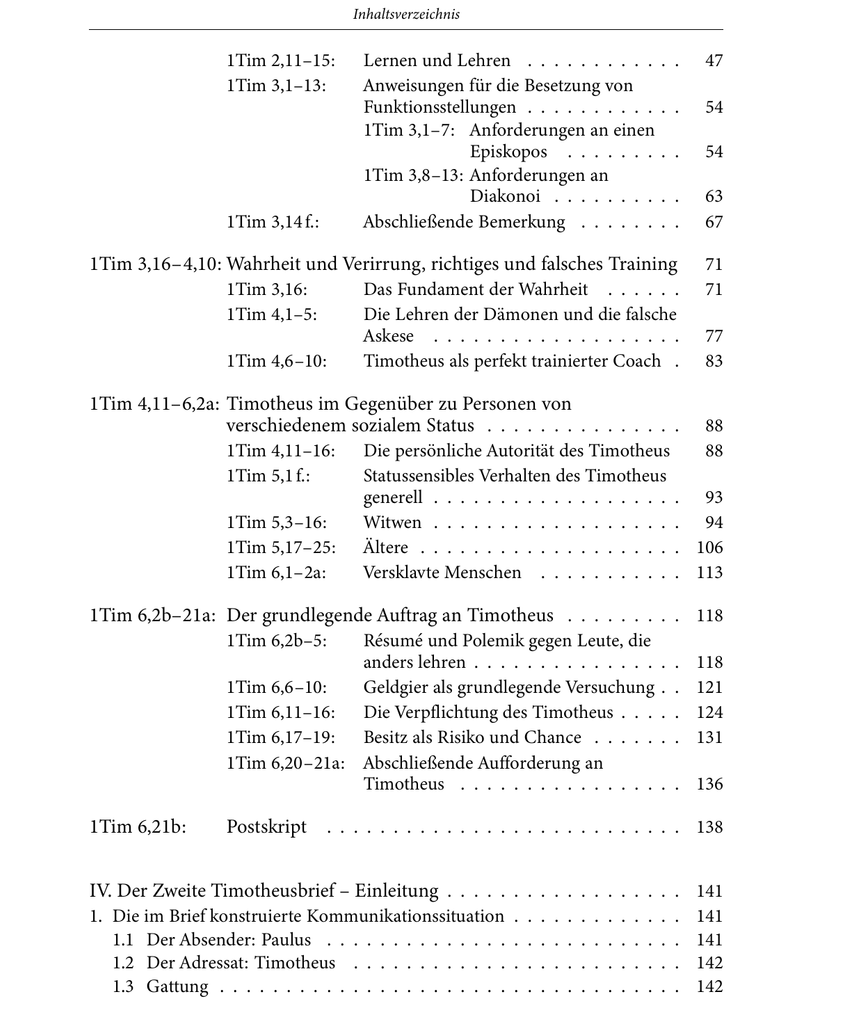
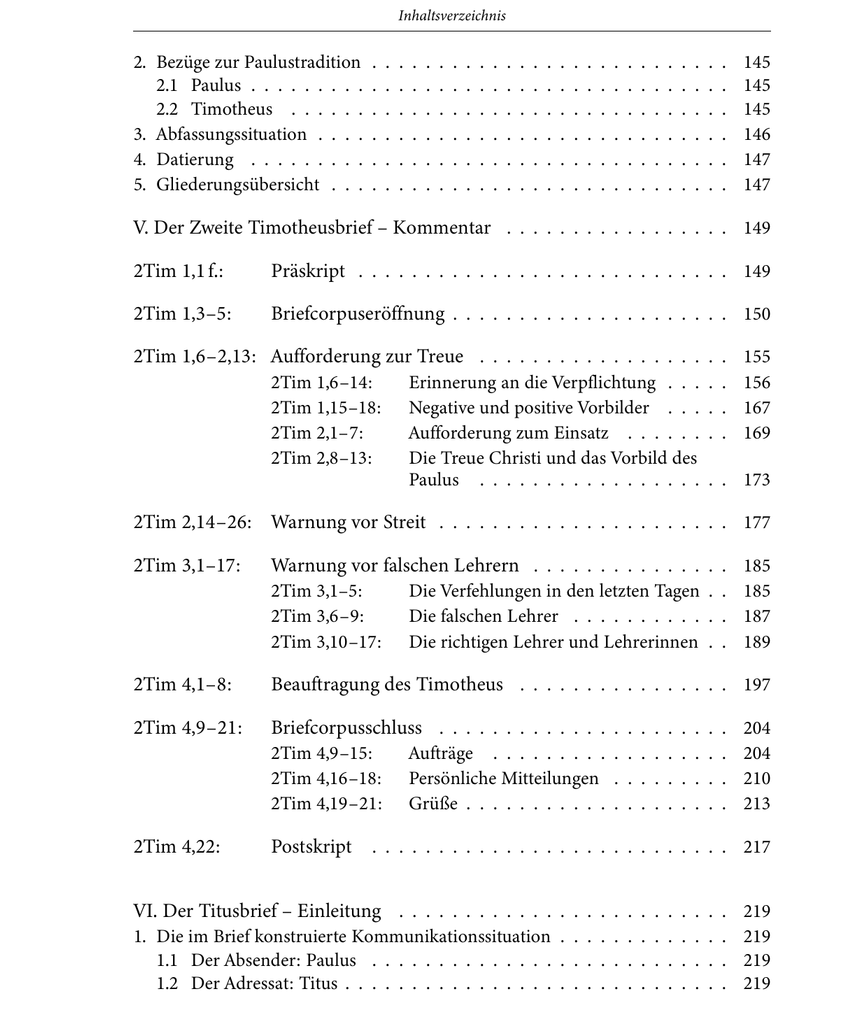
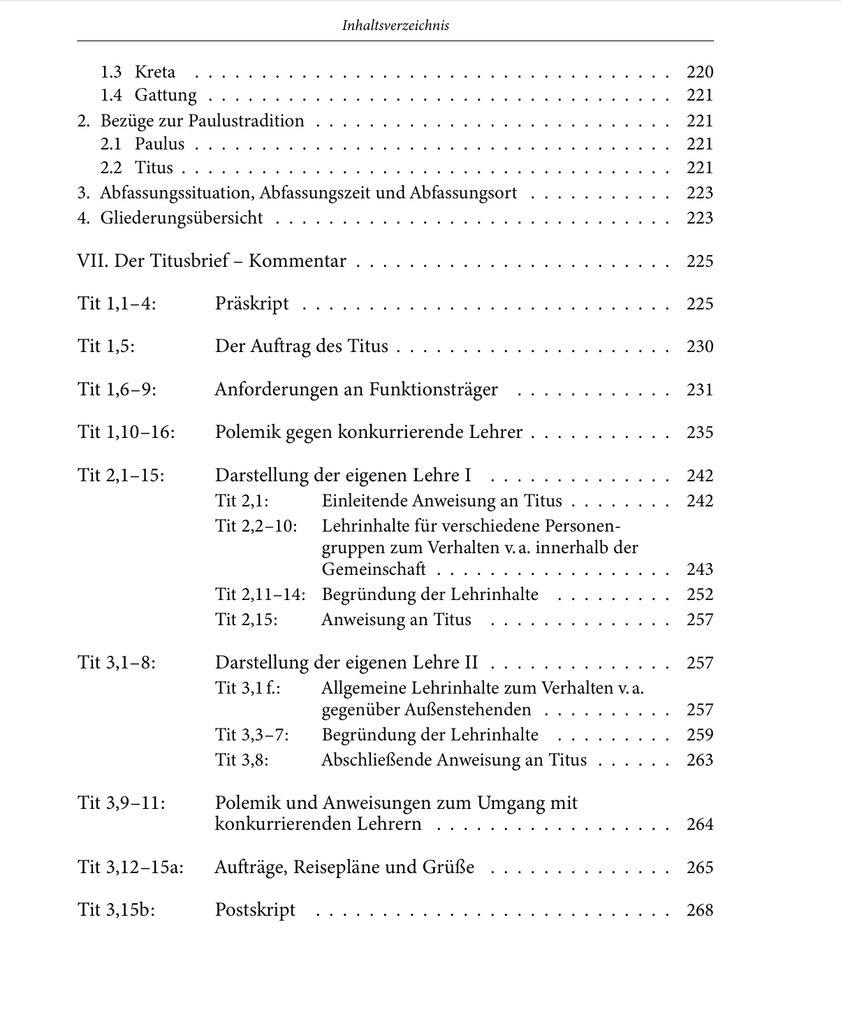
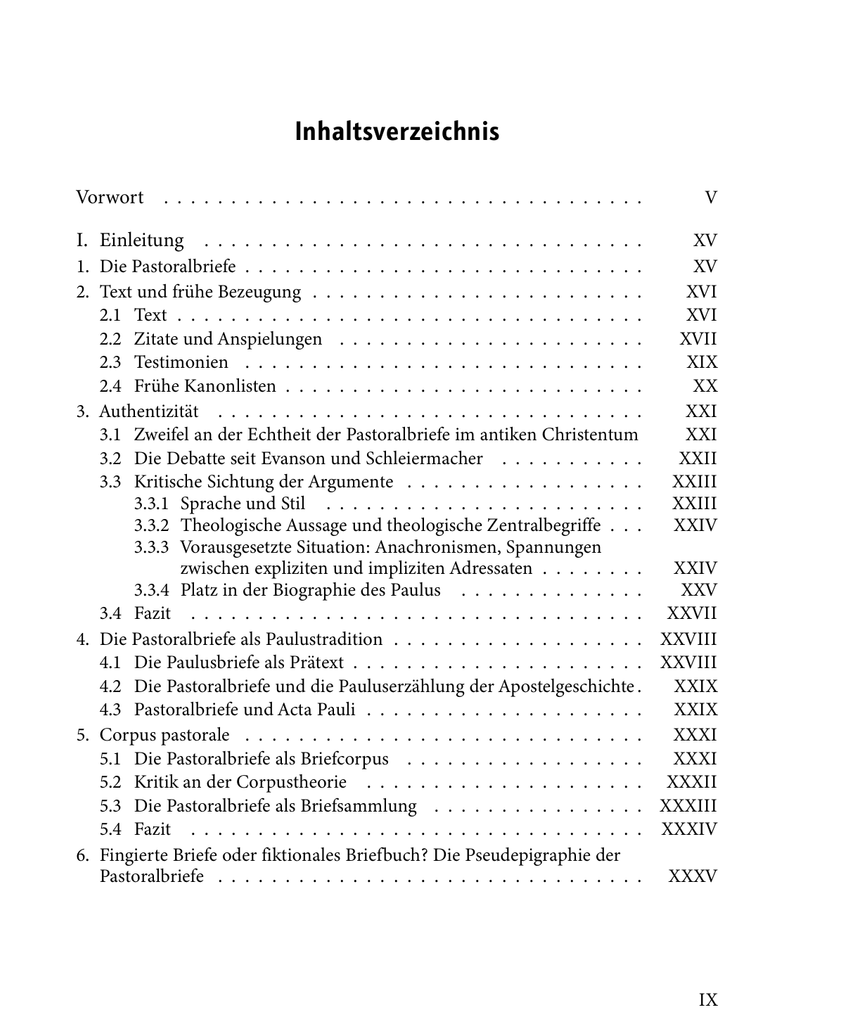
Krauter has now produced the commentary on the Pastoral Epistles in the Handbuch zum Neuen Testament to replace the hoary Die Pastoralbriefe of Martin Dibelius. Dibelius’s influential volume was originally published in 1913 as Die Briefe des Apostels Paulus. An Timotheus I, II an Titus, and saw its fourth edition in 1966, revised by Hans Conzelmann, then translated into English as The Pastoral Epistles in the Hermeneia series in 1972. Krauter’s replacement volume has now been published 120 years after Dibelius’s first edition, and 54 years after the Hermeneia volume. The table of contents and a sample of the work are available at Mohr Siebeck, and I have reproduced the TOC at the end of this post for convenience.

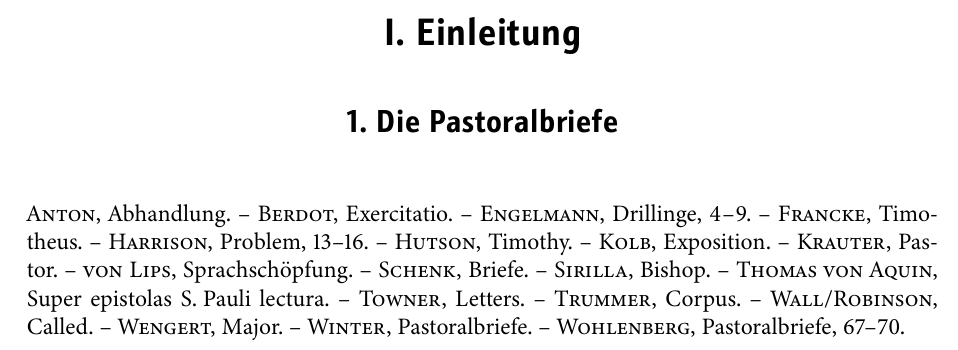
I’m pleased to note the presence of section bibliographies—that seems to be a growing trend, and I hope it continues. Note the wise employment of very abbreviated titles; that’s a good practice generally, and helps when trying to engage a great deal of scholarship in a relatively brief commentary.
And for a critical commentary, Krauter’s is “relatively brief,” due no doubt to HNT series constraints. Commentaries of 700-900 pages on the Pastorals are not uncommon these days (Mounce, 778; Pao: 831; Porter: 969; Tsuji, 759), and Krauter’s weighs in at 367 pages.

Though he favors the letters’ pseudonymity, Krauter is not of the mindset of much 20th-century scholarship that embraced that position as an accepted dogma. After a succinct multi-part summary of the status quaestionis, he concludes,

Die Sichtung der Argumente führt zu keinem klaren Bild, aber zu einer Tendenz: Es ist nicht sicher nachweisbar, dass alle drei Briefe oder einige von ihnen nicht von Paulus stammen. Es wird aber doch deutlich, dass die Annahme der Echtheit der Briefe große Probleme mit sich bringt. Sie macht unumgänglich, entweder Teile der Apg und andere Paulusbriefe für historisch falsch oder lückenhaft zu erklären oder mithilfe der Two imprisonments-Theorie eine Art Irgendwann für die Entstehung der Past zu schaffen. Dazu kommen die Spannungen in der vorausgesetzten Kommunikationssituation und die Hinweise auf eine frühe Zehnbriefesammlung ohne Past . . . . All dies lässt die Unechtheit der drei Briefe als plausiblere Annahme erscheinen, jedoch nicht als sicheres Wissen, auf das man allzu viele weitere Hypothesen bauen sollte. (xxvii)

An examination of the arguments yields no clear picture, yet it does reveal a trend: it cannot be conclusively proven that all three letters—or even some of them—did not originate with Paul. Nevertheless, it becomes evident that assuming the letters’ authenticity entails significant difficulties. Such an assumption necessitates either dismissing parts of Acts and other Pauline letters as historically inaccurate or incomplete, or invoking the “two imprisonments” theory to posit a vague timeframe for the composition of the Pastoral Epistles. Added to this are the tensions inherent in the implied communication context and the indications of an early ten-letter collection that excluded the Pastoral Epistles . . .. All these factors make the inauthenticity of the three letters appear the more plausible hypothesis—though not a certainty upon which too many further hypotheses should be built. (Google Translate)

When it comes to his own approach to the letters, he does take them as pseudonymous, though he observes the question of authenticity would not adjust his interpretation in most cases. He finds it more likely that the same author wrote all three letters.

In preparation for this volume, Krauter produced an impressive collection of research pieces which informed the production of the commentary proper:

“1 Tim 4:13: Public Lecture or Private Study?” Journal of the Bible and Its Reception 12.2 (2025): 215–30. 

“1 Tim 5:19‒21: The Beginnings of Ecclesiastical Disciplinary Law?” Zeitschrift der Savigny-Stiftungfür Rechtsgeschichte: Romanistische Abteilung 112 (2026): 301–22.  

“‘All Things Bright and Beautiful’: La théologie de la création dans 1 Timothée.” Revue de théologie et de philosophie 155 (2023). 

“Auf den zweiten Blick: Eine Hinführung zu den Pastoralbriefen.” Bibel und Kirche 78.2 (2023). 

“Cretan Memories: Crete in the Letter to Titus and the Acts of Titus.” Early Christianity 13 (2022): 455–67.  

“Exilliteratur und die Gattung des Zweiten Timotheusbriefes.” Revue Biblique 129 (2022): 183–98. 

“Ein Geist der Besonnenheit? Σωφρονισμός in 2Tim 1,7.” Zeitschrift für die neutestamentliche Wissenschaft 114.1 (2023): 123–36.

“Geistlose Briefe? Πνεῦμα in den Timotheusbriefen und im Titusbrief.” In Geist | Ruach | Pneuma | Spiritus. Exegetische, theologische, religionsgeschichtliche und phänomenologische Perspektiven. Edited by R. Feldmeier, J. Frey, and B. Schliesser. Wissenschaftliche Untersuchungen zum Neuen Testament. Tübingen: Mohr Siebeck, forthcoming. 

“Genderrollen in den Pastoralbriefen: Ein Experiment mit verschiedenen Lesestrategien.” Theologische Literaturzeitung 146.5 (2021): 375–88. 

“Ich weiß, wem ich mein Depositum anvertraut habe (2 Tim 1,12).” Biblische Zeitschrift 68 (2024).  

“Die Kirche – Pfeiler und Fundament der Wahrheit? zur Übersetzung und Auslegung von I Tim 3,15f.” Theologische Zeitschrift 77.1 (2021): 45–59. [English abstract at close] 

“The Lord be with your spirit (2 Tim 4:22a).” Revue Biblique 130 (2023).  

“Ordination und Neues Testament.” Pages 11–28 in Ordination: Grundfragen und Impulse aus reformierter Perspektive. Edited by Stefan Krauter and Matthias D Wüthrich. Zürich: Theologischer Verlag, 2023. 

“The Pastoral Epistles and the Jewish Paul.” Pages 139–156 in Reception of Paul during the First Two Centuries: Exploration of the Jewish Matrix of Early Christianity. Edited by František Ábel. Lanham, MD: Lexington Books/Fortress Academic, 2023. 

“Die Pastoralbriefe im Dienst reformatorischer und antireformatorischer Polemik bei Caspar Cruciger dem Älteren und Ambrosius Catharinus.” Pages 247–68 in Reformatorische Paulusauslegungen. Edited by Stefan Krauter and Manuel Nägele. History of Biblical Exegesis 5. Tübingen: Mohr Siebeck, 2023. 

“In Würde altern: Tit 2 und antike Vorstellungen vom Alter.” Theologische Zeitschrift 79.2 (2023): 146–65. 

“Zwischen Oikos und Polis: Die Gemeinde und ihre Gemeindeversammlung in den Pastoralbriefen.” Pages 383–403 in Qahal und Ekklesia: Typen und Funktionen von Versammlungen im Alten und Neuen Testament und ihren Umwelten. Edited by Joachim J. Krauter, Stefan Krauter, and Wolfgang Oswald. Studies in Cultural Contexts of the Bible 19. Leiden: Brill, 2024.  

_______
Annual Bibliographies on the Pastorals

In the first half of each year, we compile and post annual bibliographies for researchers in the Letters to Timothy and Titus. These lists of just-published and soon-to-be published studies aim to give some idea of research trends and to help researchers in the Pastorals maintain control of the secondary literature. Among other avenues of bibliographic discovery, we solicit the input of Pastorals scholars who have published previously on the letters. Our thanks to all who contributed!

Our annual bibliography of recent publications on the Letters to Timothy and Titus covers contributions from all of 2024 and early 2025. Over 180 items long and international in scope, the list contains monographs, journal articles, and commentaries, as well as lists of dissertations and conference presentations on the letters. It is available for viewing and downloading here.

Our annual bibliography of forthcoming academic publications on the Letters to Timothy and Titus is wide-ranging, containing over fifty forthcoming works, including essays, monographs, and commentaries. This bibliography is available for viewing and downloading here.

2024 Annual Pastorals Bibliographies

Around April of each year, we compile and post annual bibliographies for researchers in the Letters to Timothy and Titus. These lists of just-published and soon-to-be published studies aim to help researchers in the Pastorals maintain control of the secondary literature, and to give some idea of research trends. Among other avenues of bibliographic discovery, we solicit the input of Pastorals scholars who have published previously on the letters. Our thanks to all who contributed!

Our annual bibliography of recent publications on the Letters to Timothy and Titus covers contributions from all of 2023 and early 2024. Over 125 items long and international in scope, the list contains monographs, journal articles, and commentaries, as well as lists of dissertations and conference presentations on the letters. It is available for viewing and downloading here.

Our annual bibliography of forthcoming academic publications on the Letters to Timothy and Titus is wide-ranging, containing around 60 forthcoming works, including essays, monographs, and commentaries. This bibliography is available for viewing and downloading here.

Luke Timothy Johnson and the Pastorals

I learned a good deal by reading Luke Timothy Johnson’s recently published memoir, The Mind in Another Place: My Life as a Scholar (Grand Rapids: Eerdmans, 2022), from both his interesting and detailed account of his scholarly preparation and career, and his incisive treatment of the intellectual and moral virtues of a scholar. Researchers in the Pastorals are, of course, familiar with his work in the letters, most notably his volume on the letters to Timothy in the Anchor Bible series. That volume is remarkable not least for its robust disagreement with the position that the Pastorals are pseudonymous, but also for its extensive treatment of history of research in the letters. On the former point regarding authorship, he notes, “Of particular importance was my demonstrating how the ‘consensus’ view of scholarship was based not on the power of argument but on the weight of custom” (165).

Johnson’s oeuvre is far broader than his work on the Pastorals, and his specific remarks about his work in those letters are actually fairly brief. I have pulled three pertinent excerpts, thinking they might be of interest to students of the letters. They may be read here.

Annual Bibliographies on the Pastorals

It’s that time of year again! For some years now, we’ve been compiling and posting annual bibliographies for researchers in the Letters to Timothy and Titus. These projects are intended to help researchers in the Pastorals maintain control of the secondary literature, and give some idea of research trends. Our compilation of these bibliographies involves the input of Pastorals scholars who have published previously on the letters. Our thanks to all who contributed!

Our annual bibliography of recent publications on the Letters to Timothy and Titus covers contributions from all of 2022 and early 2023. Over 170 items long and international in scope, the list contains monographs, journal articles, and commentaries, as well as lists of dissertations and conference presentations on the letters. It is available for viewing and downloading here.

Our annual bibliography of forthcoming academic publications on the Letters to Timothy and Titus is wide-ranging, containing over 60 forthcoming works on the Pastoral Epistles, including essays, monographs, and commentaries. In some cases, authors have provided a brief synopsis of their work. This bibliography is available for viewing and downloading here.

The Pastorals in New Testament Abstracts 66.1

The following items listed in New Testament Abstracts 66.1 (2022) may be of interest to Pastorals scholars.

218. Annette Huizenga, “Idealized Motherhood: Examples of the Gendered Worldview of the Pastoral Letters.” Interpretation 75.4 (2021): 294–304. https://doi.org/10.1177/00209643211027765

219. Margaret Y. MacDonald, “Education and the Household in the Pastoral Epistles.” Interpretation 75.4 (2021): 283–93. https://doi.org/10.1177/00209643211027768

220. Jermo Van Nes, “Second-Century Vocabulary in the Pastoral Epistles? A Reassessment.” Filología Neotestamentaria 34 (2021): 41–67.

221. Marie M. Fortune, “Is Nothing Sacred? I Timothy and Clergy Sexual Abuse.” Interpretation 75.4 (2021): 317–27. https://doi.org/10.1177/00209643211027764.

222. Marianne B. Kartzow, “The ‘Believing Woman’ and Her ekklēsia: Rethinking Intersectional Households and Manuscript Variations in the Widows’ Tale (1 Tim 5:3–16).” Interpretation 75.4 (2021): 305–16. https://doi.org/10.1177/00209643211027767

(p. 146) Andreas J. Köstenberger, 1–2 Timothy and Titus. Evangelical Biblical Theology Commentary. Bellingham, WA: Lexham, 2021.

The Pastorals in WUNT

Recently, the Pastorals seem to be having an outsized presence in Mohr Siebeck’s Wissenschaftliche Untersuchungen zum Neuen Testament series. The following are recently published and forthcoming volumes in WUNT 1 and and WUNT 2 which each focus solely on one or more of the Pastorals. Authorship/editorship is widespread: Australia (Kidson), Germany (Herzer, Zimmermann), Nigeria (Manomi), Switzerland (Bulundwe), USA (Langford).

Lyn Kidson, Persuading Shipwrecked Men: Rhetorical Strategies in 1 Timothy (WUNT 2/526; 2020) (RBL review) (JETS) (ABR) (JSNT)
Dogara Ishaya Manomi, Virtue Ethics in the Letter to Titus: An Interdisciplinary Study (WUNT 2/560; 2021)
Jens Herzer, Die Pastoralbriefe und das Vermächtnis des Paulus: Studien zu den Briefen an Timotheus und Titus (WUNT 476; 2022)
Ruben Zimmermann and Dogara Ishaya Manomi, eds. “Ready for Every Good Work” (Titus 3:1): Implicit Ethics in the Letter to Titus (WUNT 484; 2022)
Andrew M. Langford, Diagnosing Deviance: Pathology and Polemic in the Pastoral Epistles (WUNT 2/ ; 2022 est.)
Kampotela Luc Bulundwe, 2 Timothée dans le corpus paulinien. Analyse mémorielle (WUNT 2/ ; 2022 or 2023)

To be sure, plenty of single essays on one or more of the Pastorals have appeared in edited WUNT collections. However, before the recent spate of volumes just noted, only the following WUNT volumes (to my knowledge) focused solely on one or more of the Pastorals (or, for Trebilco and Smith, were monographs with a very significant Pastorals component):

Ulrike Wagener, Die Ordnung des “Hauses Gottes.” Der Ort von Frauen in der Ekklesiologie und Ethik des Pastoralbriefe (WUNT 2/65; 1994)
Andrew Y. Lau, Manifest in Flesh: The Epiphany Christology of the Pastoral Epistles (WUNT 2/86; 1996)
Hanna Stettler, Die Christologie der Pastoralbriefe (WUNT 2/105; 1998)
Paul R. Trebilco, The Early Christians in Ephesus from Paul to Ignatius (WUNT 166; 2004)
Bernhard Mutschler, Glaube in den Pastoralbriefen: Pistis als Mitte christlicher Existenz (WUNT 256; 2010)
Claire Smith, Pauline Communities as “Scholastic Communities”: A Study of the Vocabulary of “Teaching” in 1 Corinthians, 1 and 2 Timothy and Titus (WUNT 2/335; 2012)

The first batch of volumes above has six WUNT volumes on the Pastorals being published in around four years (2020–2023). The earlier batch of volumes, another half-dozen, spans nearly two decades (1994–2012).

Annual Bibliographies on the Pastorals

For some few years now, we have been producing annual bibliographies for researchers in the Letters to Timothy and Titus. These bibliographies are meant to help students of these letters keep up with the secondary literature, and give some idea of research trends. We compile this list each year by contacting academic publishers and Pastorals scholars who have published previously on the letters. Our thanks to all who contributed!

Our annual bibliography of recent publications on the Letters to Timothy and Titus covers contributions from all of 2021 and early 2022. Over 170 items long and international in scope, the list contains monographs, journal articles, and commentaries, as well as lists of conference presentations and dissertations on the letters. It is available for viewing and downloading here.

Our annual bibliography of forthcoming publications on the Letters to Timothy and Titus is wide-ranging and academically oriented, containing over 60 forthcoming works on the Pastoral Epistles, including essays, monographs, and commentaries. In some cases, authors have provided a brief synopsis of their work. This bibliography is available for viewing and downloading here.

The Pastorals in NTA 65.2

New Testament Abstracts 65.2 lists the following entries which intersect with research on the Letters to Timothy and Titus:

641. Krauter, Stefan. “Genderrollen in den Pastoralbriefen: ein Experiment mit verschiedenen Lesestrategien.” Theologische Literaturzeitung 146.5 (2021): 375–88.

642. King, Fergus J., and Dorothy A. Lee. “Lost in Translation: Rethinking Words about Women in 1–2 Timothy.” Scottish Journal of Theology 74.1 (2021): 52–66. DOI: 10.1017/S0036930621000053

643. Towner, Philip H. “2 Tim 1,7, Cowardice, and the Specter of Betrayal: The Intersection of Intertextuality and Paronomasia.” Biblica 101.4 (2020): 577–601. DOI: 10.2143/BIB.101.4.3289121

644. Henriksson, Gustav W. “Grace in Action: Exploring the Intersection of Soteriology and Ethics in the Letter to Titus.” Scottish Journal of Theology 73.4 (2020): 330­-39. DOI: 10.1017/S0036930620000666

684. Ebner, Martin. “Zur Vielfalt neutestamentlicher Gemeindemodelle.” Theologisch-praktische Quartalschrift 169.2 (2021): 115–23.

696. Marius Reiser, “Die Neugestaltung von Ehe und Familie im frühen Christentum.” Theologische Beiträge 52.2 (2021): 109–20. (This article does not appear to address the Pastorals directly, but looks as though it would have implications for the content of the letters vis-a-vis marriage and family.)

(p. 283) Campbell, Constantine R., and Jonathan T. Pennington. Reading the New Testament as Christian Scripture: A Literary, Canonical, and Theological Survey. Reading Christian Scripture. Grand Rapids: Baker, 2020. [chap. 21, “The Pastoral Letters: 1–2 Timothy and Titus”]

(p. 287) Three essays which are part of a recent WUNT volume: Gegenspieler: Zur Auseinandersetzung mit dem Gegner in frühjüdischer und urchristlicher Literatur. Edited by Michael Tilly and Ulrich Mell. Wissenschaftliche Untersuchungen zum Neuen Testament 428. Tübingen: Mohr Siebeck, 2019.
* Herzer, Jens. “Vom Sinn und Nutzen der Polemik: Zur Pragmatik der Gegnerinvektiven in den Pastoralbriefen.” Pages 183–205.
* Lichtenberger, Hermann. “‘Wie Jannes und Jambres Mose widerstanden’ (2Tim 3,8).” Pages 207–18.
* Zamfir, Korinna. “Shipwrecked, Enemies and Deserters? The Opponents and their Function in the Pastoral Epistles and the Acts of Paul and Thecla.” Pages 281–310.

(p. 288) Burnet, Régis. “Petit fait vrai et construction du personnage: Réflexions sur 2Tm 4,13.” Pages 331–42 in La contribution du discours a la caracterisation des personnages bibliques: Neuvieme colloque international due RRENAB, Louvain-la-Neuve, 31 mai – 2 juin 2018. Edited by André Wénin. Bibliotheca Ephemeridum Theologicarum Lovaniensium 311. Leuven: Peeters, 2020.

(p. 301) Boring, M. Eugene. Hearing Paul’s Voice: Insights for Teaching and Preaching. Grand Rapids: Eerdmans, 2020. [note the section on the Pastorals, pp. 175–207]

(p. 302) Wieland, George M. “Re-Ordering the Household: Misalignment and Realignment to God’s οἰκονομία in 1 Timothy.” Pages 147–60 in Sin and Its Remedy in Paul. Contours of Pauline Theology. Edited by Nijay K. Gupta and John K. Goodrich. Eugene, OR: Cascade, 2020.

(p. 304) Johnson, Luke Timothy. The Canonical Paul, vol. 1: Constructing Paul. Grand Rapids: Eerdmans, 2020. [note “Letters to Paul’s Delegates Cluster,” pp. 85­–88; opponents in the “Letters to Delegates,” pp. 115–17; “The Texture of Experience” in 1 Tim, 2 Tim, Titus, pp. 219–21]

(p. 304) Johnson, Luke Timothy. The Canonical Paul, vol. 2: Interpreting Paul. Grand Rapids: Eerdmans, 2021. [Note chaps. 20–23: “Oikonomia Theou,” “The Shape of the Struggle,” “Second Timothy and the Polemic Against False Teachers,” “The Pedagogy of Grace”]

(p. 310) Kobel, Esther. “Paulus πρεσβύτης: Der alternde Paulus im Kontext antiker Altersdiskurse.” Pages 153–74 in Alter und Altern in der Bibel: Exegetische Perspektiven auf Altersdiskurse im Alten und Neuen Testament. Edited by Malte Cramer and Peter Wick. Stuttgart: Kohlhammer, 2021.

(p. 313) Witt, William G. Icons of Christ: A Biblical and Systematic Theology for Women’s Ordination. Waco, TX: Baylor University Press, 2021. [note esp. chap. 16, “Women’s Ministry in the New Testament: Bishops, Presbyters, Deacons”]

Forthcoming Publications on the Pastorals (as of April 2021)

We have produced our annual list of forthcoming publications on the Letters to Timothy and Titus. This bibliography is wide-ranging and academically oriented, containing 50 forthcoming works on the Pastoral Epistles including essays, monographs, and commentaries. We compile this list each year by contacting academic publishers and Pastorals scholars who have published previously on the letters, with the aim of helping researchers in the Pastorals to see current trends. In some cases, authors provided a brief synopsis of their work specifically for this project. Our thanks to all who contributed!

The list is available here.

« Older posts

© 2026 Pastoral Epistles

Theme by Anders Noren — Up ↑