Tag: Letters to Timothy and Titus (Page 4 of 11)

Zimmermann and Manomi, “Ready for Every Good Work” (Titus 3:1)

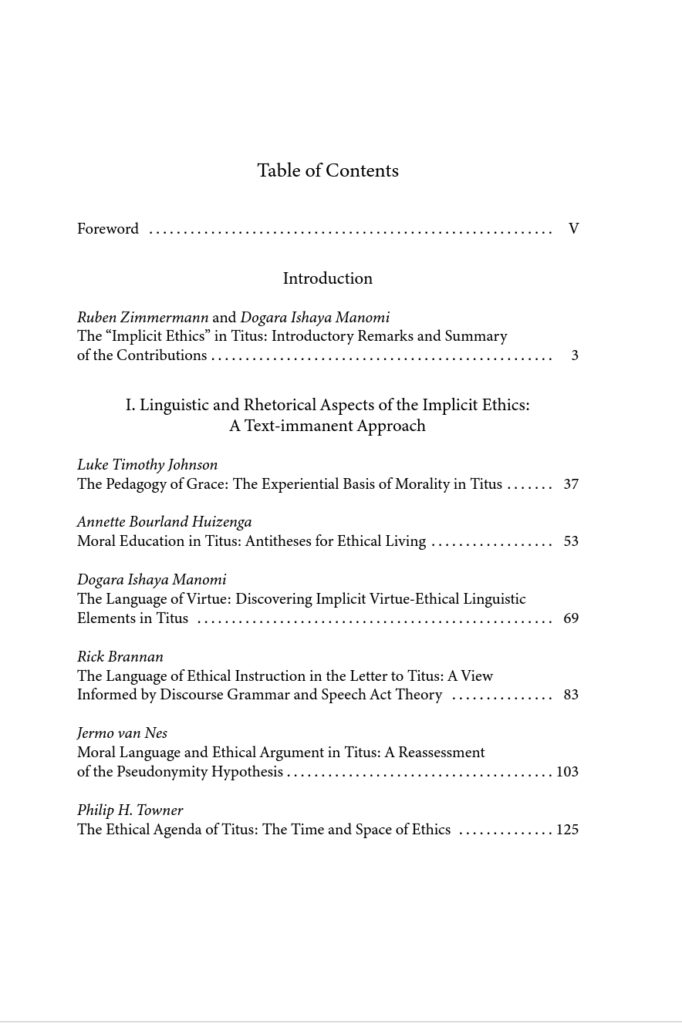
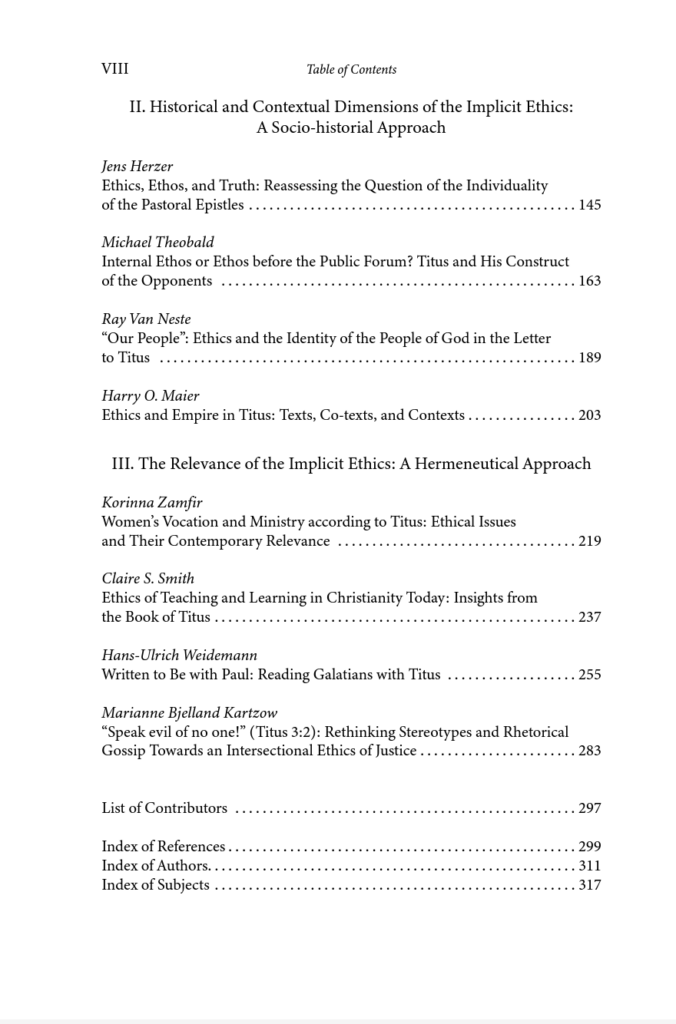
A 2019 specialist conference on “Ethics in Titus” was held in Mainz (presentations and abstracts), We posted earlier about the forthcoming publication of its proceedings, which were made available from Mohr Siebeck in late 2022:

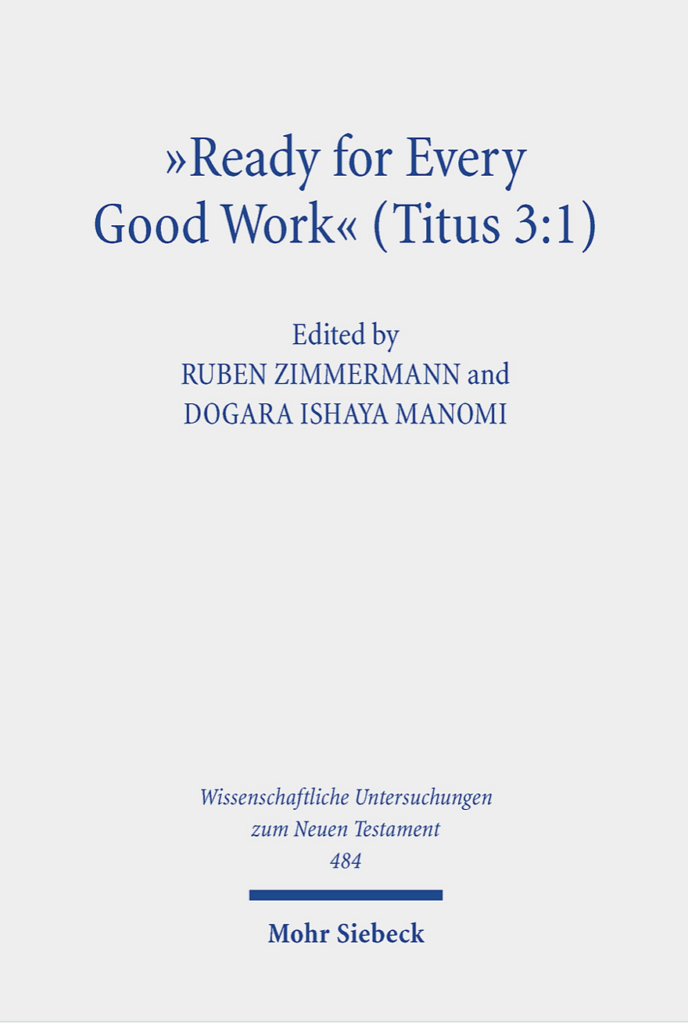
Ruben Zimmermann and Dogara Ishaya Manomi, eds. “Ready for Every Good Work” (Titus 3:1): Implicit Ethics in the Letter to Titus. Wissenschaftliche Untersuchungen zum Neuen Testament 484. Kontexte und Normen neutestamentlicher Ethik/ Contexts and Norms of New Testament Ethics 13. Tübingen: Mohr Siebeck, 2022.

The conference and collection of essays represents a veritable “who’s who” in Pastorals scholarship; I know of nothing comparable in recent years. More detailed information about the volume is available at Mohr Siebeck, and we have provided the contents of the volume below.

Bauer, “Befähigung und Einsetzung, Tugendlehre und Standesethos”

A new article on church offices in the Pastorals against their Greco-Roman background:

Thomas Johann Bauer, “Befähigung und Einsetzung, Tugendlehre und Standesethos: Die Ämterspiegel der Pastoralbriefe und der religiös-philosophische Diskurs der hellenistisch-römischen Zeit.” Pages 147–68 in Ermutigung zur Verantwortung: Festschrift für Josef Römelt. Edited by Christof Mandry and Stefan Meyer-Ahlen. Studien der Moraltheologie 16. Münster: Aschendorff, 2022.

De Virgilio, “‘In attesa della beata speranza’ (Tt 2,13).”

I have not seen a new article by Giuseppe De Virgilio for some time, but noticed this one tonight:

De Virgilio, Giuseppe. “‘In attesa della beata speranza’ (Tt 2,13): L’esercizio della speranza nelle Lettere a Timoteo e Tito [‘Waiting for the blessed hope’ (Tit 2:13): The exercise of hope in the Letters to Timothy and Titus].” Ricerche storico-bibliche 34.1–2 (2022): 319–29.

Abstract: “The exercise of hope is examined in the Letters to Timothy and Titus, as a development of the eschatological theme in the Pauline correspondence. The exercise of hope expressed through the use of elpis (1Tm 1,1; Tt 1,2; 2,13; 3,7) and elpizô (1Tm 3,14; 4,10; 5,5; 6,17) is part of the broader vision that characterizes the development of the Pauline tradition. The vital environment of the Pastoral Letters witnesses a climate of active expectation and hope, characterized by long-distance dialogue between the apostle, his faithful interlocutors and their respective Christian communities. In reviewing the attestations of elpis / elpizô and the use of hypomonê / hyomenô and makrothymia in the pastoral corpus, three peculiar aspects of the theme are focused on: a) hope as a sign of the industriousness of the present time and fidelity in its duration; b) the didactic and ethical emphasis on the exercise of hope; c) the pedagogical connotation of hope for the formation of the pastor between the apousíaparousía of Paul.”

De Virgilio is on the faculty of a Roman Catholic institution in Rome, the Pontificia Università della Santa Croce, and has published a great deal of specialist literature on the Pastorals over the years:

“2 Tm 3,14–17: l’identità delle Scrittura ispirata nella prospettiva teologica delle Lettere Pastorali.” Pages 208‒226 in La Sacra Scrittura anima della teologia: Atti del IV Simposio Internazionale della Facoltà Teologia. Edited by M. Tábet. Vatican City: LEV, 1999.

“Aspetti e profili della solidarietà nelle Lettere Pastorali.” Pages 195–222 in Il deposito della fede: Timoteo e Tito. Edited by Giuseppe De Virgilio. Supplementi alla Rivista Biblica 34. Bologna: Dehoniane, 1998.

“L’attesa del tempo e l’esercizio della speranza nelle Pastorali.” Parole di Vita 57.5 (2012): 16–21.

“La categoria paolina della speranza e il suo uso nelle Lettere Pastorali.” Pages 129‒61 in Speranza umana e speranza escatologica. Edited by R. Altobelli and S. Privitera. Teologia morale 11. Cinisello Balsamo (Milano): San Paolo, 2004.

“Chiesa e ministeri nelle Lettere Pastorali.” Pages 107‒34 in Chiesa e ministeri in Paolo. Edited by Giuseppe De Virgilio. Bologna: Dehoniane, 2003.

“‘Dio vuole che tutti gli uomini siano salvi’ (1Tm 2,4)”. Parola Spirito e Vita 1 (2014): 167–182.

“La figura di Paolo nelle Lettere Pastorali.” Parole di Vita 57.4 (2012): 44–50.

“Helpis-helpízein [ἑλπις-ἑλπιζειν] nel corpus pastorale.” Pages 65‒81 in Planus: Quaderno di studi a cura di Giovanni Giorgio (Istituto Teologico Abruzzese-Molisano). Pescara: Sigraf, 2006.

“L’impiego di pistéuein – pistis nelle Lettere a Timoteo e Tito.” Firmana 21.1 (2012): 71‒84.

“‘In attesa della beata speranza’ (Tt 2,13): L’esercizio della speranza nelle Lettere a Timoteo e Tito.” Ricerche storico-bibliche 34.1–2 (2022): 319–29.

“Ispirazione ed efficacia della scrittura in 2Tm 3,14–17: In occasione del XXV anno della promulgazione della Costituzione Dogmatica Dei Verbum.” Rivista biblica italiana 38 (1990): 485–94.

Lettere a Timoteo, Lettera a Tito. Nuovo Testamento: Commento esegetico e spirituale. Rome: Città nuova, 2017.

“Le Lettere Pastorali: profili etico-morali in dialogo con l’ambiente ellenistico.” Bibbia e oriente 48.4 (2006): 223–48.

“Il ministero del pastore nella Chiesa (1Tm 3‒5).” Parole di Vita 5 (2012): 22‒27.

“Πᾶν κτίσμα θεοῦ καλόν (1Tm 4,4). La positività della creazione e la sua dimensione salvifica nelle Lettere Pastorali.” Pages 361–76 in Creation and Salvation in the Bible. Edited by M. V. Fabbri and M. Tábet. Rome: EDUSC, 2009.

“Ravviva il dono di Dio.” Parole di Vita 5 (2012).

Ravviva il dono di DioUna lettura vocazionale di 2Tm 1,1-18. Rome: Rogate, 2018.

“San Paolo ‘Educatore’: Aspetti e motivi pedagogici nell’epistolario paolino.” Rassegna di Teologia 53 (2012): 357–82. (Note “6. L’accentuazione ‘pedagogica’ nelle comunità delle Lettere Pastorali.”)

Hauck, “Der Kampf gegen die Irrlehre als ‘Krieg’”

A new article of interest to students of 1 Timothy:

Marion Hauck. “Der Kampf gegen die Irrlehre als ‘Krieg’: Überlegungen zur Semantik der Verben ἀπωθέομαι and ναυαγέω im Kontext 1 Tim 1.” Novum Testamentum 65.1 (2023): 57–82. https://doi.org/10.1163/15685365-bja10037

Abstract: In 1 Tim 1, particularly in vv. 18–20, the author of the letter uses a cluster of terms that evoke the image of “Timothy” engaged in a military campaign. Along these lines, the verb ἀπωθέοµαι (v. 19) activates the mental picture of a previous struggle or clash through which one party (the τινες) has been disadvantaged. This article seeks to identify the leading metaphors that the author summons in 1 Tim 1, to scrutinize the concepts that he employs for creating these metaphors, and to describe the set of relations that enables a coherent understanding of 1 Tim 1 in general and 1:18–20 in particular. In addition, this article examines how these metaphors are embedded in the wider framework of 1 Tim 1–6 and integrated into the author’s struggle against a false teaching circulating in the Ephesian ekklesia.

The article is available here.

The Pastorals in New Testament Abstracts 66.3

The following entries in New Testament Abstracts 66.3 may be of interest to students of the Pastorals.

921. Butticaz, Simon. “De la parenté d’auteur(s) à la ‘mémoire générationelle’ (P. Nora): L’œuvre de Luc et les lettres pastorales en relation.” New Testament Studies 68.3 (2022): 274–93. https://doi.org/10.1017/s0028688522000054

1008. Beale, Greg K. “The Background to ‘Fight the Good Fight’ in 1 Timothy 1:18, 6:12, and 2 Timothy 4:7.” Zeitschrift für die neutestamentliche Wissenschaft 113.2 (2022): 202–30. https://doi.org/10.1515/znw-2022-0011

1009. Kidson, Lyn M. “Real Widows, Young Widows, and the Limits of Benefaction in 1 Timothy 5:3–16.” Australian Biblical Review 70 (2022): 83–100.

1026. Schmidt, Karl Matthias. “Alter von Schönheit? Anmerkungen zur Datierung des Zweiten Petrusbriefes.” Novum Testamentum 64.4 (2022): 489–510. https://doi.org/10.1163/15685365-bja10026 [engages parallelism between 2 Peter 3:3 and 2 Timothy 3:1]

(p. 432) Porter, Christopher A. “1 Timothy” (pp. 445–60), “2 Timothy” (pp. 461–68), “Titus” (pp. 469–73) in T&T Clark Social Identity Commentary on the New Testament. Edited by J. Brian Tucker and Aaron Kuecker. Edinburgh: T&T Clark, 2020.

Darko, “Kinship and Leadership in 1 Timothy”

A new article of potential interest to students of 1 Timothy:

Daniel K. Darko. “Kinship and Leadership in 1 Timothy: A Study of Filial Framework and Model for Early Christian Communities in Asia Minor.” Religions 14.2 (2023): 1–14, article 169. https://doi.org/10.3390/rel14020169

Abstract: “This essay examines the kinship framework and lexemes in the directives for leadership in 1 Timothy, aiming to curb the influence of false teachers and to bolster internal cohesion in the communities. It explores the author’s appeal to household conduct, natural and fictive kinship, and group dynamics couched in filial parlance vis-à-vis the undisputed Pauline letters. The study sheds light on the authorial framework, and suggests that the notion of a departure from ‘love-patriarchalism’ or egalitarian Paul developing later into hierarchical kinship framework in 1 Timothy may be misleading. It becomes apparent that the letter’s kinship lexemes are consistent with what we find in the undisputed letters. Thus, the pseudonymous author, an associate of Paul, does not appeal to or use kinship lexemes any differently from the undisputed letters or elsewhere in Greco-Roman discourse. This does not establish Pauline authorship, but suggest that the notion that the kinship lexemes reflect an elevated hierarchical institutional development in a post-Pauline era, that is uncharacteristic of Paul in the authorship debate, may need to be reconsidered if not revised.”

The article is open access.

Jodamus, “(Con)texturing Ideologies of Modesty, Authority, and Childbearing in 1 Timothy 2:8–15”

Another addition to the literature on 1 Timothy 2 has appeared:

Jonathan Jodamus. “(Con)texturing Ideologies of Modesty, Authority, and Childbearing in 1 Timothy 2:8–15.” Journal of Early Christian History 12.3 (2022): 59–78. https://doi.org/10.1080/2222582X.2022.2146520

Abstract: “Feminist and gender critical biblical scholarship has shown how texts ideologically function as products of their ancient social and cultural norms. In my dissertation work on Pauline texts, through isolating the ideological component of socio-rhetorical-interpretation, I demonstrated how these texts are “ideologically textured” within their ancient social context. In this article, I bring a combination of approaches from ideological criticism and theoretical insights from feminist criticism to bear on both the biblical text of 1 Timothy 2:8–15 and contemporary interpretations of this text. The latter is exemplified by the conservative Christian blogger, “The Transformed Wife.” Beginning with an examination of how both Paul and the blogger establish authority amongst believing communities, I then interrogate three areas of focus within their ideological purview: modesty, authority, and childbearing. I conclude that (con)texturing (a taxonomy of approaches that I propose which reads for ideological texture within text and context) provides a productive way to engage with the enduring influence of biblical texts and their harmful interpretations for wo/men.”

Pastorals at archive.org

You may have been unaware, as I was until yesterday, that a good number of Pastorals commentaries and monographs are available in full at archive.org. With a free account, you can “borrow” the volumes for an hour at a time, renewable every hour pending availability.

Bartsch, Die Anfänge urchristlicher Rechtsbildungen: Studien zu den Pastoralbriefen

Beker, Heirs of Paul. Their Legacy in the New Testament and the Church Today

Brandt, Das anvertraute Gut. Eine Einführung in die Briefe an Timotheus und Titus

Brox, Die Pastoralbriefe: 1 Timotheus, 2 Timotheus, Titus (RNT) (note this is the 1969 4th edition, not the 1989 5th edition)

Dibelius, Die Pastoralbriefe (HNT) (note this is the 1966 4th and final edition, revised by Hans Conzelmann)

Donelson, Colossians, Ephesians, 1 and 2 Timothy, and Titus

Fruendorfer, “Die Pastoralbriefe,” in K. Staab and J. Fruendorfer, Die Thessalonicherbriefe, die Gefangenschaftsbriefe und die Pastoralbriefe (RNT)

Glaser, Paulus als Briefroman erzählt: Studien zum antiken Briefroman und seiner christlichen Rezeption in den Pastoralbriefen

Guthrie, The Pastoral Epistles, rev. ed. (TNTC)

Hanson, The Pastoral Letters (CBC)

Harding, What Are They Saying about the Pastoral Epistles?

Harrison, The Problem of the Pastoral Epistles

Holtz, Die Pastoralbriefe (THKNT) (note this is the 1965 edition; the final edition of Holtz was the 5th, published in 1992)

Houlden, The Pastoral Epistles

Huizenga, Moral Education for Women in the Pastoral and Pythagorean Letters: Philosophers of the Household

Jeremias, Die Briefe an Timotheus und Titus (NTD) (note this is an early edition from 1947; the 12th and latest edition is from 1981)

Johnson, 1 Timothy, 2 Timothy, Titus (KPG)

Karris, The Pastoral Epistles (NTM)

Kelly, A Commentary on the Pastoral Epistles

Kidd, Wealth and Beneficence in the Pastoral Epistles

Knight, The Faithful Sayings in the Pastoral Letters

Köstenberger, Schreiner, and Baldwin, eds. Women in the Church: A Fresh Analysis of 1 Timothy 2:9–15 (1st ed., 1995)

Kroger and Kroger, I Suffer Not a Woman: Rethinking 1 Timothy 2:11-15 in Light of Ancient Evidence

Lau, Manifest in Flesh: The Epiphany Christology of the Pastoral Epistles

de Lestapis, L’énigme des Pastorales de Saint Paul

Liefeld, 1 & 2 Timothy / Titus (NIVAC)

Lütgert, Die Irrlehrer der Pastoralbriefe

MacDonald, The Legend and the Apostle: The Battle for Paul in Story and Canon

MacDonald, The Pauline Churches: A Socio-Historical Study of Institutionalism in the Pauline and Deutero-Pauline Writings

Maier, Die Hauptprobleme der Pastoralbriefe Pauli

Malina and Pilch, Social-Science Commentary on the Deutero-Pauline Letters

Martin, Pauli Testamentum: 2 Timothy and the Last Words of Moses

Meinertz, Die Pastoralbriefe des heiligen Paulus

Merz, Die fiktive Selbstauslegung des Paulus: Intertextuelle Studien zur Intention und Rezeption der Pastoralbriefe

Metzger, Der Christushymnus 1. Timotheus 3,16: Fragment einer Homologie der paulinischen Gemeinden

Mounce, The Pastoral Epistles (WBC)

Oberlinner, Die Pastoralbriefe: Kommentar zum Titusbrief (HTKNT)

Oberlinner, Die Pastoralbriefe: Kommentar zum zweiten Timotheusbrief (HTKNT)

Oden, First and Second Timothy and Titus (IBC)

Quinn, The Letter to Titus (AB)

Ramos, I Timoteo, II Timoteo, y Tito

Ridderbos, De Pastorale brieven

Schlarb, Die gesunde Lehre. Häresie und Wahrheit im Spiegel der Pastoralbriefe

Schlatter, Die Kirche der Griechen im Urteil des Paulus: Eine Auslegung seiner Briefe an Timotheus und Titus (note this is the 1958 second edition; a third edition was published in 1983)

Schwarz, Bürgerliches Christentum im Neuen Testament? eine Studie zu Ethik, Amt und Recht in den Pastoralbriefen

Spain, The Letters of Paul to Timothy and Titus

Spicq, Les Épîtres pastorales (note this is the 1943 edition, which I believe is the 1st edition. Typically, the 4th edition from 1969 is used for scholarly work)

Taylor, “1 and 2 Timothy, Titus,” in The Deutero-Pauline Letters: Ephesians, Colossians, 2 Thessalonians, 1 & 2 Timothy, Titus

Thurston, The Widows: A Women’s Ministry in the Early Church

Towner, The Letters to Timothy and Titus (NICNT)

Trummer, Die Paulustradition der Pastoralbriefe

Wagener, Die Ordnung des “Hauses Gottes.” Der Ort von Frauen in der Ekklesiologie und Ethik des Pastoralbriefe

Wilson, Luke and the Pastoral Epistles

Wolter, Die Pastoralbriefe als Paulustradition

Wright, Paul for Everyone: The Pastoral Letters

Percival, “The Plan of Salvation in the Letters to Timothy and Titus”

John Percival has finished up his Cambridge PhD thesis on the Pastorals, and researchers in the Pastorals will want to engage his work in their own where they can. Because of the nature of the project, it will be germane to other research done throughout all three letters. This is true not only for the thesis’s main area of investigation, the plan of salvation, but also in the way it examines distinctions among the three letters.

Here’s the abstract:

“The New Testament letters to Timothy and Titus (LTT) are often lumped together as ‘The Pastoral Epistles.’ While there are understandable reasons for this approach, it has meant that the distinctive contribution of each of the three letters has not been sufficiently considered. Furthermore, narrative approaches to the Pauline letters have led to fruitful explorations of their theology, especially from a salvation-historical perspective, but these approaches have not been applied to the LTT, at least in part due to their marginal status in the conversation. Taken together, this has impoverished our understanding of the theology and purpose of the LTT.
“Therefore, this thesis employs a narrative approach to examine the salvation-historical outlook of each of the LTT. This is accomplished by adopting minimal assumptions about authorship and reviewing each letter in turn, describing the components of a narrative ‘plan of salvation.’ The relationship between the elements of the plan is examined so as to shed light on the narrative world, theology and, especially, the rhetorical purpose of the letter. For such short letters, there is a wealth of data and clear differences between the three. Thus we are able to identify areas where the letters have been misrepresented or misunderstood in scholarly literature, offering a fresh and creative contribution to scholarship on the LTT. The outcome is a clearer understanding of the distinctive contribution of each letter, particularly in terms of the plan of salvation as conceived from a narrative perspective.”

For more information, see this Cambridge repository page.

Kidson, “Naming 1 Timothy 3.16b”

Lyn Kidson has added to the considerable amount of secondary literature on 1 Timothy 3:16:

Lyn Kidson, “Naming 1 Timothy 3:16b: A ‘Hymn’ by Another Name?” New Testament Studies 69.1 (2023): 46–56. https://doi.org/10.1017/S002868852200025X

Abstract: Most scholars assume that 1 Timothy 3.16b is a hymn, or a fragment of a hymn, belonging to another context. However, Furley (1995) points out that even the ancients had difficulty categorising their poetic materials. 1 Timothy 3.16b has no metre and neither praises God nor asks him for benefits, which are the usual indicators of a hymn. This article argues that 1 Timothy 3.16b was written by the writer for insertion into the letter, and it was intended to be used in his congregation as a bulwark (1 Tim 3.15) against his opponents. 1 Timothy 3.16b more closely resembles an epigram, normally written to accompany an epiphany of a god.

For earlier literature on 1 Timothy 3:16, see this earlier post.

« Older posts Newer posts »

© 2026 Pastoral Epistles

Theme by Anders NorenUp ↑